Background
Since a crystal oscillator has a
temperature dependence you get better performance when the
crystal and the associated oscillator are enclosed in an
oven. A measure of how good the oven is performing is
how much the inside changes temperature when the ambient
temperature changes one degree. By using double ovens
and maximizing the gain of the temperature control loops the
level of oven performaqnce is improved.
These were used in the HP Z3815A which was a GPS disciplined
oscillator used for cell phone timing (maybe in Australia).
Major ICs
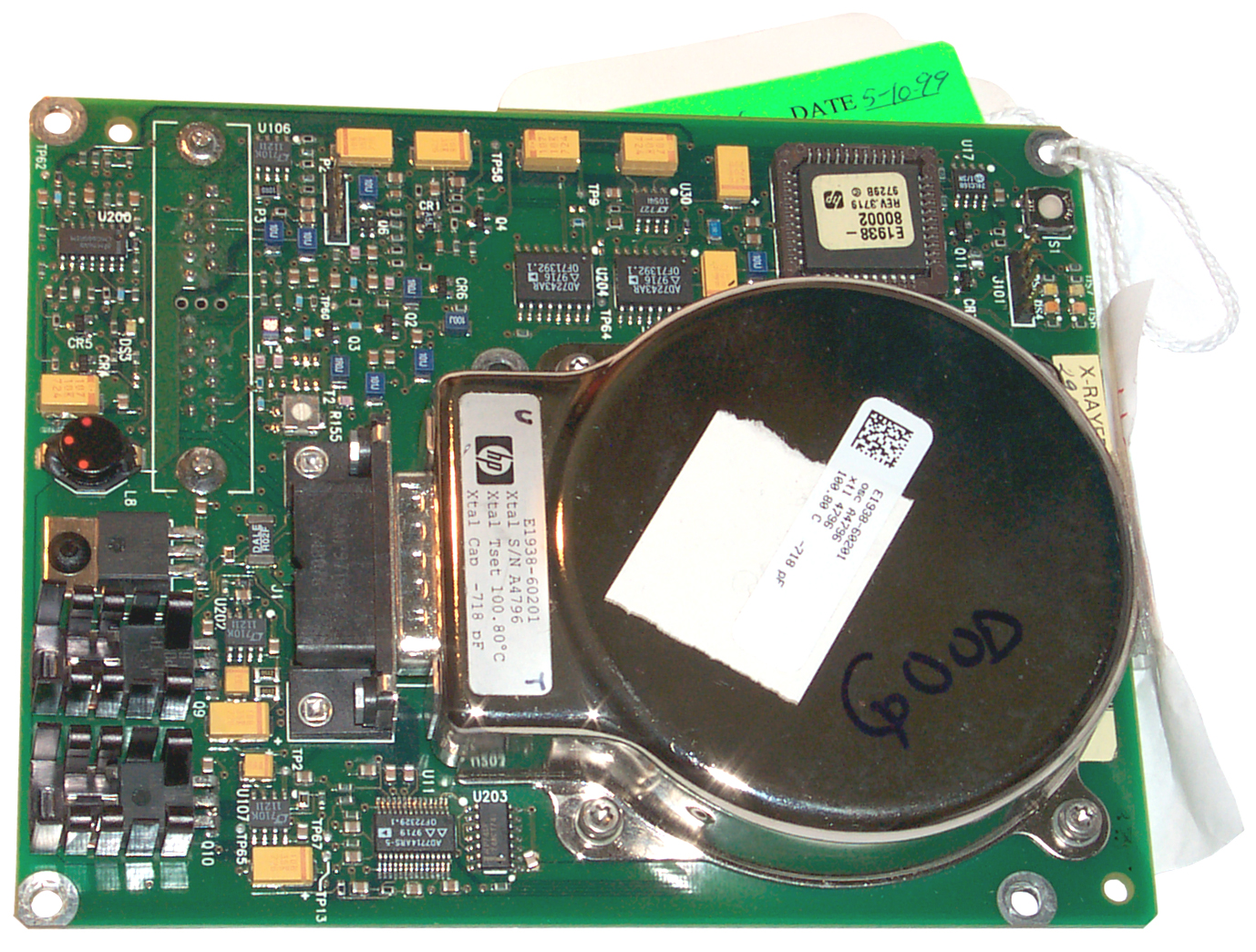
U105 44pin
Microcontroller (maybe PIC) marked E1938-80002, Rev 3719,
9729B (Fig 1 upper right)
U104, U105 16 pin
AD7243
CMOS, 12-Bit Serial DACPORT - 100k S/s (Fig 1 just to the left
of U105)
U11
AD7714
28 pin CMOS, 3V/5V, 500 µA, 24-Bit Sigma-Delta,
Signal Conditioning ADC (Fig 1 bottom center)
U200 14 pin
LMC660
CMOS Quad Operational Amplifier (Fig 1 upper left)
Versions
There were different versions:
The
Z3815A
GPS Time Frequency Reference GPSR-A VXI instrument like
this one has a D connector on the bottom with sockets.
The E1938A puck on PCB as shown above (has a D connector on
the top with pins.)
E1938-60201 is just the puck
Operation
Connector

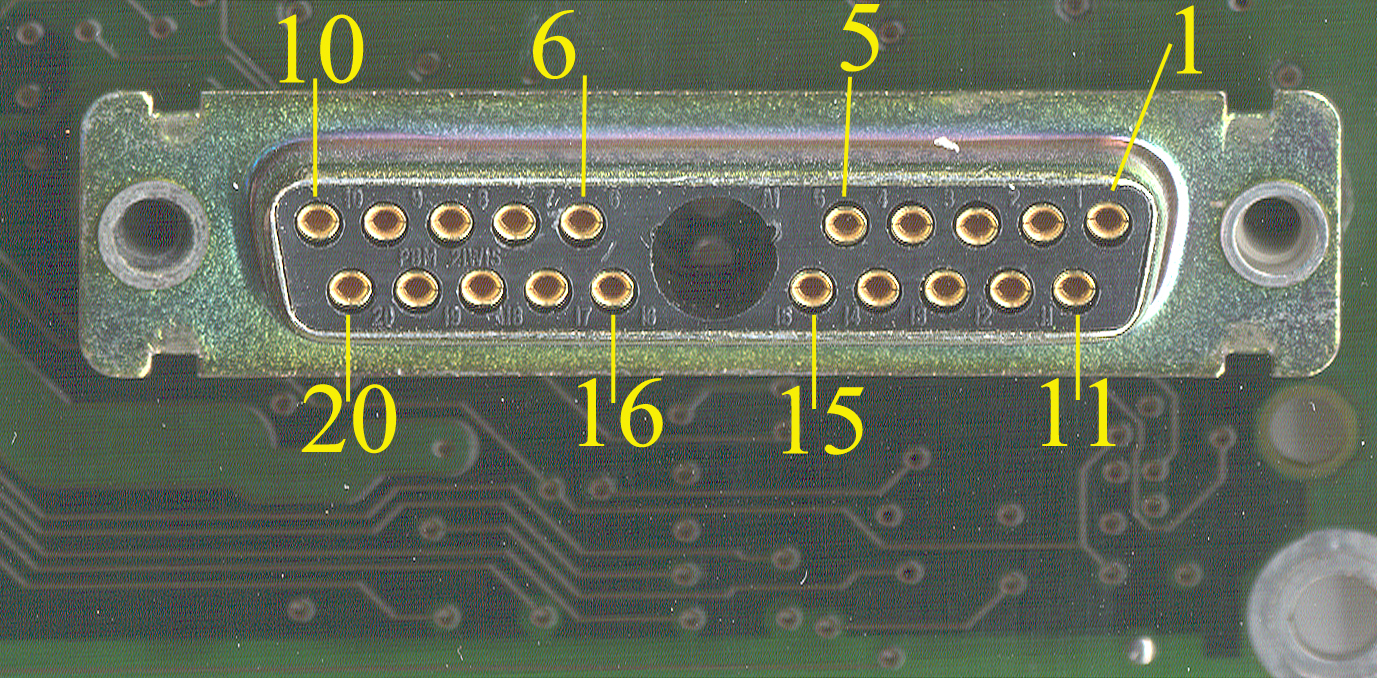
The
connector on the bottom of my unit is a special "D" type with
20 sockets and a center hole where a coax connector might be
installed (not in this one).
Tom's E1938
has the connector installed on top of the board and his has
male pins. Pin numbers are as shown in the photo on the
left.
These connectors will mate with standard DB-25 series
connectors, but the pin numbers are only the same for pins 1
to 5. Three pins are skipped between 5 and 6 and two
pins are skipped between 15 and 16.
The E1938A was sold to
at least 3 major customers and we played games with the
connector to make it compatible with them. I don't
remember exactly why that funny connector was used. Either
the connector it had to mate with had coax inserts already
for historical reasons, and the E1938A connector had to at
least have holes in it without inserts to allow mating, or
there was some other arcane reason like the connector with
inserts was a different height or something. Some versions
had the connector on the other side of the board. Whatever
the reason was, you don't need to worry about it because
no version of the E1938A ever used those coaxial
positions. I think you can put a regular connector in
there if you clip off the unused pins. I vaguely remember
shenanigans like that.
-Rick-
Top and Bottom photos annotated with function of each pad or
pin.
E1938A_Pinout_Pictorial.pdf
Theory of Operation
Theory.pdf
explains the schematic and block diagrams.
Back Side Component Locator
E1938asdrawa.pdf E1938asdrawb.pdf
Top Side Component Locator
E1938asdrawa-8.pdf
GIF format
schematics of the board and oscillator and layout drawings
as E1938gifs.zip file.
pdf format schematic of the board and oscillator & layout
drawings as
E1938pdfdocs.zip
On the computerized data printout there is an item called
Hz off freq. after warm up:
This is a measure of how well the reasonating capacitor was selected by the factory to center 10 MHz in the EFC window.
Temperature Control
The 10811 has an ANALOG oven control loop. The gain is set to
be just
below the oscillation point. This is due to the stability
limits
dictated by the oven mass and (believe it or not) the size of
integrator capacitor that can physically fit. If you want to
"soup up"
at 10811 oven, externally wire a larger capacitor in parallel
and
change the resistors to increase the gain. The 10811 designers
did the
best they could with what they had to work with, but you don't
want to
blindly copy them in new applications. BTW, do not use a
"metalized" plastic integrator capacitor. Must be "foil" type.
I am extremely happy with the PII^2D control loop on the
E1938A (I
didn't design it, only tested it). I can't imagine anything
being
better.
I would like to point out that
the
E1938A uses a PID controller and has a *transient* thermal
gain of many
1000's not to mention a static gain that has in some cases
exceeded
1,000,000 for a single oven.
(referring to another temperature control system) The block
cannot be
well insulated because of the thermal overhead of the oven
circuitry
(the heat has to escape). I explained in my 1997 FCS paper
how to
achieve the isothermal condition, which is achieved by
symmetry rather
than high amounts of insulation. The E1938A oven works quite
well if
the insulation is omitted or replaced by poor insulation,
except that
it consumes more power.
Referring to vacuum oven:
http://rfdesign.com/vlf_to_uhf/time_and_frequency/709RFDF1.pdf
At HP, in the 90's, we did a lot of brainstorming about
vacuum ovens.
This never seemed to make sense to us. If you actually
achieve high
amounts of thermal resistance, then you can't get the heat
out of the
oven. And if you don't, why bother with a vacuum. Also, a
vacuum only
helps if you do everything else you need to do to make a
true Dewar
(thermos bottle), like having mirrored surfaces, etc.
Finally, having a
vacuum means that nothing that outgasses can be used in the
oscillator.
Maybe Vectron has figured out something we didn't think of
or has
sufficiently difference constraints that a vacuum makes
sense for them.
We went through this tradeoff on the E1938A. Resistive
heaters can be
distributed. However, it is very inefficient to drive them
with
transistors, because then you waste a lot of power heating
the
transistors, which is waste heat if resistive heating is
used. Prior to
the 10544, they just put up with this. The 10544 used a
switching
regulator for up the efficiency, but it put a 1 kHz spur on
the
oscillator. The 10811 used two transistors on opposite sides
to try to
sort of distribute the heat. On the E1938A, we looked at an
array of
small surface mount transistors to have the best of both
worlds.
However, this turned out not to be manufacturable and we
settled for
resistive heaters (back to 1970!).
-Rick-
Computer Program
NGOcomm.zip
- Windows control program & 3 DLLs it needs.
Papers
A New Type of
Balanced-Bridge Controlled Oscillator, R.K. Karlquist,
HP Labs, date?, publication?
The Theory Of Zero
Gradient Crystal Ovens, R.K. Karlquist, L.S. Cutler,
E.M. Ingman, J.L. Johnson, T. Parisek, HP & HP Labs,
date?, publication?
A Low-Profile
High-Performance Crystal Oscillator For Timekeeping
Applications, R.K. Karlquist, L.S. Cutler, E.M. Ingman,
J.L. Johnson, T. Parisek, HP & HP Labs, date?,
publication?
Patents
Directly Related to the E1938
2004613
Phase Shifting Apparatus, Larned A. Meacham, assigned to Bell
Telephone Labs, filed Aug 23, 1933, issued Jun 11,1935,
323/218
; 361/299.1
2163403
Stabilized Oscillator, Larned A. Meacham, assigned to Bell
Telephone Labs, filed July 2, 1937, issued June 20,
1939.,
331/139 ; 331/140; 331/183; 331/66; 333/17.1;
333/188 - uses light bulb to stabilize a crystal oscillator.
2268872
Variable Frequency Oscillation Generator, William R. Hewlett,
assigned to H-P, , filed June 11, 1939, issued Jan 6, 1942,
331/141
; 331/183 - this is the model 200A audio oscillator that got
H-P
started. - uses light bulb to stablize a bridge audio
frequency
oscillator. The frequency is controlled by an air
variable
capacitor which would not have any effect on conventional
audio
frequency oscillators.
The E1938A project started out as a Meacham bridge
oscillator and the
number was chosen because it was the date of invention of
that
oscillator. Eventually, we realized that design wasn't going
to work
for us and we had to invent our our bridge oscillator.
The lamp thing is interesting because there is a lot of HP
folklore
that has grown up around the HP garage, the invention of the
200A
oscillator, etc, and it seems that Bill Hewlett has gotten
credit for
the lamp stabilization idea. Possibly, he independently
invented it,
since he filed 6 months after Meacham did, but long before
the Meacham
patent was granted. Hewlett also copied or reinvented the
idea of a
bridge oscillator. His real contribution was to harness
Meacham's
previous technology to enable him to eliminate the inductor
from the
oscillator, which allowed him to raise the impedance level
high enough
to allow air variable capacitors to be used. It was a great
design,
whoever invented it.
(According to tradition, the model number 200 was used
instead of 100
to give the impression that this wasn't the first HP
product).
The original Hewlett patent is on display at Agilent
headquarters where
I work. I was kind of surprised that HP ("HP Invent") let
Agilent have
it. I am also pleased that in the HP Archives museum, on the
first
shelf, in the center, is a *working* 5071A. There is also,
of course, a
200A oscillator on display.
The above are my own opinions and don't represent Agilent or
HP.
Rick Karlquist
2275452
Stablized Vacuum Tube Oscillator, Larned A. Meacham, assigned
to Bell
Telephone Labs, filed June 24, 1935, issued March 10, 194
5708394
Bridge-Stabilized Oscillator Circuit and Method, R.K.
Karlquist, Jan 13, 1998, 331/1R ; 331/116R; 331/139; 331/158;
331/177V; 331/183
5729181
High Thermal Gain Oven With Reduced Probability Of Temperature
Gradient Formation For the Operation Of a Thermally Stable
Oscillator,Cutler; Leonard S. (Los Altos, CA), Karlquist;
Richard K. (Cupertino, CA), Collin; James R. (Palo Alto, CA),
Johnson; James L. (Morgan Hill, CA), Parisek; Theodore (San
Jose, CA), Giffard; Robin P. (Los Altos, CA) ,March 17,
1998, 331/69 ; 310/315; 310/343; 331/158
Calls:
Called by:
| 7,113,051 |
Frequency
characterization of quartz crystals |
| 7,102,220 |
Multiple
cavity/compartment package |
| 6,784,756 |
On-board
processor compensated oven controlled crystal
oscillator |
| 6,606,009 |
Self-compensating
ovenized clock adapted for wellbore applications |
| 6,362,700 |
Temperature
controlled compensated oscillator |
| 6,208,213 |
Thermostatically
controlled crystal oscillator |
| 6,166,608 |
Thermo-electric
cooled oven controlled crystal oscillator |
| 6,127,661 |
Dynamic
thermal control for ovenized oscillators |
| 6,060,692 |
Low
power compact heater for piezoelectric device |
| 6,049,256 |
Low
profile ovenized oscillator packing having a high
thermal conductivity substrate |
| 5,919,383 |
Package
for a temperature-sensitive optical component with
inner and outer containers and resistive element
therein |
| 5,917,272 |
Oven-heated
crystal resonator and oscillator assembly |
Links
Back to Brooke's
Time & Frequency,
Electronic Crystal,
Crystal Unit Equivalent Circuit,
Crystal Temperature compensation Patents,
home page
[an error occurred while processing this directive] page created 26 Aug
2007.

 The
connector on the bottom of my unit is a special "D" type with
20 sockets and a center hole where a coax connector might be
installed (not in this one). Tom's E1938
has the connector installed on top of the board and his has
male pins. Pin numbers are as shown in the photo on the
left.
The
connector on the bottom of my unit is a special "D" type with
20 sockets and a center hole where a coax connector might be
installed (not in this one). Tom's E1938
has the connector installed on top of the board and his has
male pins. Pin numbers are as shown in the photo on the
left.