TVS-2B Night Vision Scope MX-7794B
Crew Served Weapon Night Sight
© Brooke Clarke 2005 - 2008
Description
Operation
What Goes Wrong
Power
BA-1100
1100BA Battery Adapter
Battery Eliminator
Manuals
Patents
Links
Description
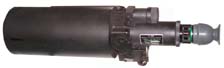
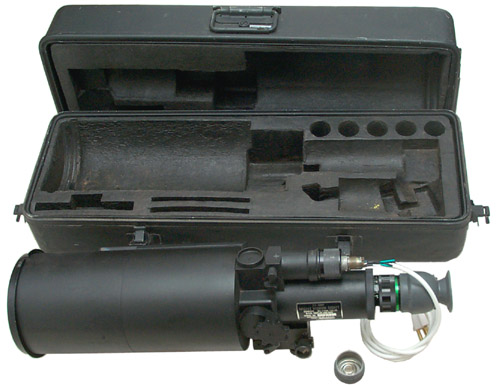
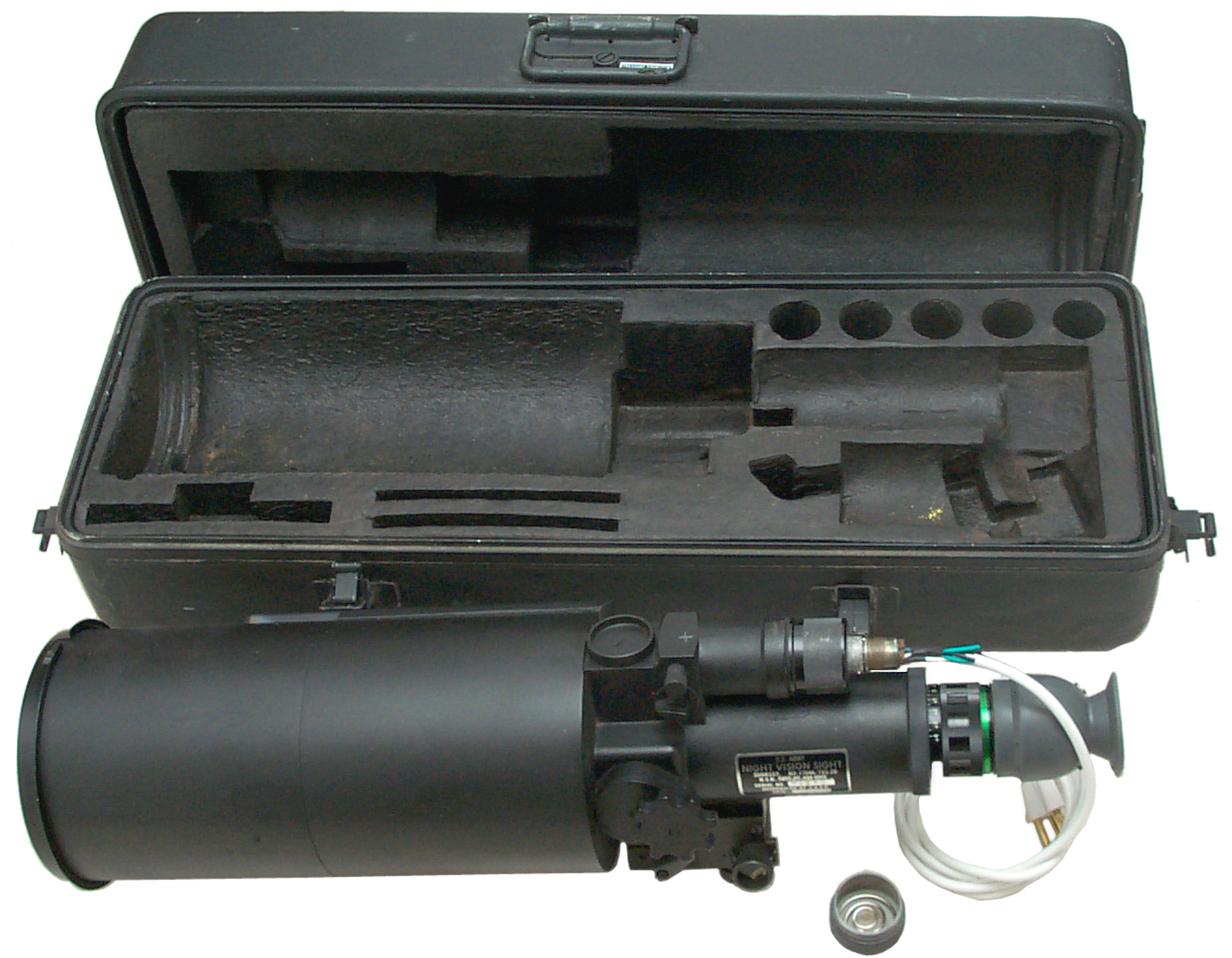
This is a Vietnam era Crew Served
Weapon Night Vision Device. It uses a Schmidt-
Cassegrain optical system. The manual says 7
power. The objective diameter is probably 5.5 to 6 inches.
Image Intensifier
Marked: Image Intensifier, Type:
MX-7854/UV, FSN 5855-051-2702, U.S. Property, Ser. No. 17452,
8524
2.74" diameter x 7.3" long. 34mm flat exit diameter.
1.4" dia. flat fiber optic plate.
Oscillator
Marked: Oscillator H.V.,
M?052374B(F10), Lectrospace Co., Westbury, N.Y., Contract No.,
DAARC7-69-C-032, Ser. No., 3922
The oscillator has a socket on it's bottom that plugs directly
into a pin on the image intensifier.
Focus
Turning the Focus knob clockwise
moves the main mirror back
Lens Cap - Filter
The front cover
contains a small open segment and a filter wheel with 3
neutral density filters, each more dense than the prior one as
well as an open window. This would allow testing the
scope in the daytime. Using the darkest filter on a
cloudy day is about the same as no cover at night with 1/2
moon on distant hills.
Reticule
This sight is intended for use on
either the M2 .50 cal. Machine Gun (M2 rtucule) or the 106 mm
Recoilless Rifle (M40 reticule).
This on is setup with the M2 reticule and straight through
eyepiece. When the M40 reticule is used the right angle
eyepiece is used.
The reticule gets it's electricity from a cble that goes into
the front of the front lens element. This is not a high
voltage wire.
Operation
The switch with the pointer has 3
positions. CCW is OFF, then scope ON, then Scope and
Reticule ON.
The large knob controls objective focus and the eyepiece controls
focusing on the image intensifier tube output window.
When looking up at the stars at night there's a much larger number
of start visible than with the naked eye. Also there is no
night adaptation of the eye needed since the scope has a bright
output. But you probably can see fainter stars with night
adapted eyes. The output color is green to match the peak in
a human eye's spectral response.
This scope was not intended to be hand held, and doing so is very
difficult. Need to figure out a way to get it mounted on a
tripod.
Upon receipt the unit appeared to be
DOA. The 1½" diameter knob on the top of the scope gives
access to the oscillator, which can simply be lifted out.
Plugging it in and removing it a few times cleaned it's contacts
and now it's working OK. It again failed to start and
cycling the oscillator up and down a couple of times fixed
it. Maybe it needs cleaning with a pencil eraser?
Power
BA-1100 Battery
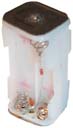
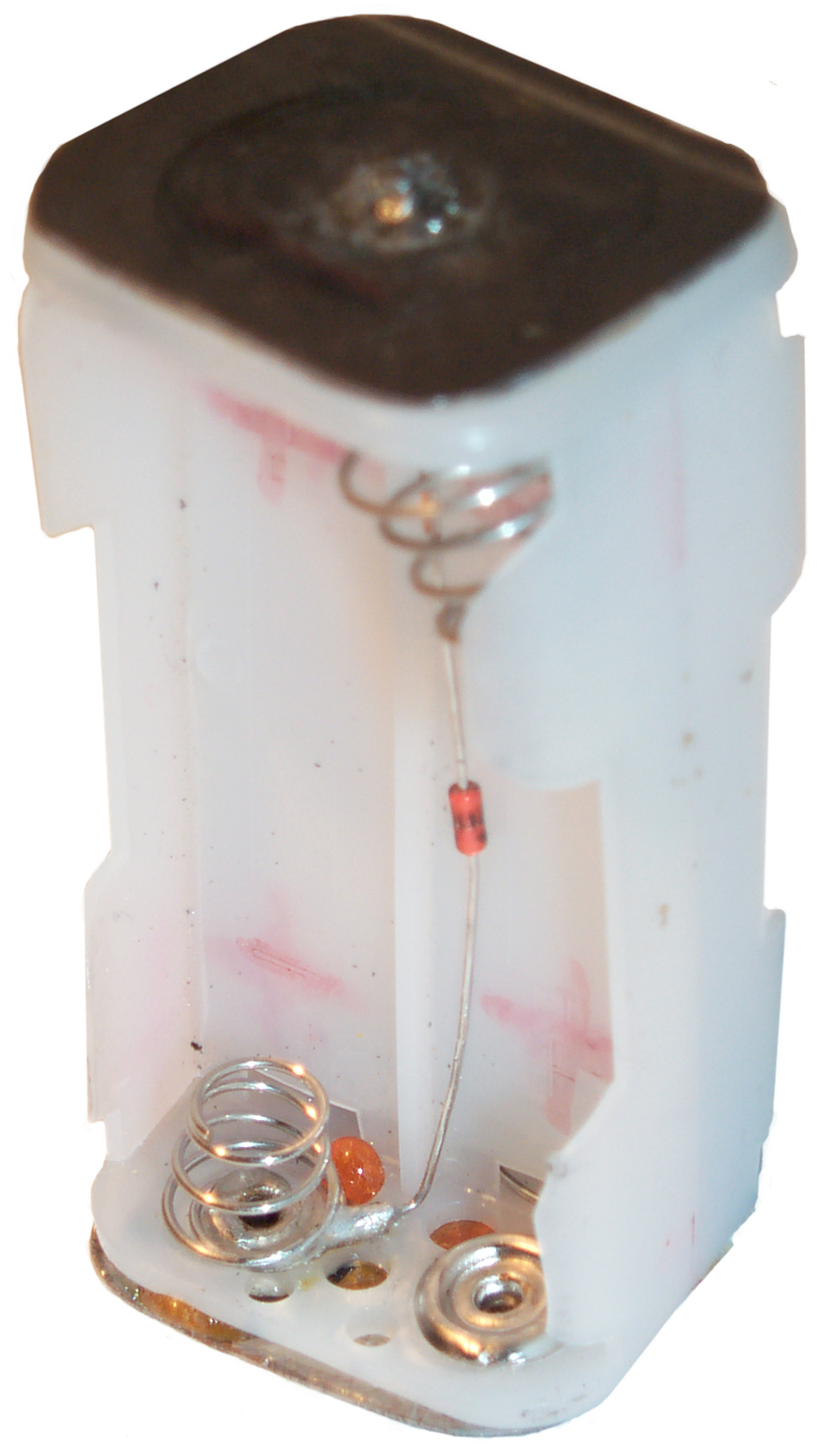
The
original battery was the BA-1100/U 6135-00-926-0827 which is one
of the long obsolete Mercury based batteries. A prior owner
has made a simple battery adapter by taking a four "AA" battery
holder where all the cells are wired in series and attaching a
metal plate to each end. The "battery" goes into the scope
Positive (+) end first. The scope case is a negative ground.
The 4 AA battery holder has both the + and - terminals on the same
end. This adapter is made by placing a metal plate on the
terminal end with the positive contact connected to the positive
terminal and with epoxy or hot melt glue insulating the negative
contact. A diode is connected from the negative spring to
the opposite end and goes through a small drilled hole to the
negative metal plate that is glued to insulate it from the jumper
eyelets on that end. Single sided PCB material would be a
good material to use for this.
The BA-1100 used 4 Mercury cells which when fresh put out 4 * 1.35
= 5.40 Volts. When dead it was 5.0 volts.
If 4 AA rechargeable batteries were to be tried they would be
about 1.4 V * 4 = 5.6 Volts fresh and 1.2 * 4 or 4.8 when
dead. So although they probably would work when fresh, the
useful life would be short.
If 4 AA Alkaline cells are used the fresh voltage would be 4 *
1.52 or 6.08 which is a little too hot, that's why the diode is in
the adapter to drop the fresh voltage down to about 5.6, very
close to the Mercury battery. The 5.0 volt dead voltage for
the adapter occurs when the cell voltage is 1.4 so when the AA
cells no longer work in this adapter they would still power a
flashlight.
5VV500RH Ni-Cad may be a direct replacement for the BA-1100.
Let me know a
source for them.
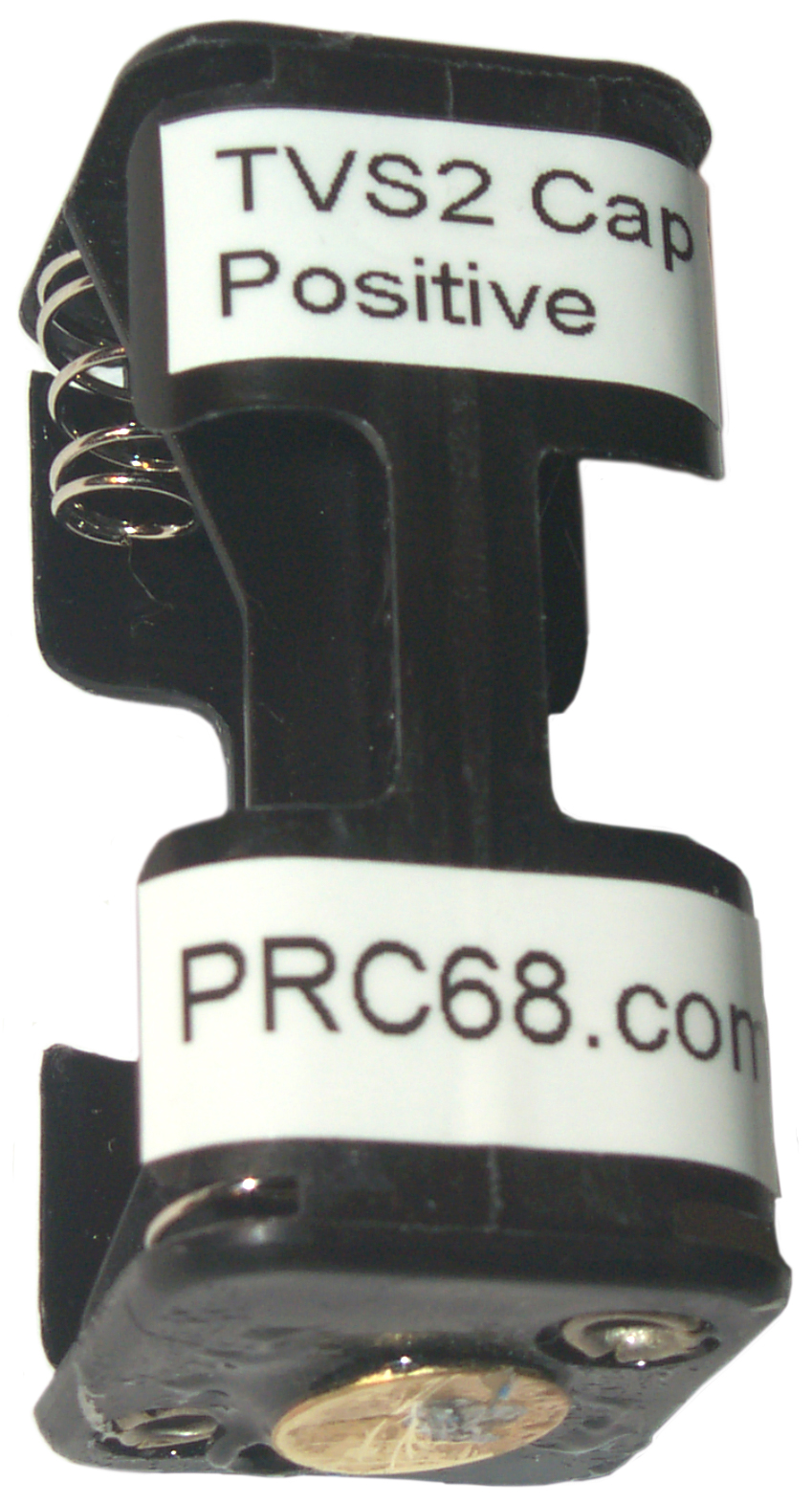
1100BA Battery Adapter
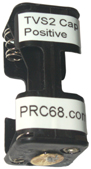
After working with the Battery Eliminator (see below) it's clear
that 6.6 Volts DC is OK so the diode used in the above battery
adapter is really not needed and not desired since it wasts
energy. The
1100BA product
does not use a diode.
The brass disk contacts have polarity (+) and (-) stamped into
them. Also the label "TVS2 cap Positive" is on the Positive
end.
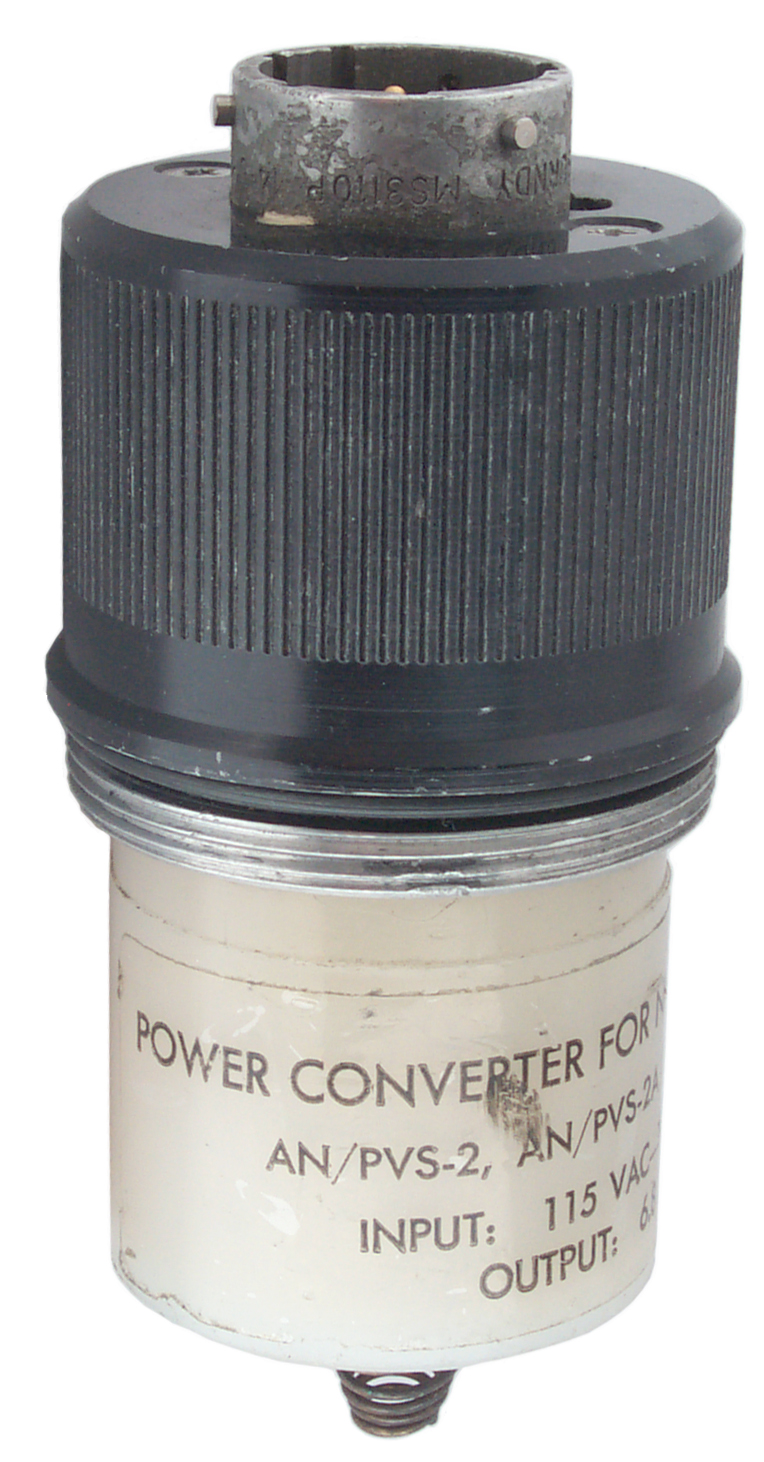
Battery Eliminator
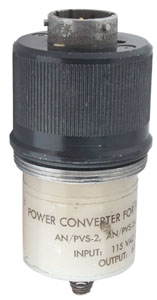
This is a battery eliminator that replaces the BA-1100/U Mercury
battery that's long obsolete. It's line powered from regular
115 VAC single phase power.
|
|
|
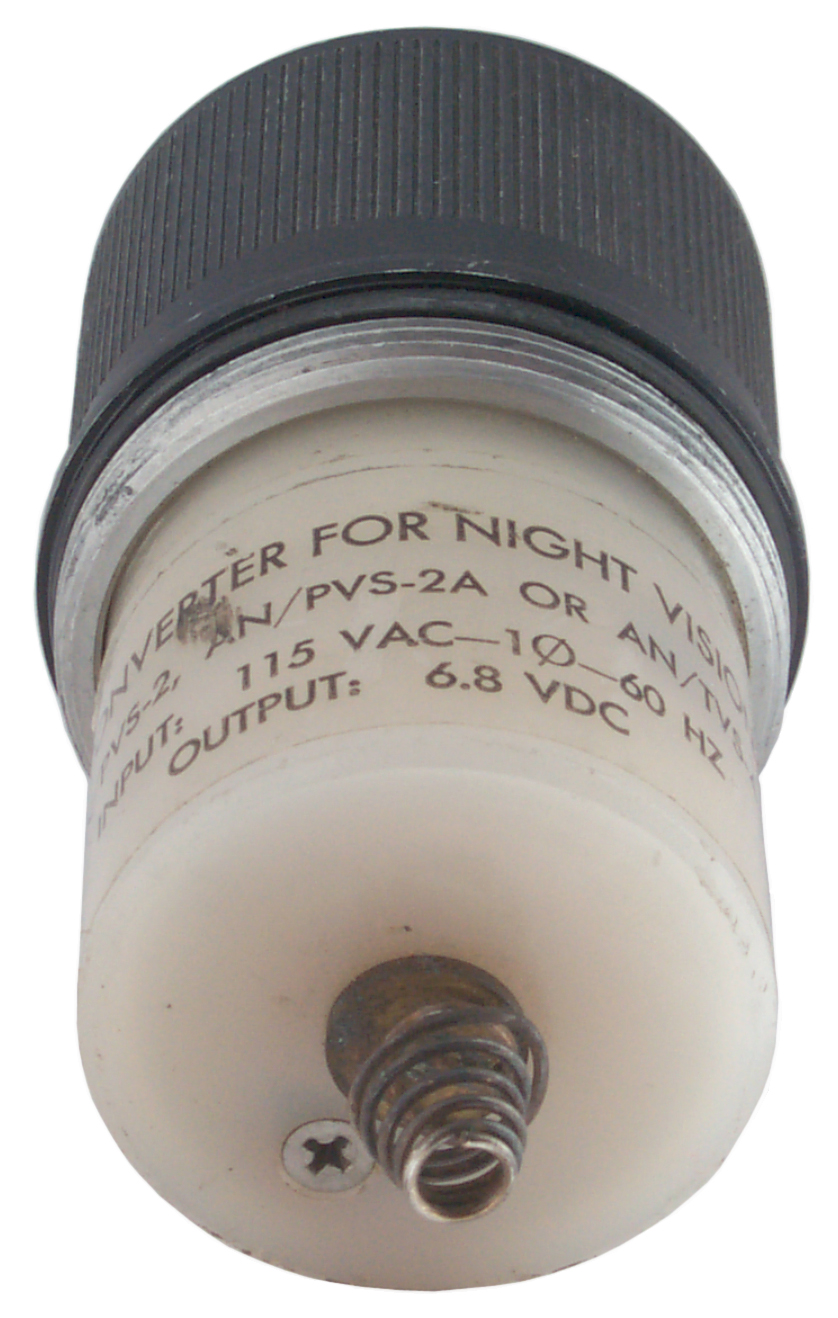
Power
Converter for Night Vision Sights
AN/PVS-2, AN/PVS-2A or AN/TVS-4
Input: 115 VAC single phase 60 Hz
Output: 6.8 VDC
|
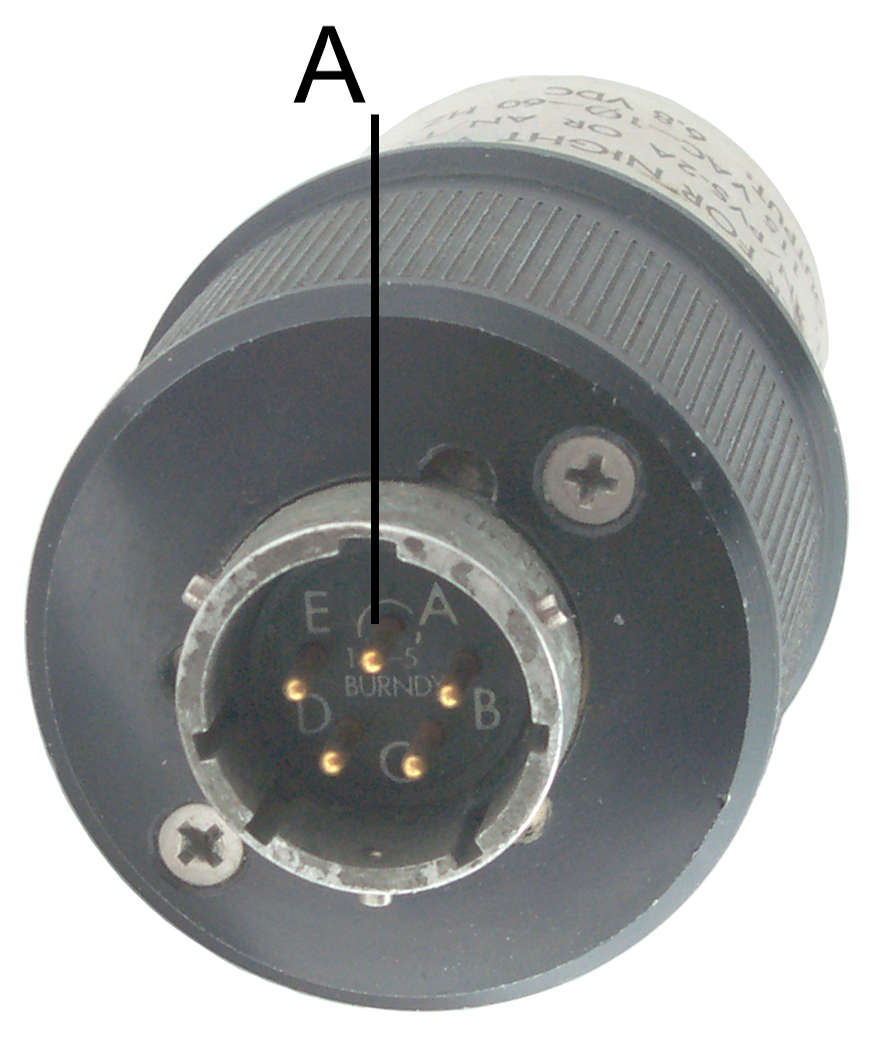
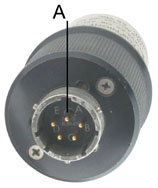
MS3110P-14-5-5P
shown with pin A next to wide keyway
at top. Letters go clockwise.
|
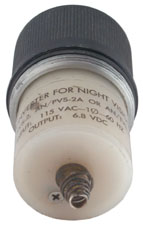
DC
output is case threads
and spring.
|
The A.C. cable will use a MS3116E-14-5S or MS3116F-14-5S or
MS3116P-14-5S connector.
The MS3116E-14-5S is the lowest cost and is available from
William Perry Co.
Wiring is A.C. line to pins B and C.
Earth ground to pin E = threads on battery eliminator and
connector shell.
Open circuit output about 6.6 Volts.
Although only three Night Vision Sights are listed on the batery
eliminator it should work for anything that uses the BA-1100/U
like the TVS-2B.
These are available from
Mike Murphy on
his
NIGHT VISION, SURVEILLANCE
AND RELATED ITEMS web page.
Manuals
TM 11-5855-202-10 If you have a pdf
let me know
TM 11-5855-202-23P Organizational and Direct Support
Maintenance Repair and Special Tools Lists (Including Depot
Maintenance Repair Parts and Special Tools) For Night Vision
Sight, Crew Served Weapons AN/TVS-2 (NSN 5855-00-087-3144),
AN/TVS-2A (NSN 5855-00-791-3358) and AN/TVS-2B (NSN
5855-00-484-8638)
TM 11-5855-203-10
Night Vision Sight, Individual Crew Served Weapon AN/PVS-2 (NSN
5855-00-087-2947), AN/PVS-2A (5855-00-179-3708) and AN/PVS-2B
(5855-00-760-3869)
TM 11-5855-203-13 Organizational and DS Maintennance Manual, Night
Vision Sight: Crew Served Weapons Models 9927 and 9927A, April
1967
TM 11-5855-203-23P Technical Manual Organizational and Direct
Support Maintenance Repair Parts and Special Tools Lists
(Including Depot Maintenance Repair Parts and Special Tools) for
Night Vision Sight, Crew Served WeaponsAN/TVS-2 (NSN
5855-00-087-3144), AN/TVS-2A (NSN 5885-00-791-3358) and AN/TVS-2B
(NSN 5855-00-484-8638), November 1977 Change 1
TB 11-5800-212-24 Procedure for Determining Serviceability of
Night Vision Sight Individual Served Weapon Sight, Crew Served
Weapon AN/PVS-2 and AN/PVS-2A; Night Vision Sight, Crew Served
Weapons AN/TVS-2B; Night Vision SIghts, Mimiaturized AN/PVS-3 and
AN/PVS-3A; and Night Vision Sight, Tripod Mounted AN/TVS-4 and
AN/TVS-4A.
TC 23-13 Crew-Served Weapon, Night Vision Sight, Jan 1967
Related Equipment
Night Vision Patents
3454773 BINOCULAR NIGHT TELESCOPE
WITH SINGLE IMAGE TUBE, Bulthuis et al (NV Optische), Jul 1969,
3744872 BINOCULAR WITH IMPROVED PRISM MOUNT, Akin (Bushnell), Jul
1973, - moulded plastic body
4030047 Opto-mechanical subsystem with temperature compensation
through isothermal Design, F.E. Goodwin (NASA), - Beryllium
4205894 Hermetically sealed binoculars, (Bell & Howell) -
single objective
4463252 Night vision goggle system, (Baird Corp), - single
objective
5029963 Replacement device for a driver's viewer (ITT), - upgrades
the AN/VVS-2 to a Gen III device
5084780 Telescopic sight for day/night viewing, (ITT), - single
objective, single eyepiece, two internal paths
4822994 Small arms sight for use
during daylight and nighttime conditions, (ITT) - removable
image intensifier
Photoelectricity and Its
Applications", 1949, John Wiley & Sons Chapter 18 Light
Beam Signalling & Infared Detection
4629295 Night vision instrument with electronic image converter
(Simrad Optronics A/S) - beam splitter
3509344 DEVICE WITH A NIGHT TELESCOPE (NV Optische) - two
objectives one eyepiece
4467190 Night-vision equipment, Aug 21, 1984
4576432 Aiming or sighting apparatus with synchronously rotating
thermal imager and aiming head Mar 18, 1986
4629295 Night vision instrument with electronic image converter
Dec 16, 1986
4653879 Compact see-through night vision goggles Mar 31, 1987
4655562 Objective lens system, relay lens system, and eyepiece
lens system for night-vision goggles Apr 7, 1987
4775217 Night vision viewing system Oct 4, 1988
4828378 Night vision viewing systems May 9, 1989
4863269 Weapon sights Sep 5, 1989
4867549 Re-imaging optical system Sep 19, 1989
5157553 Collimator for a Binocular Viewing System -
5223974 Collimator for a Binocular Viewing System -
5301060 Optical element (Minolta) - laser scanner
5347397 Diopter cell assembly for a
binocular viewing system (ITT) - splitter for single objective two
eyepiece systems
5444568 Consumer night vision viewing device
5455711 Magnification lens coupling device for a night vision
assembly (ITT) - two adapter rings to add accy lens to NVD
5495364 Night vision binoculars (ITT) - waterproof single
objective two eyepieces
5471374 Illuminator bracket for a night vision device (ITT) -
breaks easily
5495364 Night vision binoculars (ITT) - waterproof single
objective two eyepieces
5537261 Night vision binoculars (ITT) - commercial low cost single
objective two eyepiece waterproof
5595435 Flashlight illuminator for a night vision device (ITT)
-LED or Laser Diode - fits the easily broken bracket (viewer may
be the 160/260?)
5737131 Night vision monocular (ITT) -
5847868 Night vision binoculars (ITT) - single objective two
eyepieces low cost
6069557 Automatic long-life infrared emitter & locator system
- flashing IR LED beacon (like the one that fits a 9V battery -
many circuits
6219250 Night vision binoculars (ITT) - single objective two
eyepieces low cost
6456497 Night vision binoculars (ITT) - single objective two
eyepieces low cost
6570147 Color night vision apparatus (ITT) - RGB are split like
for a TV camera, seperate Intensifiers work on the three paths
where the output phosphor is the same color as the path color and
then combined
H1599 Synthetic-color night vision - blends a visible color image
and an IR image into a single false color image
Links
Fort Belvoir Army Night Vision
Labs - Early
Attempts at Night Vision Technology - 1967 - Pulse Gated
I2-TVS-2 Crew Served Weapon Night Sight
A
History of the United States Army Communications-Electronics
Command (CECOM) - "Second generation night vision
devices (image intensification technology) replaced the first
generation "sniper scope" (near infrared technology) of World War
II. The Small Starlight Scope AN/PVS-2, the Crew Served Weapons
Sight AN/TVS-2, and the medium range Night Observation Device
AN/TVS-4 all saw service in Vietnam. The Night Vision Laboratory,
which was attached to ECOM in 1965, began their development in 1961.
Production of the AN/PVS-2 began in 1964."
S.T.A.N.O. Components
- Night Vision dealer
Back to Brooke's PRC68, Products for Sale, Astronomy, CCD
Astronomy, Binoculars, Optics, Military
Information, Personal Home page
[an error occurred while processing this directive] page created 24 Jan.
2005.

 The
original battery was the BA-1100/U 6135-00-926-0827 which is one
of the long obsolete Mercury based batteries. A prior owner
has made a simple battery adapter by taking a four "AA" battery
holder where all the cells are wired in series and attaching a
metal plate to each end. The "battery" goes into the scope
Positive (+) end first. The scope case is a negative ground.
The
original battery was the BA-1100/U 6135-00-926-0827 which is one
of the long obsolete Mercury based batteries. A prior owner
has made a simple battery adapter by taking a four "AA" battery
holder where all the cells are wired in series and attaching a
metal plate to each end. The "battery" goes into the scope
Positive (+) end first. The scope case is a negative ground.