HP 5060A Cesium Beam Frequency Standard
© Brooke Clarke 2000 - 2020
|
 |
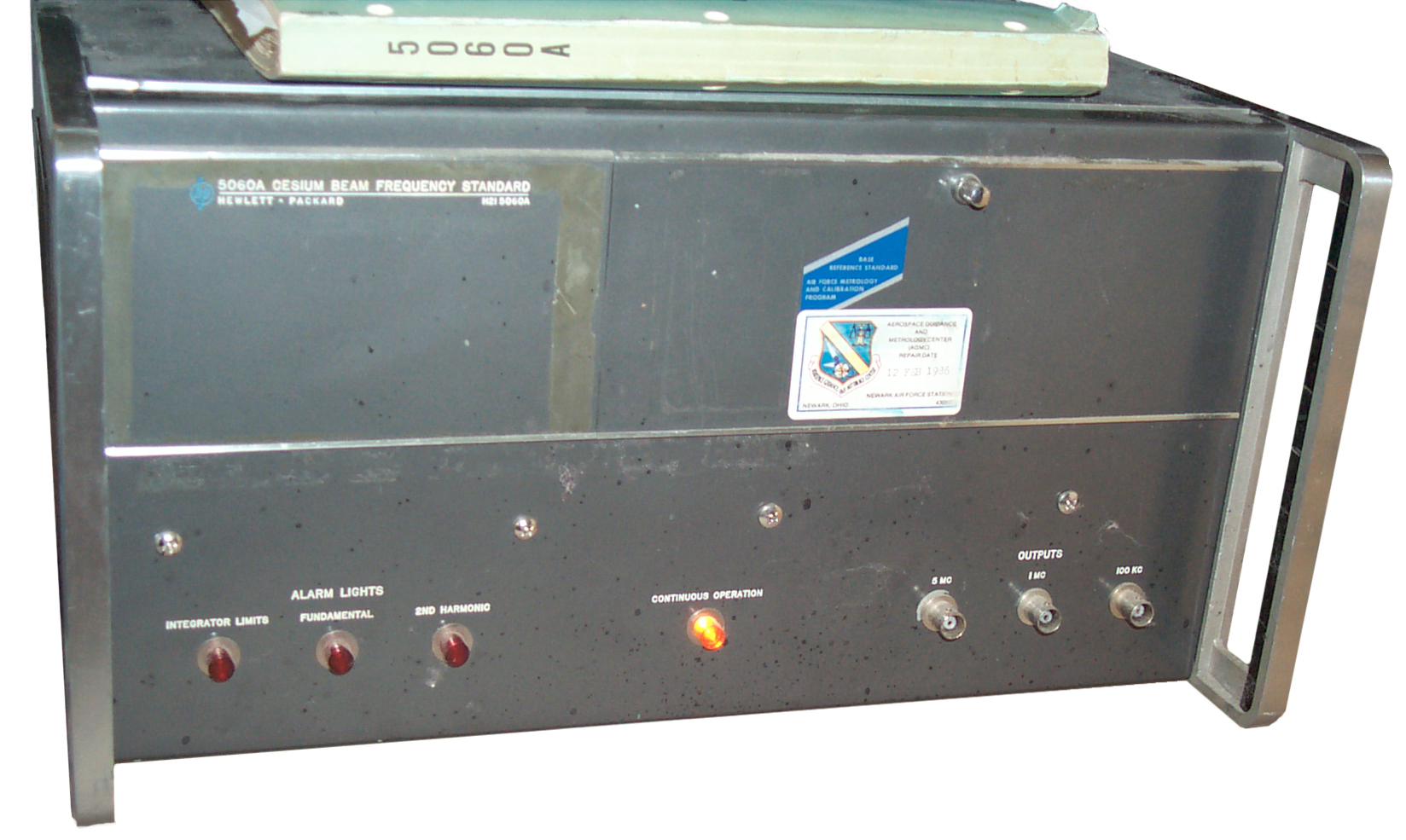
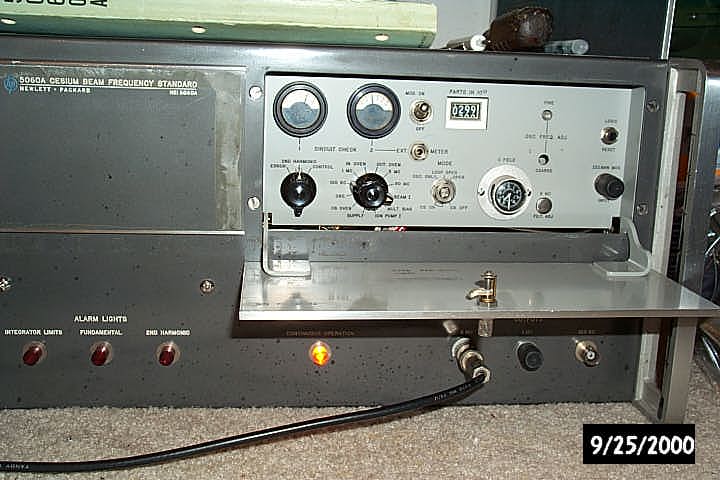
Fig 1
Front
|
Fig 2
Rear
|
|
|
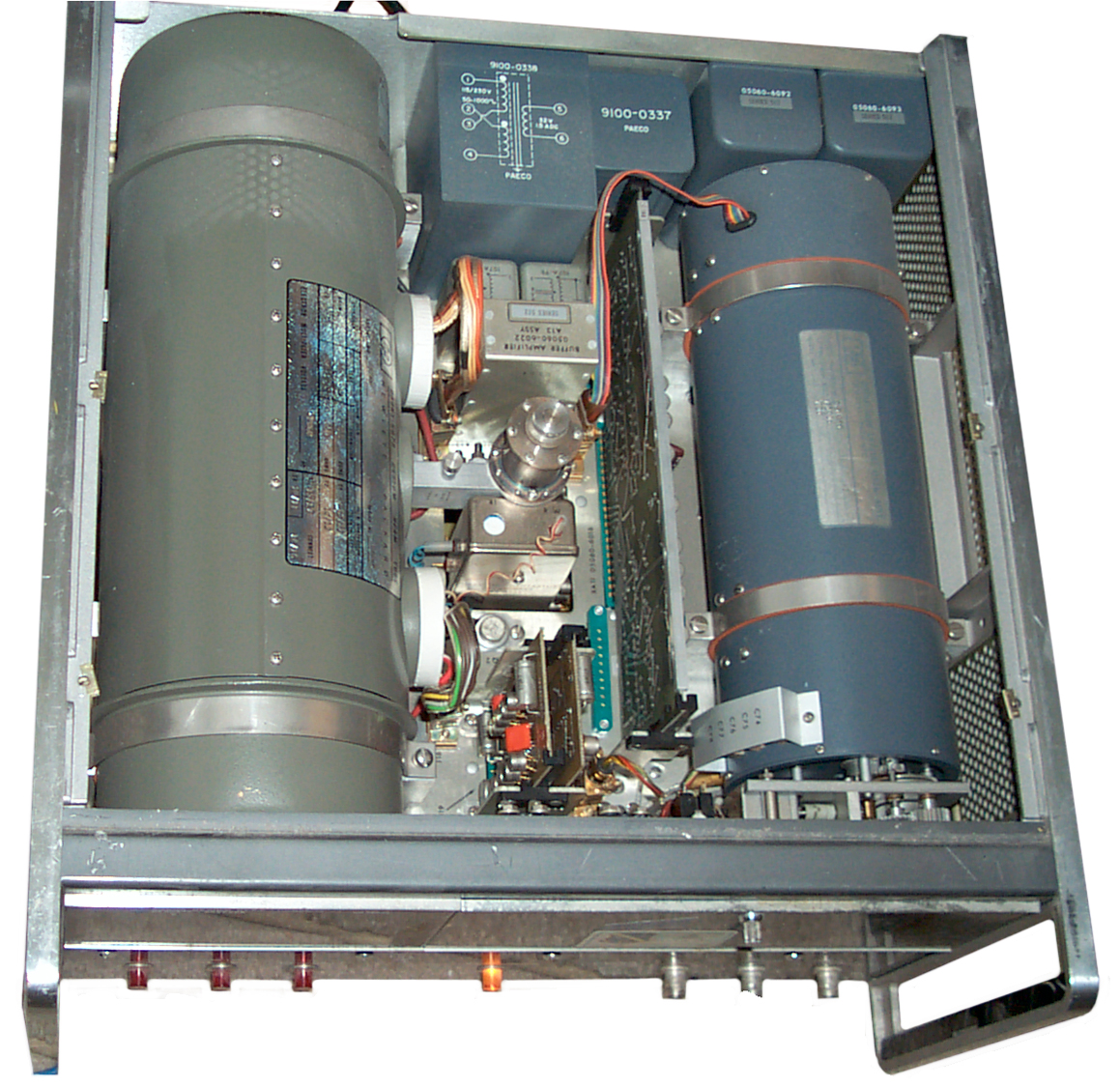
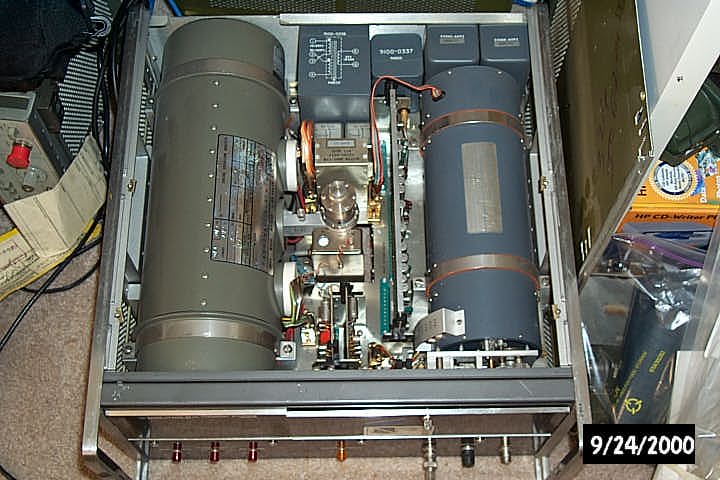
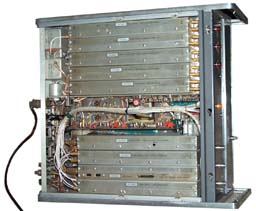
Fig 3
Top Inside
|
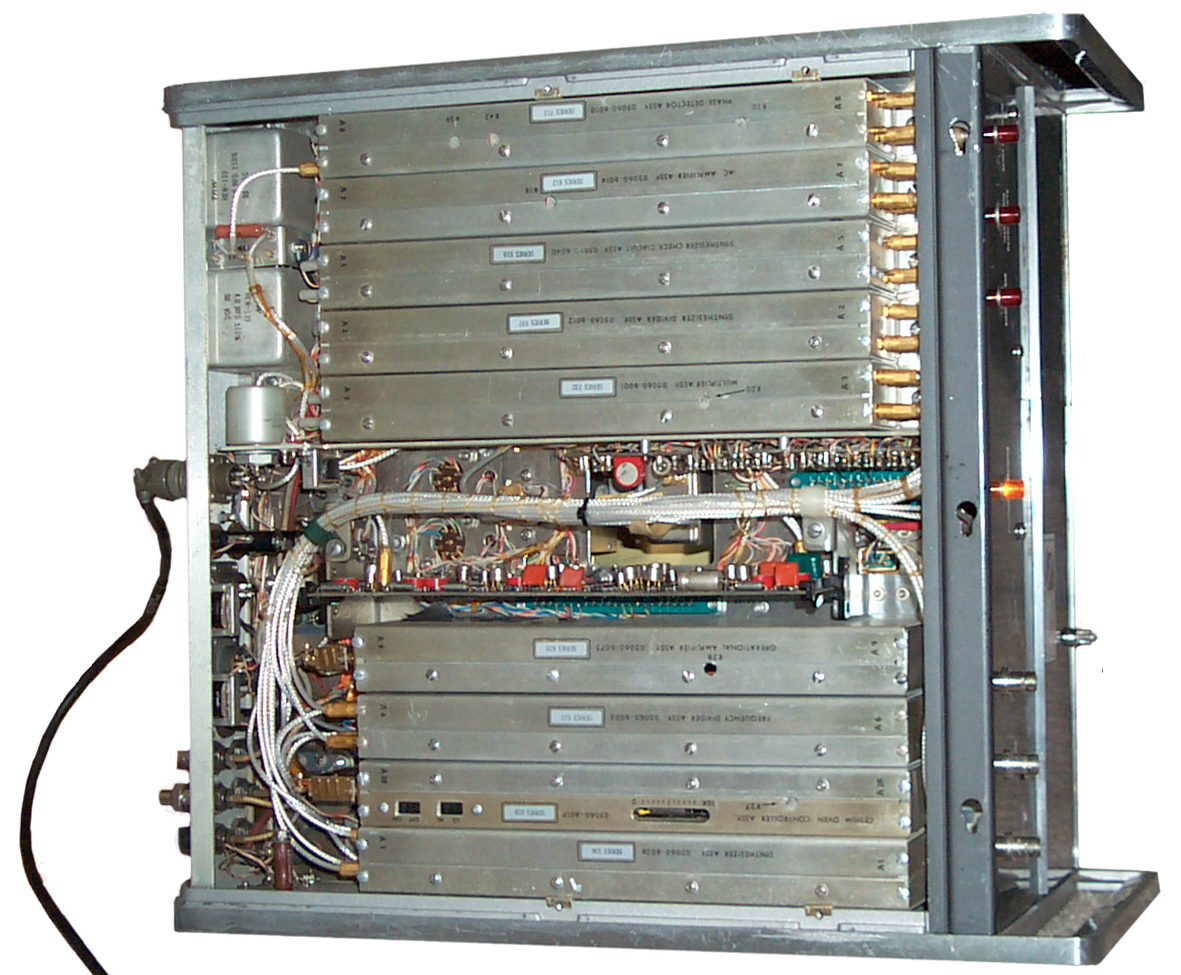
Fig 4
Bottom Inside
|
 |
|
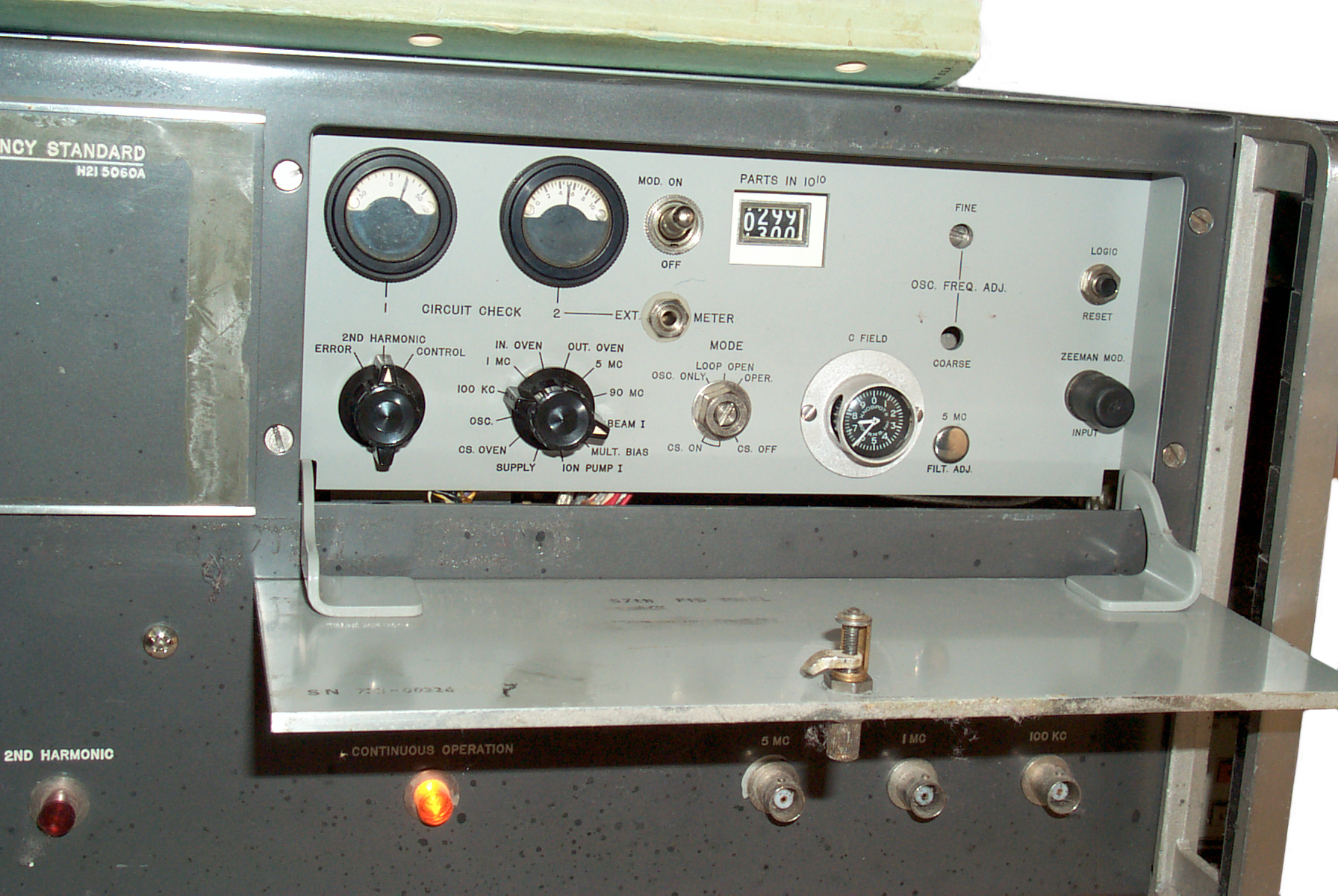
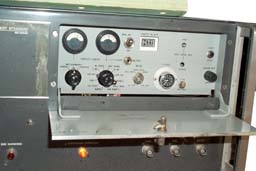
Fig 5
Control Panel
|
Fig 6
Manual
|
|
|
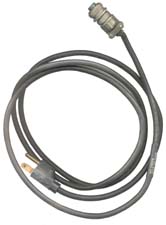
Fig 7
Power Cord
|
|
Used Cesium Standards
Cesium frequency standards work by
squirting Cesium atoms from a reservoir that's heated to boil off
some atoms from a small piece of cesium liquid metal. These
atoms are processed is such a way that they become an atomic
frequency standard. The problem is that there is a finite
life to the Cesium source and when it's used up the whole physics
package needs to be replaced.
Another problem is that the physics package operates under a hard
vacuum. To maintain this vacuum there's an internal ion
pump. If the unit is left in storage without power the ions
in the physics package accumulate and when the unit is powered up
some time will be needed to pull them out. After some years
of storage it may not be possible to get the hard vacuum and the
unit will be dead.
Symmetricom sells a
universal Cesium physics package for about $16,000 plus
installation. Most of the used Cesium standards on the
market are there because they have either died or are about to
die.
History
Prior to working Cesium beam
frequency standards the official meter was defined by an invar rod
(i.e. a real physical standard). Today a meter is defined
based on the distance that light travels in a specified
time. The definition of a second was also changed from being
based on the rotation of the Earth to the Cesium clock since the
Earth speeds up and slows down. Of all the things that can
be measured time (or frequency, time interval, etc.) is the one
that can be measured with the most precision.
The HP Cesium standards became the
world's common time standard. As of 2005 Agilent (formerly
the Test & Measurement division of HP) is selling off their
Cesium standard business to
Symmetricom.
1948 - Harold Lyons at NBS starts
work on an amonia based atomic clock
1955 - Louis Essen at the National Physical Lab in the UK comes up
with the idea for a Cesium clock and the first one is built.
Note that the NPL unit was a clock that kept Cesium based time for
the three years needed to do a correlation study with the USNO
(and probably ran longer than that). The U.S. standard was
moved from the East coast to Colorado and was more a frequency
standard than a clock.
1964 - The HP 5060A, a cesium-beam standard instrument, gains
worldwide recognition as the "flying clock." International
standards for time set by flying the HP 5060A around the world.
Accuracy 2E-11, Precision 1E-11, uses 5 MHz Xtal oscillator.
1967 - HP acquires the rights to make the Cesium Beam Tube from
Varian, Beverly Mass.
1982 -
FTS introduces microporcessor
controlled Cesium standards
1987 - 5061B Cesium Beam Standard - Accuracy 4 or 6E-12,
Settability 1E-13, has 10 MHz output
5065A Rubidium Frequency Standard, 5
MHz output
105B Quartz Oscillator, 5 MHz
5089A 22 - 28 VDC Standby Power Supply 67# 7"
high rack box
1989, 1990, 1991, 1992 - same offering
1993 5071A Primary Frequency Standard introduced (first
microprocessor HP unit almost 10 years after FTS), Accuracy
1.5E-12 Setability resolution 6.3E-15, RS-232 remote control. 10
MHz output , 5065A Rb dropped
1995 - 58000A Time and Frequency Reference Distribution Module,
58503A GPS Time and Frequency Reference , 10811D/E Oscillators,
E1750A 100 kHz to 10 MHz distribution amp in VXI format, E1752A
1PPS dist. amp in VXI format.
1997, 1998 - 55000 Ultra-Precise Time and Frequency Systems
2000 - 58502A 12 chan sine wave dist amp, 58503B GPS T&F
Reference instrument, 58533A GPS T&F Reference box
Continuous Operation
Now that the 5060A has been running for a number of days
with the "Continuos operation" light always on, it just needed
some time to settle down.
When all is well you get the "continuous
operation" light.
C Field Adjustment
There is an adjustment for changing the magnetic field around the
Cs beam tube.
This has the effect of tweaking the output frequency.
The scale of the 10-turn knob is about 1E-9 per turn, or
1E-10 for 1/10 of a turn (big division), or 1E-11 for 1/100 of a
turn (one tick mark).
You can see that's it's not easy to get the Cs source set to
within better than 1E-11.
This appears to be like the PRS10 which
has a very high Q Rubidium oscillator but the actual frequency
depends on a number of subtle factors.
It's questionable to me which is the better timekeeper, the old
5060A (1E-11 spec) or the new PRS10 (1E-12 spec)?
The life of the PRS10 will be much longer than any Cs source but
the newest Agilent
5071A will provide better stability.
The manual says that the C Field adjustment is to set the correct
hyperfine transition using a injected audio signal at the
Zeeman frequency.
But the specifications clearly say that the fine frequency
adjustment is 1E-9 per revolution or 1E-10 per division (10
divisions per revolution).
26 July 2005 - Note even though the actual operating frequency can
not be set as accurately as newer standards, because of being a
Cesium standard the frequency will be constant (i.e. it will not
drift). By using a GPS timing receiver the actual frequency
can be determined and then backed out of measurements made.
So for measurement applications it's as good as a modern standard.
Description
The two main cylinders
inside on the top are the Cs
physics package and the 5 MHz crystal oscillator. This
crystal oscillator is used in a number of other HP products.
It is based on the idea of having a
large thermal mass surrounded by a double oven that uses a
proportional controller rather than a bang bang controller.
The electronics are contained in metal boxes on the bottom side.
Condition
This is a used unit that has scratches and dings. The
physics package seems to be working, but the 1 Mc divider does not
start. An adjustment may be needed or a repair. Since
the 1 Mc divider is not working then the 100 kc divider can't
work.
Start Up Instructions
These instructions are intended for
starting a unit that has just been received or has not been used
for some time.
- First take the top and bottom covers off and look to make
sure all modules are there and cables connected inside
- Place the mode switch to osc. only.
- Connect AC power. (if you don't have a cord you can make a
temporary cord with some matching pins)
- With circuit check 2 switch in supply verify a reading of
about 8.
If significantly hi or low remove ac power until supply is
repaired.
- If OK so far place the switch to ion pump I.
The meter might be pegged, if so leave unit on till it drops below
1. (This may take up to 24 hours!)
- Then place the mode switch to loop open.
The ion pump I may rise and peg again.
This is OK it may cycle for up to 24 hours again.
The cesium oven reading should come up to above 4 when you switch
to loop open.
It may also cycle Off and On until the ion pump I stops cycling.
- Once the cycling stops the Cesium oven reading should drop to
approx. 4 in about 30 minutes.
If it doesn't, turn power off until oven repaired.
- The in oven and out oven readings should drop in about 4
and 2 hours.
If not turn power off until repaired.
- Now with mod switch off and meter 2 in beam I position
connect a frequency counter to the 5 Mhz output.
- Slowly adjust the coarse oscillator adj. back and forth
across 5 Mhz by about plus/minus 1 Hz while watching the beam I
meter.
You should see three peaks on the meter with the one at 5 Mhz the
biggest.
- Set the adj. for the central peak.
Put circuit check I to 2nd harmonic.
Turn mod to on.
The 2nd harmonic reading should rise.
- Now place mode to operate.
Wait about 30 seconds and then push the logic reset button.
The continuous operation lamp should light.
This is a quick check only. If the peaks are present while tuning
through 5 Mhz this is a good sign that the tube is operating, but
you would need to run it at least 100 hours to make sure the levels
stay stable. However not seeing them could be the result of other
circuit failures.
Note that once you have the 5060A locked, it can be unplugged
and later just plugged in and will just lock by it's self.
Links
50th
Anniversary of the First Accurate Cesium Atomic Clock - The
NPL Cesium standard was very stable
Clock.Time Lord….
Louis Essen D.Sc., F.R.S. - about the inventor of the Cesium
standard (Need IE not Netscape to see it.)
History
of Atomic Frequency Standards: A Trip Through 20th Century Physics
-
Time & Frequency -
scanned items of historical interest -
NPL - How
an atomic clock works - practice
Louis
Essen
1908-1997 -
Fifty years
of atomic clocks -
YouTube: HP 5061A Cesium Clock -
2020 March 20
HP
Journal August 1966 Vol 17, No. 12 -
2025 Jan 22 HP 5061A
Atomic Clock Repair, 31:06 -
Patents
2993638
Electrical vacuum pump apparatus and method, Lewis D
Hall, John C
Helmer, Robert
L Jepsen, Varian
Medical Systems Inc, App:1957-07-24 - HP licensed from
Varian.
Varian Associates (Wiki,
patents)
was founded by Russell and Siguard Varian. I don't remember
which of them asked my mother out on a date while they were both
at Stanford, but she refused. The products they made mostly
relied on ultra high vacuum technology (Wiki).
Wiki
says Varian made a fuse (sic: Fuze) for the atomic
bomb. That may be the Kryton
Tube.
2894209
Gyromagnetic resonance apparatus, Chodorow
Marvin, Russell
H Varian, Varian,
App: 1953-07-13, - I think this is the Backward-Wave Oscillator
(Wiki: BWO).
Prior to this Klystrons (Wiki) and
Traveling Wave Tubes (Wiki: TWT)
were common. Also see the MIT Rad
Lab books. The BWO was the heart of the first
generation of microwave sweep oscillators.
I didn't know that the BWO made an excellent RADAR jammer until
reading the Wiki BWO page. Which references:
Navy Electrical Engineering Training Series (NEETS):
Module
11, Microwave Principles.pdf 229 pages - 2.3.6 The
Backward-Wave Oscillator. but no mention about radar jamming.
2999448
Dust free work bench apparatus, Robert
A Abler, Floyd
L Becker, David
G Clifford, Varian,
App: 1958-03-06, - The laminar flow (Wiki)
work bench that makes use of HEPA (Wiki) filters is
ubiquitous in Silicon Valley in semiconductor and hard drive
manufacturing as well as many other situations where low airborne
particle count is important.
Also see:
Russell: First? star tracker 2462925
on MD-1 web page
Russell: Top Secret radio based Proximity Fuse 3269314 on China Lake
Patents web page.
5148122
Atomic beam frequency standard having RF chain with
higher frequency oscillator September 15, 1992 331/3;
331/94.1
5146184
Atomic clock system with improved servo system
September 8, 1992 331/3; 331/79
Back to Brooke's PRC68, Products for Sale, Time & Frequency, Electronics, Personal
Home page