Laser Infrared Observation Device MX-9838/GVS-5
© Brooke Clarke 2010 |
 |
 |
| There are two connectors in
the
bottom of the battery compartment. If you know what they can do, please contact me.  |
18 each AAA batteries will
fit
the battery compartment with some room to spare. Not enough room to use battery holders. Now to see if AAA is available with tabs. (3x3x2x[1.5V/1.2V] = 27 V / 21.2V) 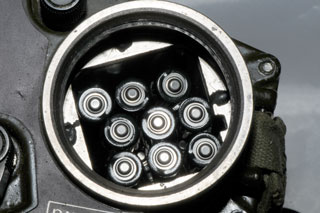 |
Do-It-Yourself BB-326. 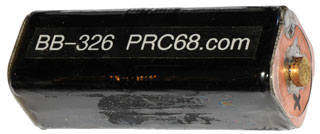 |
The GVS-5 is not drawing
any
current from the battery. The yellow cap is 26.4 uF
@ 1000V. |
 |
The problem was the
interlock
switch (on right). At the left you can see the 4 digit + 2 point LED display. The cover needs to be installed is a special way to activate the switch. 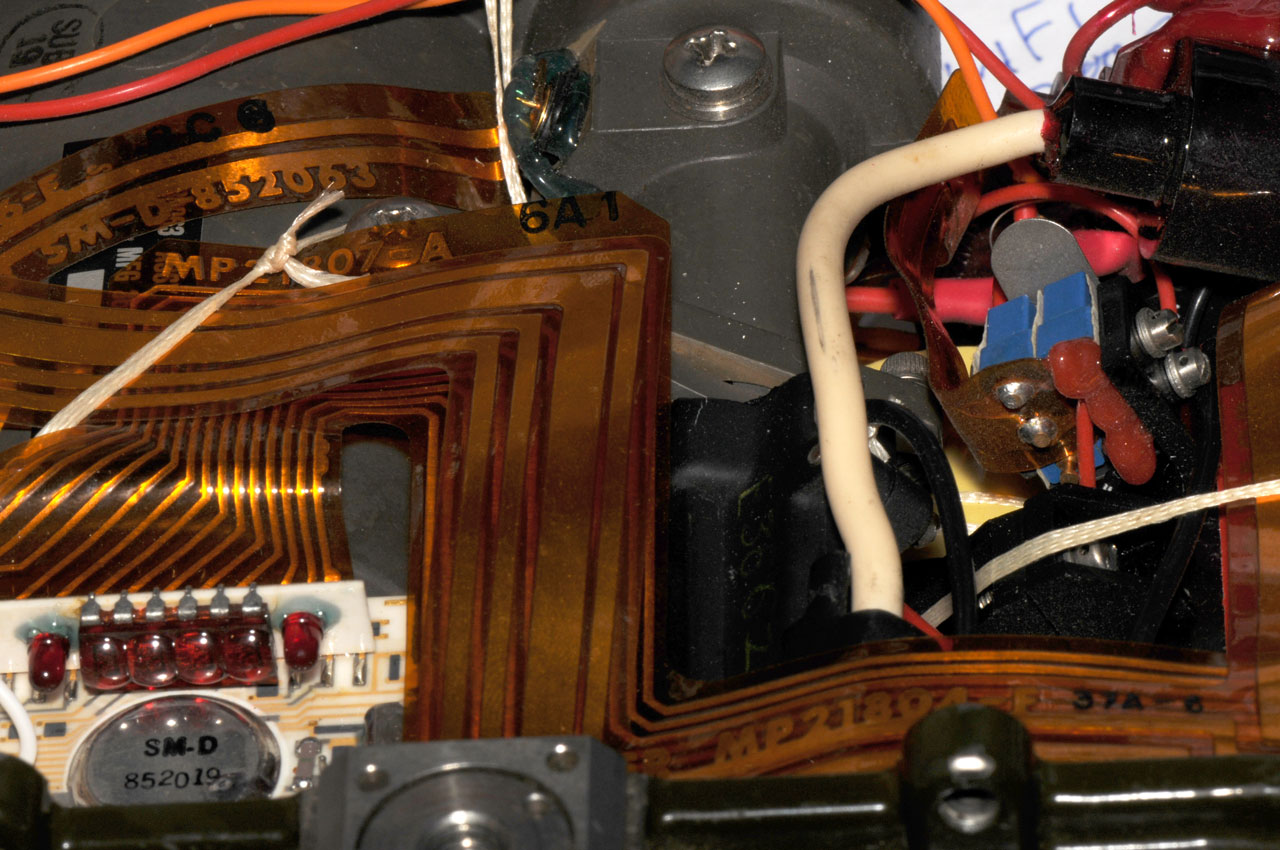 |
Background
This is an infrared laser
range
finder. By using IR the flash is not visible to
someone
down range. There are two problems with this unit from
my point
of view. First, the Neodymium YAG laser emits IR with a
wavelength of 1064 nm. This penetrates a thin layer of
skin, like
an eyelid and so is not eye safe. I think that's the
main reason
this model is now obsolete. The other thing is that it
doesn't
have a data output port to allow connection of a military GPS
(PLGR, DAGR)
that
accepts azimuth, elevation and range data and computer the
target
coordinates.
This device only measures distance, i.e. it does not contain a magnetic compass function.
This device only measures distance, i.e. it does not contain a magnetic compass function.
Description
NSN: 5860-01-062-3543
The AN/GVS-5 is a lightweight
hand-held
laser rangefinder that an accurately determine the range to a
target
within 1 second after the FIRE button has been
pressed. The
device emits a laser burst and detects its return when the
burst is
reflected from a distant object. The time lapse between
emission
of the beam and its return is converted to meters and
displayed in the
eyepiece on the range-to-target display. The entire
AN/GVS-5
provides a range to the target that is accurate to within +/-
10 meters.
To use the AN/GVS-5 an observer simply aims the device by superimposing the circle at the center of the reticule pattern over the target and presses the FIRE button. The range is displayed in the range-to-target window and remains there as long as the FIRE button is pressed. The observer should not automatically consider the displayed range to be the correct range to the target. On the contrary, clutter in front of or behind the target may, at times, produce false ranges. The observer must continually associate the displayed range with a terrain-map analysis and his own range estimate to decide whether the reading is accurate. If, in the observer's opinion, all of these figures do not correlate, he should consider the information below.
3 Jan 2011 - the minimum range appears to be 170 Yards/Meters. That makes it harder to test the unit. There's no solid target that far away.
To use the AN/GVS-5 an observer simply aims the device by superimposing the circle at the center of the reticule pattern over the target and presses the FIRE button. The range is displayed in the range-to-target window and remains there as long as the FIRE button is pressed. The observer should not automatically consider the displayed range to be the correct range to the target. On the contrary, clutter in front of or behind the target may, at times, produce false ranges. The observer must continually associate the displayed range with a terrain-map analysis and his own range estimate to decide whether the reading is accurate. If, in the observer's opinion, all of these figures do not correlate, he should consider the information below.
Multiple Firings
To ensure that the observer is aiming at the correct target, he should take a series of readings on the same target. These consistent readings generally indicate that the observer has aimed in the same place each time.Minimum Range Set
Although the emitted laser beam is relatively narrow, it is wide enough to reflect from more than one target or object. The AN/GVS-5 has a multiple target warning light inside the eyepiece that lights when more than one return signal is received. When multiple target readings are indicated, the range displayed is the range to the first object from which the beam is reflected. To prevent obtaining a false reading from an intermediate object between the observer and the target the AN/GVS-5 i.e. equipped with a minimum range set (MIN RG SET). Ranges to the nearest 10 meters and up to 5,000 meters may be set on the IN RG SET by using the variable control. The MIN RANGE SET indicates the minimum range at which the AN/GVS-5 will register a return, thereby eliminating false readings from intermediate objects. The observer can continue a trial-and-error process of eliminating false ranges by adjusting the MIN GR SET until the range read in the display correlates with the observers own range estimate based on map and terrain analysis. The observer can save time in this process by establishing on the MIN RG SET the range beyond which he is certain the target lies before he begins ranging a target. Upon completion of a mission, the MIN RG SET should always be set back to zero.3 Jan 2011 - the minimum range appears to be 170 Yards/Meters. That makes it harder to test the unit. There's no solid target that far away.
Self-Location
The AN/GVS-5 an help the observer locate himself by giving him accurate distances to known points. The observer can report these distances to his FDC, which will in turn, using graphical or computer means, give him his location. Self-location also may be obtained by giving the FDC distances to, two burst locations of rounds that have been fired after the unit has complete4d registration. A combination of one round and one known point may also be used for self-location. The two points or bursts should be separated by at least 300 mills.Adjustment of Fire
Lateral and vertical shifts in the adjustment of fire are computed by using the mil relation in the same way as adjustment of fire by using binoculars. Range between the target and the bust and making the correction in the appropriate direction.Target Location
The distance provided by the AN/GVS-5 should always be used with the most accurate direction to the target available and a quick, but thorough, map analysis. The observer should remember that the AN/GVS-5 is designed to help him refine distance. The distances determined by the device should always be correlated with known information before a target location is produced.DC Power
The PVS-6 (MELIOS) Mini Eye Safe
Laser
Infrared Observation Set uses the same battery as the
GVS-6.
BB-516/U
(NSN: 6140-01-419-8191) which used Ni-Cad chemistry.BB-326/U
(NSN: 6140-01-533-7674) which is a Ni-MH chemistry. 300 mAh with a 3 Amp load (is this correct?)BA-6516/U
(NSN: 6135-01-231-3498 which is a Lithium Thionyl Chloride chemistryTS-3620
Contains a battery eliminator that is a new battery compartment cap with wires to supply DC power.Manuals
GVS-5
TM-11-5860-201-10-HR Hand ReceiptTM-11-5860-201-10 Operator's
TM-11-5860-201-20 Maintenance
TM-11-5860-201-20P 2nd echelon parts
TM-11-5860-201-30P 3rd echelon parts
TS-3620
TM-11-6625-2684-12 TEST SET, LASER INFRARED OBSERVATION DEVICE, TS-3620/GVS-5 (NSN 5860-01-052-9477)TM-11-6625-2684-12HR
TM-11-6625-2684-20P
TM-11-6625-2684-30P
Related
Range Finders
-
PAS-6 - Varo Metascope Model 9902E
EOG - Electro Optical Gadgets
Optics - day, Night,
PAS-6 - Varo Metascope Model 9902E
EOG - Electro Optical Gadgets
Optics - day, Night,
Links
Back to Brooke's PRC68, Products for Sale, Astronomy, CCD Astronomy, Binoculars, Optics, Military Information, Personal Home page[an error occurred while processing this directive] page created 3 Dec 2010.