For years I've been trying to find a
way to cut Printed Circuit Boards (PCB) for both through hole and
Surface Mount Technology work. A
scroll saw mounted under a work bench works but it has about a
1/16" saw kerf that's wasting expensive PCB material. A
scribe used on both sides of the board (making "V" grooves) takes
a lot of time and hurts the fingers. The
8" Mini Shear Break worked a small
fraction of the time.
Tin Snips
work but have a very short cut distance so even when going from
each side are very limited. They also bend the PCB material
to the point where it might be overstressed. The Harbor
Freight 67256 Multi-Function Tool cuts very slowly with the 67264
diamond blade. A foot operated sheet metal shear that's
about five feet long works but takes up a lot of space and is
expensive.
The
Enco 130-5700
12" Bench Top Hand Shear cuts 1/16" PCB material like a knife
through hot butter and is very easy to control. The 5" ($67)
, 6" or 8" versions may also work well, but I got the 12" ($120)
to error on the safe side. If you know how the smaller units
work for cutting 1/6" PCB material please
let me know.
The Harbor Freight Throatless Shear
item#
38413 is designed to allow making a curved cut and so is not
as good a choice as the 12" shear for making straight cuts.
The 12" shear will not stand up by
itself. The factory intended for it to be anchored to
something very substantial so leverage could be applied to the
handle but it takes a very small amount of force to cut PCB
material since the shear uses a compound linkage. So it does
not need to be anchored for leverage but does need to be mounted
to keep from falling over. You also need to have good
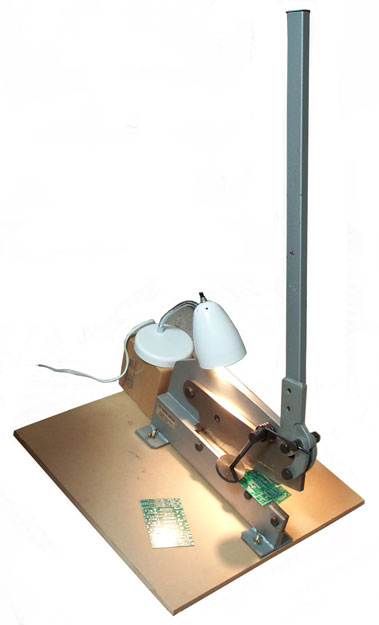
lighting to see the PCB cut lines and the blade. The plan is
to mount it on a two foot square piece of heave plywood.
With the shear sitting on the floor and a table lamp on the left
side and the back leaning against a cardboard box to keep it from
falling over I separated a 2.5" x 3.8" ExpressPCB "Mini Board"
into 63 (6 by 9) smaller boards in about 5 minutes.
Note that after making 6 cuts then each strip needs 9 more cuts so
63 cuts for 63 parts. Note that there is no fiberglass dust
like with a saw.
Tried the shear of a stack of paper about 1/2" think and although
it cuts the paper easily it does not cut straight.
Sheet-metal will be another test. Both Brass and Phosphor
Bronze.
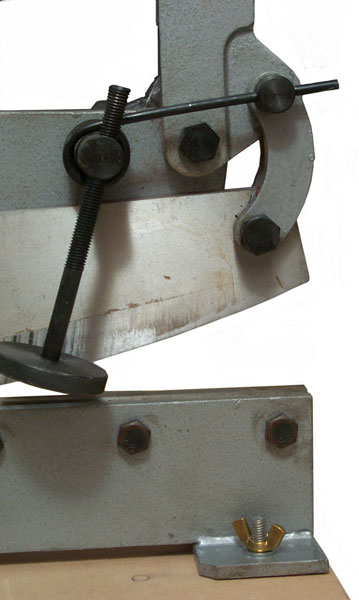
The "Wheel" shown in
Fig 1 can be adjusted up
and down and is there to keep a steel plate from lifting when it's
cut. But the wheel is not needed for PCB matgerial.
11 Feb 2010 - I'm now thinking to mount it on my work bench using
the thumb nuts so that it can be moved to the back when not being
used. But will need help to lift it.
I tried to get the shadow of the blade to act as an optical guide
for cutting, but the lamp is too wide of a light source.
Something like a single LED may work. Because of parallax
the apparant position of the PCB needs to be offset a little to
get the cut on top of the 0.006" wide cut lines. If you know
a good way of positioning the PCB
let
me know.
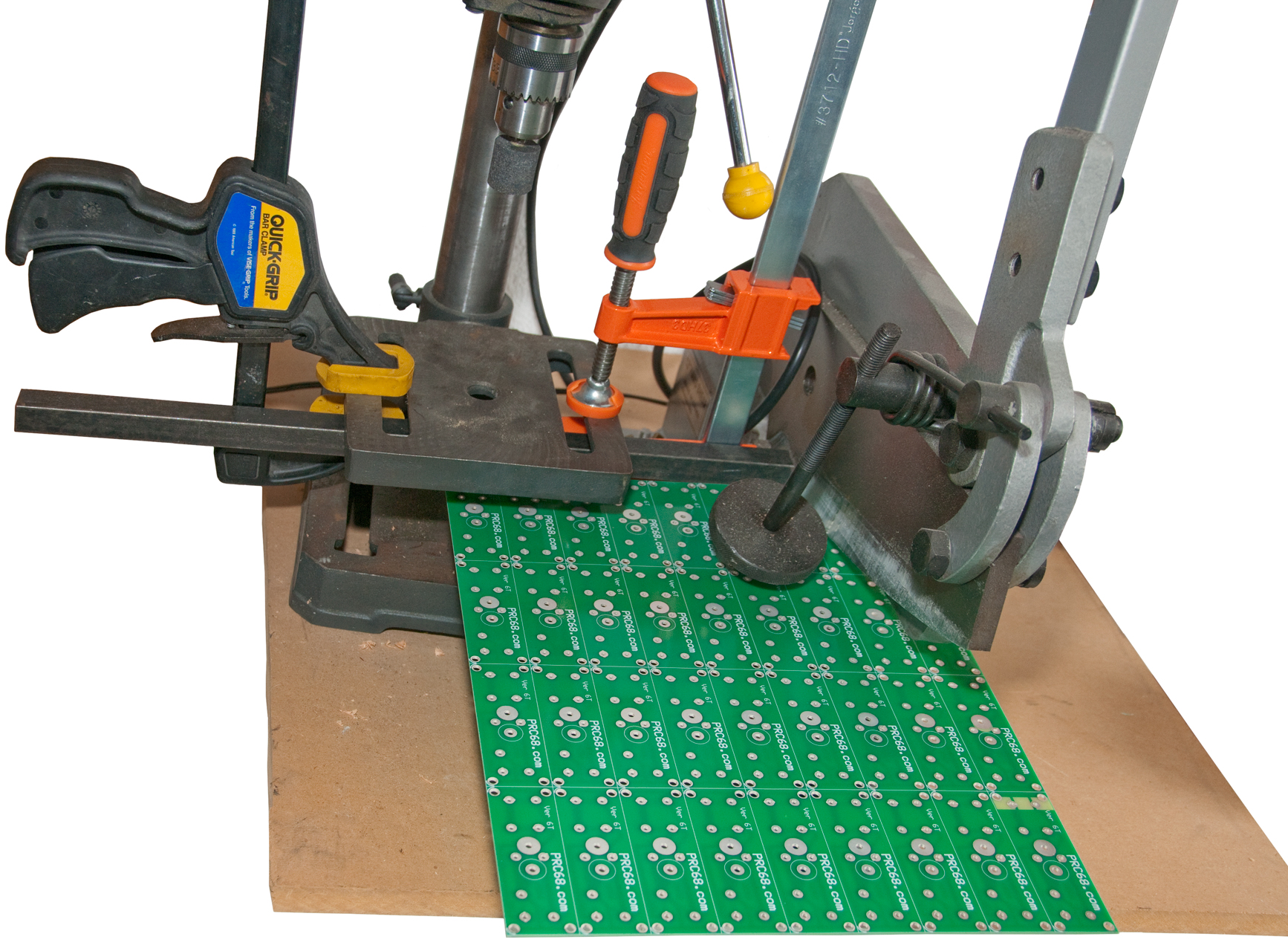
April 2016 - Separating 12" x 14" panel of 68BA battery adapters,
see
Fig 3 above.
Each panel consists of an array of 4 x 9 (26 total) final sized
PCBs. The first round of cuts was to make a cut 12" long
separating the panel into sticks 3.5" x 12".
Note although the shear is named a "12 Inch" model the actual
cutting length is an inch or two short of 12" so in order to cut a
12" long PCB two operations are required.
First, using a piece of angle iron clamped to the bottom of the
drill press table as a guide for a
square cut, the PCB panel was cut about 3/4 of the way (about 9")
then the board was turned 180 degrees for the next cut. But
before making the second cut the board was sprung so that the cut
part of the board can be pushed against the right side of the
lower cutting blade. This has the effect of lining up the
second cut with edge made by the first cut. So it takes two
cuts to get through 12" of board.
It's probably possible to cut a panel 18" by a larger dimension
using this two step process.
The Handle is a little over 34
inches long and the distance between the handle pivot bolt
connecting link top is 2 inches for a 17:1 advantage. If a
PCB is inserted at the back of the shear there is about a 2:1
advantage for a total of 34:1. But even if a PCB is inserted
at the very front it still cuts with very little force on the
handle.
[an error occurred while processing this directive] page created 6 Feb
2006.