This was a page I developed when
looking for a chucker lathe. Prior to screw machines,
chuckers were the best way of making the same part over and over
again. They have a hollow shaft holding the head stock and
it's fitted with a collet system. The "5C" was the one our
shop had at
Aertech. In the
shop there was a hand made plywood board about chest high and
slopped back so that it was easy to read the printing on the face
of all the collets that were held by round holes. Maybe 50
to 100 collets. There were stock ones for various diameters
of round stock and for common square and hex stock. In
addition a "blank" collet could have a pocket machined into it's
face to hold a custom shape.
Instead of a tail stock there was the chucker turret. It
held a number of tools and every time the lever was cycled back
and forth either a new tool would be brought up in line with the
collet. The cross slide was also lever operated.
These typically were used for diameters under 3/8" but I didn't
remember the max rod diameter that could be used.
The collet was opened by working the
left lever.
A pneumatic ram or spring or manually the long rod stock was feed
until it hit the stop on the turret. (this part I'm not clear on).
The collet was closed by working the left lever.
The turret was rotated by working it's lever which would bring up
the next tool. Say it was an end drill. There would be
a way to feed the drill into the work piece and a stop would
control how deep it went. It might be hand fed for a small
diameter or lever fed for a bigger drill.
The turret was rotated again to bring up the next tool. Say
it was a tap, the operation would proceed as the prior step.
The turret was rotated again to bring up the next tool. Say
it was to turn a specified diameter. This could be done be
feeding the tool from the end using a lever.
The cross slide might have tools on both the front and rear that
could be brought up to a stop with a lever.
The turret was rotated again to bring up the next tool. Say a
different diameter was needed closer to the collet. so the
work piece may need to be moved forward so the tool would be a
stop in a new location. The collet lever on the left would
be opened and after the work piece moved closed. The turret
cycled and the new cutter used.
The turret was rotated again to bring up the next
tool. Say it was a cutoff tool which could be fed
using a lever.
You can see that these are no skill type operations, it's all
cycling levers to stops. The dimensions are controlled by
machine setup. A skilled machinist is not needed.
I don't have a feel how hard the setup is on a chucker compared to
a modern CNC type lathe. So can't comment on their viability
today. But in the days prior to screw machines they were the
way to go.
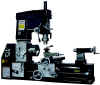
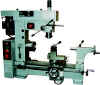
The Enco
Turn-Pro
Second Operatin lathe looks exactly like the Hardinge
chucker. Better photo in their online catalog
page
419.
Optional:
Vertical
Cut-off Slide
567549
Taper-turning machine, A. Petereit, 1896-09-08, - this is a
chucker type setup
HSL
Five-Nine Speed Lathe
1-1/16" bar capacity 5C collet spindle, 3,000-rpm spindle drive,
6" chuck
capacity, 9" swing. Wide range of attachments and pedestal
available.
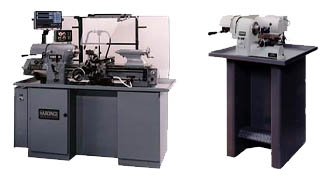

HLV-H manual toolroom lathe
1-1/16" bar capacity 5C collet spindle, 125 to 3,000-rpm spindle
drive, 6"
chuck
capacity, 11" swing, 18" center distance and inch dials. Comes
with
an
inch gearbox which allows a thread range of 11 to 108".
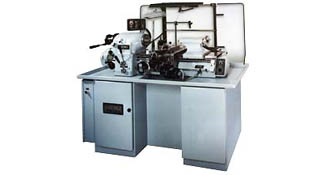
Hardinge HC-T Chucker
Hardinge
CNC chucker, Bandit II control 8 position turret $5,000