Annotated Atheist Reading List
© Brooke Clarke 2009 - 2022
Background
Important Books & Videos
Books Read
The Demon-Haunted World:
Science as a Candle in the Dark by Carl Sagan
The God Delusion by Richard
Dawkins
The Greatest Show on Earth:
The Evidence for Evolution by Richard Dawkins - Tree
of Life
The Blind Watchmaker: Why the
Evidence of Evolution Reveals a Universe without Design by Richard
Dawkins
Society without God: What the Least
Religious Nations Can Tell Us About Contentment by Phil Zuckerman
Letter to a Christian
Nation by Sam Harris
The End of Faith: Religion,
Terror, and the Future of Reason by Sam
Harris
The Moral
Landscape: How Science Can Determine Human Values by Sam Harris
God Is Not Great: How Religion Poisons Everything
by Christopher Hitchens
Breaking the Spell by Daniel
C. Dennett
The Ethical Brain by Michael
S. Gazzaniga
Denialism: How Irrational
Thinking Hinders Scientific Progress, Harms the Planet, and
Threatens Our Lives by Michael Specter
the blank slate: The
Modern Denial of Human Nature by Steven Pinker
Trick or Treatment: The
undeniable Facts about Alternative Medicine by Simon
Singh & Edzrd Ernst MD
The Post American World by
Fareed Zakaria
Bonk: The Curious Coupling of
Science and Sex by Mary Roach
Surely You're Joking, Mr.
Feynman! (Adventures of a Curious Character) by Richard P.
Feynman
The Pleasure of Finding Things
Out by Richard P. Feynman
What Do You Care What Other
People Think?: Further Adventures of a Curious Character by
Richard P. Feynman
Idiot America: How
Stupidity Became a Virtue in the Land of the Free by Charles P. Pierce
Muslim Mafia:
Inside the Secret Underworld That's Conspiring to Islamize America
by P.D. Gaubatz & P. Sperry
The Road to Serfdom, by F.A.
Hayek
Monetary Regimes and Inflation: History,
Economic and Political Relationships by Peter Bernholz
Dereliction of Duty: Lyndon Johnson, Robert
McNamara, The Joint Chiefs of Staff, and the Lies That Led To
Vietnam by H.R. McMaster
The Girl with Dragon Tattoo
by Stieg Larsson
The Girl Who Played with Fire by Stieg Larsson
The Girl Who Kicked the Hornets Nest by Stieg
Larsson
The Hydrogen Economy by Jeremy
Rifkin
The Empathic Civilization: The
Race to Global Consciousness in a World in Crisis by: Jeremy
Rifkin
Blackwater: The rise of
the world's most powerful mercenary army by Jeremy Scahill
The United States of America
Has Gone Mad
God and his Demons, Michael
Parenti
What the Dog Saw: And Other
Adventures - Malcolm Gladwell
Outliers: The Story of
Success - Malcolm Gladwell
Freakonomics: A Rogue
Economist Explores the Hidden Side of Everything (P.S.) -
Steven D. Levitt
Super Freakonomics Illustrated -
The Men Who Stare at Goats,
Jon Ronson
Them: Adventures with Extremists,
Jon Ronson
Why People Believe Weird Things,
Michael Shermer
Love & Survival: The
scientific basis for the healing power of intimiacy, Dean
Ornish
Kitchen Table Wisdom: Stories
That Heal by Rachel Naomi Remen
The Great controversy by E.G.
White ISBN 978-0-8163-1612-0
Sex at Dawn: The Prehistoric
Origins of Modern Sexuality
Spent! by Geoffrey F.
Miller
The Mating Mind by Geoffrey
F. Miller
The Grand Design by Steven Hawking
The Great Derangment by Matt
Taibbi
DVDs Watched
Now Reading
Atheist Manifesto: The Case
Against Christianity, Judaism, and Islam by Michel Onfray
To Be Read
On Order
To Be Ordered
Intelligence Squared Debates
People
My
Great Men Idea
A.J. Jacobs
June Cohen - book list for TED
Pat Condell - list of videos
Steven Pinker
Eva Vertes
William Li
Thomas Friedman
Bob Hazen
Robert Sapolsky (Class lecture at Stanford) - a very strong
connection between OCD & religious ritual, Schizotypal and
superstitious beliefs, etc.
Dr. Robert
Sapolsky's lecture about Biological Underpinnings of
Religiosity (1:22:46)
1/6 -
Biological underpinnings of religiosity. mal adaptive
trait/advantage:
Sickle-cell disease/protection
from Malaria,
Tay–Sachs disease/resistant
to Tuberculosis,
Cystic fibrosis/protection
against Cholera, Schizophrenia/Schizotypal (loos associations,
social withdrawal, meta magical thinking (
Wiki)
,
...
Blog
about this lecture,
Why
Sapolsky’s Take on Schizotypal Personality Disorder and Religion
is Problematic
2/6 -
Gallop poll of Americans: 25% believe in ghosts, 36% mental
telepathy, 47% UFOs, >50% Devil. Newer irrationality:
crystals & channeling, Older irrationality: Voices from
burning bushes, conversations with dead people.
"Schizotypalism runs through all human history." Bad timing:
Wako. Tx, Jim Jones, Charles Manson all highly meta magical
thinking (Schizotypal).
3/6 -
Religion as daily practice of ritual. OCD (Cleanliness,
Food, Enter & Leave buildings, numbers)/Religious Ritual
(Cleanliness, Food, Enter & Leave buildings, numbers).
Hindu
Brahmin (6 hr/day cleansing, rules for entering/leaving temple,
number of breaths, repetitions of prayers)
4/6 -
Judaism (many rules relating to food, dress, prayer shawl &
numerology, 365 (prohibitions) + 248 (must be done daily) = 613,
the numbers survive but not the things they represent.
Christianity (counting rosaries, number of times saying prayers,
rules for entering & leaving church, Lutheran prayers for even
and odd years,
Hindu:
need to repeat the Gayatri Mantra means you can make a living
doing only that.
5/6 -
Xenocide by
Orson Scott Card
who wrote Ender's Game... about a virus that causes OCD to
pacify the population of a planet.
Martin
Luther: "the more I wash the dirtier I get" and OCD marker
also confessing for many hrs/day.
Pigeons
given random feeding inputs develop superstitious belief (Wiki:
Skinner)
are prayers answered because the person asking did something
wrong.
6/6 -
Temporal Lobe Epilepsy - some have Temporal Lobe Personality (
Wiki)
classic patient saint Paul from the Bible.
“Leashed to Your Pussy:
Toxoplasma gondii and Mind Control” by
Patrick House - an interesting
tie between agriculture, rodents and cats - religion
How
Your Cat Is Making You Crazy by
Kathleen McAuliffe article
referencing a number of investigators including Sapolsky.
Have Fun
Related
Links
Background
It's becoming clear that the U.S. is
being severely damaged by it's religious population.
It used to be that the religious people claimed that without
religion the world would be much worse off, but the opposite is
the case. This is made clear in the newer books related to
Atheism, most of which have been written post 9/11. I see
this as a positive benefit of the events of 9/11.
This is a part of a larger problem of people believing in what
amounts to nonsense. For example see the listing at:
http://www.prc68.com/I/Faradic.shtml#Quackery
A Knock on the Door - Jehovah's Witnesses
Jan 2010 - On the front porch were
a couple of men in suits, one of them carrying a book with a
black cover. I invited them in and they said more people
were in the car so I ask that they also come in. The four
men and myself talked for over an hour. They were
Jehovah's Witnesses (
Wiki).
It turns out that they do NOT believe in evolution, but instead
intelligent design. They also:
- Do not vote
- Do not accept blood transfusions
- Do not celebrate holidays
- Do not have anything to do with war
- Believe in Armageddon. ( incorrectly forecast Armageddon
for the years: 1914, 1925 and 1975)
They gave me a free copy of Awake! which I've
read. It has a number of misrepresented "facts". One
of them relates to William Paley (
Wiki)
who was the author of the Watchmaker Analogy (
Wiki)
in 1802. Darwin published his theory of evolution in
1838. After reading the Paley article in Awake! I see why
Dawkins titled one of his books
The Blind Watchmaker: Why the Evidence of Evolution
Reveals a Universe without Design and so now have it on
order along with
The Greatest
Show on Earth: The Evidence for Evolution.
I asked that they come back in a month so I could do my homework
on evolution.
Policy on child abuse
"In the
organization, you have to have two witnesses, and of
course it's almost impossible to have two witnesses to a
child molestation. So if a parent comes with their
daughter to the elder, they ask and he says, no, I didn't
do it, then that's the end of the matter. I would like to
see them recognize it, take it to the civil authorities
and professionals that are capable and qualified to help
the victims." Joe Anderson, former Jehovah's Witness
elder.
Policy on Blood Transfusions
"One of the most controversial practices by Jehovah's
Witnesses is the ban on all types of blood transfusions-even
if they are meant to save a life."
Policy on Evolution
The validity of a literal interpretation of the
Genesis
creation story and rejection of the theory of evolution
Policy on Sex
Pretty much aginst everything that's not missionary position
between married couples.
Another Knock on the Door -Seventh Day
Adventist
March 2011 - A young woman (Seventh Day Adventist (
Wiki))
knocked on the door. She was by herself (usually religious
proselytizers come as pairs or more. She had a number of soft
cover publications. We talked for some time and she left
me with "The Great Controversy" (
see below)
and a small pamphlet "Signs of the Times"
Policy on Women Pastors
The
North American Division (NAD) of the
Seventh-day Adventist Church proposed to the 1995
General Conference in Utrecht, Netherlands that each World
Division be allowed to decide independently whether to ordain
women to the pastorate. The proposal was defeated by a vote of
1481 to 673.
Policy on End Times
Jesus' return: The second coming of Christ is imminent.
Believers should be ready at all times to be
removed
from earth to be with God in heaven. Others will be
exterminated by Christ during what will be the most massive
genocide
in history. Righteous Christians who had previously died will
be resurrected at that time and taken to heaven.
Policy on Alcohol, tobacco, bad habits
Diet: Members are expected to abstain from alcohol,
tobacco, and every other
"soul-defiling habit".
Policy on Evolution
Evolution: The Seventh-day Adventist church has been
quite active in the promotion of Creation Science in
opposition to the
theory
of evolution.
Policy on Sex
Pretty much against everything that's not missionary position
between married couples.
Third Knock on the Door - Jehovah's
Witnesses
Two young women with Jehovah's Witnesses (
Wiki).
Both women knew about Constantine's Sword and neither of them
was wearing a cross, they got it that it would be like wearing a
miniature sniper rifle for Jackie Kennedy.
They did not want to discuss my ideas, and left shortly after
leaving (These are both 32 page booklets):
"The Watchtower" (
Wiki)Apr
1,
2011 - ... the good news that God's Kingdom, which is a real
government in heaven, will soon bring an end to all wickedness
and transform the earth into a paradise.
"Awake!" (
Wiki)
April 2011. - End times are near.
Interfaith Gathering for Peace
This was a meetingon 15 Jan 2011 in a local church that was a
part of a larger movement sponsered by the
Winter Feast for
the Soul. I listened on the radio and then went to
the meeting, but was no allowed to speak, although another man
who showed up was allowed to. The reason is that I wanted
to talk about religion as being the problem.
The subtitle of the meeting, as shown on the
founding
web page is "Is Faith a vehicle for Eternal Peace or the
cause of endless war?".
Skepticism101 -
Welcome
(with Google custom search box)-
syllabi
- each pdf document is filled with great information including
links, books, etc.
Note: The table of contents is on the left of all the
pages.
Important Books & Videos
Feb 2012 - adding this
section. Most of these came out of my political readings (
http://www.end2partygovernment.com/index0811.html)
Books
Sex at Dawn: The Prehistoric Origins of Modern
Sexuality - this book is about a lot more than it's key idea
that humans are not monogamous by nature.
With Liberty and Justice for Some by Glenn Greenwald
The Authoritarians (published as a
free
on line book) - This is a concept that goes beyond religion
and looks at a deeper personal world view
That reminds me of the
idea of overlapping disciplines. It's not uncommon
that when studying one thing something I've learned
somewhere else shows up.
That was the case when I was watching the TED
Talk: Richard
Wilkinson: How economic inequality harms societies
http://www.ted.com/talks/richard_wilkinson.html
I noticed that on some of his slides there was a group
of countries that included Denmark. This was the
"good" end. He makes the claim that the "bad" end
corresponds to countries with high income inequality,
but because I'd read the book Society
without God: What the Least Religious Nations Can Tell
Us About Contentment by Phil Zuckerman, I knew
that the "good" end corresponded to countries that were
non religious.
Combine that with "The Authoritarians" and there's a new
metric. To test that I checked some on line data
and found this:
|
Authoritarian |
Inequality |
|
R*R |
R*R |
| Life
Expectancy |
0.52 |
0.26 |
| Obesity |
0.49 |
0.01 |
| Infant
Mortality |
0.40 |
0.27 |
| Hi School Grad |
0.40 |
0.30 |
| Teen Birth Rate |
0.37 |
0.21 |
| Murder |
0.25 |
0.32 |
| Abortion |
0.07 |
0.31 |
| Suicide |
0.00 |
0.28 |
| Prisoners |
0.25 |
0.12 |
Unemployment
|
0.22 |
0.20 |
Army Recruiting
|
0.03 |
0.15 |
| Economic Growth |
0.07 |
0.00 |
| Rape |
0.03 |
0.04 |
As a proxy for Authoritarian I use the percentage of a
state that is Evangelical Christian, income inequality
by state is available. Notice that Life
Expectancy, Obesity, Infant Mortality, High School
Graduation rate, Teen Birth Rate have a higher
correlation with authoritarianism than with income
inequality. The rest of the items do not seem to
correlate with either variable. I've emailed Richard Wilkinson
who claims that income equality is more fundamental,
but he can't explain why Evangelical Christian
(authoritarianism) has a higher correlation.
The procedure was for each dependent variable (Life
Expectancy for example) two plots were made, one vs.
percent Evangelical Christian and the other
vs. an income inequality metric. Then a straight
line was fitted to the data and the value of R squared
was compared for the two lines.
Rather than using just Evangelical Christian as a proxy
for authoritarianism, it would be better to come up with
a combination of factors using something like multiple
regression that was based on the authoritarian
test. This is an exercise for someone with a much
better knowledge of statistics than I have.
|
Videos
2014 -
TAM2014 -
Daniel Dennett - Can Churches Survive the New Transparency?
- this video he seems to be marking the end of religion and
the beginning of figuring out how to continue the good things that
churches do, only without the religion.
Sean
Carroll - "From Particles to People" - TAM 2012 - book
promotion, but also interesting in that woo-woo ideas now have no
physical basis because of physics because they are at person size
scale where physics is now a closed system with no unknown
mechanisms.
Sean
Carroll - The Particle at the End of the Universe 2013
-
Human scale particle Physics is closed, but cosmological
particle physics is still very much in the learning phase.
God
is not a Good Theory (Sean Carroll) - 2013 -
interesting in that predictions based on using God are falsefied
by experimental observations. For example if the Solar
System was made to allow for man then the rest of the Milky Galaxy
would have no purpose, or if the Galaxy was made just for man then
all the other galaxies would have no purpose, plus a number of
similar arguments.
Hijacking Catastrophe: 9/11, Fear & the Selling of American
Empire - an excellent account of what went on.
Constructing Public Opinion: How
Politicians and the Media Misrepresent the Public a
documentary by
Media
Education Fund
Wiki Pages
Catholic
Church and the Age of Discovery - Age of
Discovery - Discovery
doctrine - Romanus
Pontifex 1455 - Along with
encouraging the seizure of the lands of Saracen Turks and pagans,
it repeated the earlier bull's permission for the
enslavement of such
peoples. The bull's primary purpose was to forbid other Christian
nations from infringing the King of Portugal's rights of trade and
colonization in these regions.
Books Read
The Demon-Haunted World: Science as a Candle
in the Dark by Carl Sagan, ( , Wiki
book,
author)
Hardcover: Random House; Later
Printing edition January 1, 1995
Paperback: Ballantine Books, February 25, 1997
ISBN-13:
978-0345409461
Carl Sagan (
Wiki
Carl) "(November 9, 1934 – December 20, 1996) was an
American astronomer,
astrochemist, author, and highly
successful
popularizer
of
astronomy,
astrophysics and other
natural sciences. He pioneered
exobiology and promoted the
Search
for Extra-Terrestrial Intelligence (SETI).
This is the first book that's easy to read and makes a logical
case for atheism that I found.
Wiki: "He is world-famous for writing popular science books and for
co-writing and presenting the award-winning 1980 television
series Cosmos: A Personal
Voyage, which has been seen by more than 500
million people in over 60 countries.[2]
A book to accompany the program was
also published. He also wrote the novel Contact, the basis for
the 1997 film of the same name. One of the
last books he wrote was Pale Blue Dot. During
his lifetime, Sagan published more than 600 scientific papers
and popular articles and was author, co-author, or editor of
more than 20 books. In his works, he frequently advocated skeptical inquiry, secular humanism, and the scientific method."
May 27, 1996 on Charlie Rose Show -
Part 1,
We live in an age based on science and technology with
formidable technological powers. ... There's no more
than a handful of members of congress with any background in
science at all. The Republican congress has just abolished
it's own Office of Technology Assessment. ... CR: What's
the danger of all this?
There's two kinds of danger, 1) One is what I just talked
about. We've arranged this society based on science and
technology in which nobody understands anything about science
and technology. And this combustible mixture of
ignorance and power are sooner or later is going to blow up in
our faces. . . . 2) And the second reason that I'm
worried about this is that science is more than a body of
knowledge, it's a way of thinking. A way of skeptically
interrogating the universe, with a fine understanding of human
fallibility. If we are not able to ask skeptical
questions, to interrogate those who tell us that something is
true, to be skeptical of those in authority, then we're up for
grabs for the next charlatan, political or religious, who
comes along.
CR: There are millions of people that understand that science
does not prove religion because religion is faith based and
therefore you should not deny the value of it because it is
faith based and not scientific.
Let's look a little more deeply into that. What is
faith, it's belief in the absence of evidence. I don't
propose to tell anybody what to believe, but for me believing
when there's no compelling evidence is a mistake. The
idea is to withhold belief until there's compelling
evidence. .... Where religion gets into trouble is in
those cases where it pretends to know something about
science. The science in the Bible for example was
acquired from the Jews by the Babylonians during the Babylon
captivity of 600 BC. That was the best science on the
planet then, but we've learned something since then.
Roman Catholicism, reformed Judaism, most of the mainstream
Protestant denominations have no difficulty with the idea that
humans have evolved from other creatures, that the Earth is
4.6 billion years old, the big bang. They don't have any
trouble with that. The trouble comes with people who are
biblical literalistists who believe that the bible is dictated
by the creator of the universe to an unerring stenographer and
has no metaphor or allegory in it. ...
Part 2,
CR: You seem to say it's growing, this pseudo science.
...
CS: The problem is that today the technology has reached
formidable, maybe even awesome, proportions and so the dangers
of thinking this way are larger. Not that this is a new
kind of thing.
The God Delusion by Richard Dawkins (his web page) (WiKi
on Richard)
Hardcover:
Paperback: Mariner Books; Reprint edition (January 16, 2008)
ISBN-13: 978-0618918249
Richard sets out to make a case for atheism in this book but
does not include the arguments for Evolution here. By
using evolution Richard explains the development of complex life
forms.
This book was very well received, prompting two books written to
try and refute Richard's arguments, they are:
God is No Delusion: A Refutation
of Richard Dawkins by Thomas Crean (Paperback - Oct 31, 2007)
and
The Dawkins Delusion?: Atheist Fundamentalism and the Denial
of the Divine by Alister E. McGrath and Joanna Collicutt
Mcgrath (Hardcover - Jun 8, 2007)
There is an hour and 10 minute where Dawkins and McGrath
"debate" the issues, but in many cases McGrath will not answer
Richard's questions.
" And I thought and thought and
thought. But I just didn't have enough to go on, so I
didn't really come to any resolution. I was extremely
doubtful about the idea of god, but I just didn't know enough
about anything to have a good working model of any other
explanation for, well lift, the universe, and everything to
put in its place. But I kept at it, and I kept reading
and I kept thinking. Sometime around my early thirties I
stumbled upon Evolutionary biology, particularly in the form
of Richard Dawking's books The Selfish Game and then The
Blind Watchmaker, and suddenly (on, I think the second reading
of The Selfish Gene) it all fell into place. It was a
concept of such stunning simplicity, but it gave rise,
neutrally, to all of the infinite and baffling complexity of
life. The awe it inspired in me made the awe that people
talk about in respect of religious experience seem, frankly,
silly beside it. I'd take the awe of understanding, over
the awe of ignorance any day." Douglas Adams (pg 116)
Six Numbered Points: (pg 157, 158)
- One of the greatest challenges to the human intellect,
over the centuries, has been to explain how the complex,
improbable appearance of the design in the universe arises.
- The natural temptation is to attribute the appearance of
design to actual design itself. In the case of a
man-made artifact such as a watch, the designer really was
an intelligent engineer. It is tempting to apply the
same logic to the eye or wing, a spider or a person.
- The temptation is a false one, because the designer
hypothesis immediately raises the larger problem is who
designed the designer. The whole problem we started
out with was the problem of explaining statistical
improbability. It is obviously no solution to
postulate something even more improbable. We need a
"crane", not a "skyhook", for only a crane can do the
business of working up gradually and plausibly from
simplicity to otherwise improbably complexity.
- The most ingenious and powerful crane so far discovered is
Darwinian evolution by natural selection. Darwin and
his successors have shown how living creatures, with their
spectacular statistical improbability and appearance of
design, have evolved by slow, gradual degrees from simple
beginnings. We can now safely say that the illusion of
design in living creatures is just that - an illusion.
- We don't yet have an equivalent crane for physics.
Some kind of multiverse theory could in principle do for
physics the same explanatory work as Darwinism does for
biology. This kind of explanation is superficially
less satisfying that the biological version of Darwinism,
because ti makes heavier demands on luck. But the
anthropic principle entitles us to postulate for more luck
than our limited human intuition is comfortable with.
- We should not give up hope of a better crane arising in
the physics, something as powerful as Darwinism is for
biology. But even in the absence of a strongly
satisfying crane to match the biological one, the relatively
weak cranes we have at present are, when abetted by the
anthropic principle, self-evidently better than the
self-defeating skyhook hypothesis of an intelligent
designer.
"Religion has actually convinced people that there's an
invisible man - living in the sky - who watches everything you
do, every minute of every day. And the invisible man has a
special list of ten things, he has not want you to do. And
if you do any of these ten things, he has a special place, full
of fire and smoke and burning and torture and anguish, where he
will send you to live and suffer and burn and choke and scream
and cry forever and ever 'til the end of time . . . But He
lover you!" ... George Carlin (pg 279)
"Fundamentalist religion is hell-bent on ruining the scientific
education of countless thousands of innocent, well-meaning,
eager young minds. Non-fundamentalist, 'sensible' religion
may not be doing that. But it is making the world safe for
fundamentalism by teaching children, from their earliest years,
that unquestioning faith is a virtue." (pg 286)
"Our Western politicians avoid mentioning the R word (religion),
and instead characterize their battle as a war against 'terror',
as though terror were a kind of spirit or force, with a will and
a mind of it's own. Or they characterize terrorists
as motivated by pure 'evil'. But they are not motivated by
evil. However misguided we may think them, they are
motivated, like the Christian murders of abortion doctors, by
what they perceive to be righteousness, faithfully pursuing what
their religion tells them. They are not psychotic, they
are religious idealists who, by their own lights, are
rational. They perceive their acts to be good, not because
of some warped personal idiosyncrasy, and not because they have
been possessed by Satan, but because they have been brought up,
from the cradle, to have total and unquestioning faith."
(pg 304)
Appendix
USA
American Atheists -
"...the premier organization laboring for the civil liberties of
Atheists, and the total, absolute separation of government and
religion."
American Humanist
Association - "Humanism is a progressive philosophy of
life that, without theism and other supernatural beliefs,
affirms our ability and responsibility to lead ethical lives of
personal fulfillment that aspire to the greater good of
humanity."
The Brights' Net -
"Persons who have a naturalistic worldview should be accepted as
fellow citizens and full participants in the cultural and
political landscape, and not be culturally stifled or civically
marginalized due to society’s extensive supernaturalism."
Council for Secular
Humanism - "...advocate and defend a nonreligious
lifestance rooted in science, naturalistic philosophy, and
humanist ethics and to serve and support adherents of that
lifestance."
Freedom From Religion Foundation
- "...an educational group working for the separation of state
and church."
Institute for Humanist
Studies - "...we view humanism as having the moral
imperative to extend the circle of justice, caring and concern
to all. "
James Randi Educational
Foundation - "...to promote critical thinking by reaching
out to the public and media with reliable information about
paranormal and supernatural ideas so widespread in our society
today. "
Secular Coalition for America
- "...purpose is to amplify the diverse and growing voice of the
non-theistic community in the United States."
Secular Student
Alliance - "...purpose is to educate high school and
college students around the country about the value of
scientific reason and the intellectual basis of secularism in
its atheistic and humanistic manifestations."
Skeptic - "...is
a scientific and educational organization of scholars,
scientists, historians, magicians, professors and teachers, and
anyone curious about controversial ideas, extraordinary claims,
revolutionary ideas, and the promotion of science."
Society for Humanistic Judaism
"Humanistic Judaism offers a nontheistic alternative in
contemporary Jewish life."
UK
British Humanist
Association - "...
exists to promote Humanism
and support and represent people who seek to live good lives
without religious or superstitious beliefs.
International Humanist and Ethical
Union - "...the sole world umbrella organization embracing
Humanist, atheist,
rationalist,
secularist,
skeptic,
laique, ethical cultural,
freethought
and similar organizations world-wide."
National Secular Society
- "...the leading campaigning organisation defending
the rights of non-believers from the demands of religious
power-seekers."
New Humanist -
"...magazine of the
Rationalist
Association, promoting reason, debate and free thought
since 1885."
South Place Ethical
Society - "...the study and dissemination of ethical
principles based on humanism and freethought, the cultivation of
a rational and humane way of life, and the advancement of
research and education in all relevant fields."
Canada
Humanist Canada - "To promote
the separation of religion from public policy and foster the
development of reason, compassion and critical thinking for all
Canadians through secular education and community support."
Australia
Australian Skeptics -
umbrella organization for the Humanist societies of Australia
Council
of Australian Humanist Societies
New Zealand
New Zealand Skeptics -
"...are all interested in examining what objective scientific
support there is for claims of such things as psychic abilities,
alternative health practices, creationism and other areas where
science, pseudo-science and shonky science interact."
India
Rationalist International
- "
It aims at representing the
rationalist view where public opinion is formed and making the
voice of reason heard and considered, where decisions are
taken which will shape our future."
Islamic
Apostates of Islam
- "We denounce Islam as a false doctrine of hate and terror."
The Dr. Homa Darabi Foundation
- to promote the Rights of women and children as defined by the
Universal Declaration of the United Nations
Faithfreedom
International "No other cause is responsible for more
deaths than Islam."
Center for Inquiry
- "The mission of the Center for Inquiry is to foster a secular
society based on science, reason, freedom of inquiry, and
humanist values."
'I
Am
Offended!' - Richard Dawkins @ UC Berkeley
The Greatest Show on
Earth: The Evidence for Evolution by Richard Dawkins
hardcover 2009 ISBN 978-1-4165-9478-9
This book was written to present the evidence for evolution but
is a great book for learning about evolution. It's truly
an amazing thing.
On pg 24 is the Hairpin Thought Experiment. The connection
between any living thing can be traced by going back
(de-evolution) in time to some ancestor, then making a hairpin
turn, and then going forward in time (evolution). Note
that there is not a horizontal connection between current
animals.
Tree of Life
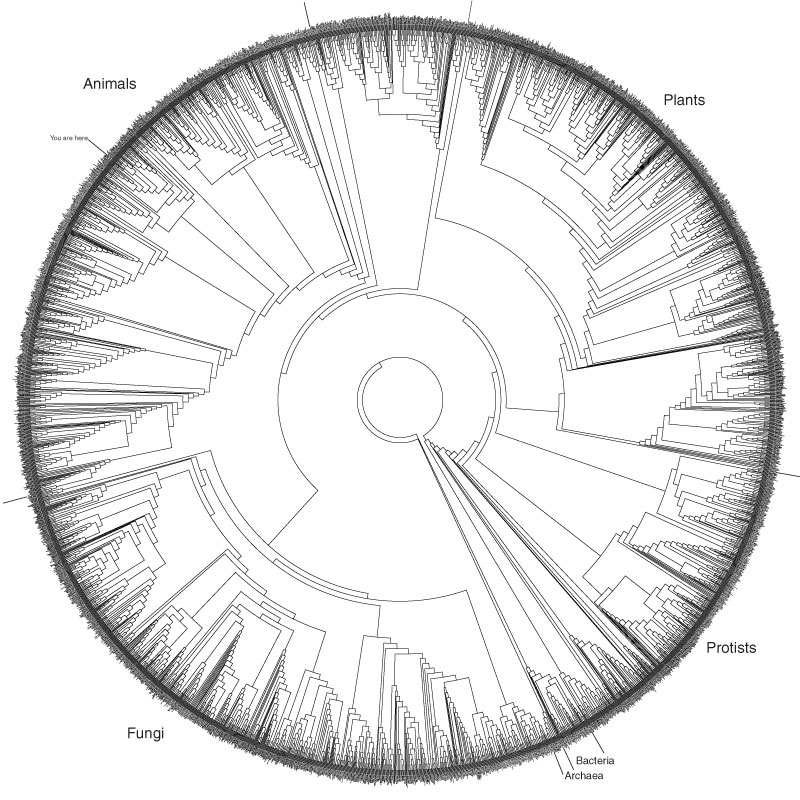
On pg 329 is a small image of the
David M. Hillis, Derrick Zwickl, and Robin Gutell, University of
Texas
Tree
Of Life showing the evolutionary family connections of
animals, plants, Fungi, Protists, Bacteria & Archaea (3,000
species less than 1% of all species shown). Based on RNA
genetic coding. The Just under ANIMALS is a "You are here"
for humans. Note if in Acrobat Page Scaling you select
"Tile All Pages" then 35 sheets will be printed which when
assembled will make a single sheet about 5 feet on a side
allowing you to read the names on the outside edge.
Discover
Life - has a linear version of the Tree of Life
Introduction
to Phylogeny -
Tree of
Life alphabetical with common names
for example: animals - Chordata
(animal phylum) - Vertebrates - Mammals & kin - Mammals -
Placental mammals - Primates - Homo sapiens
PBS -
What
Darwin Never Knew (
Video)
- Dec 2009 Transcript is on line, DVD for sale. Has info
on Chimp jaw muscle size vs. human jaw muscle size and it's
effect on brain cavity size. (that may be the difference between
chimps and humans)
Map of Life - a world
map based on Google Maps that shows where different animals are
The Blind Watchmaker: Why the Evidence of
Evolution Reveals a Universe without Design by Richard
Dawkins
This book
was written to present definitive refutations of the arguments
of creationists. But it also has a chapter about
bats and has a lot about evolution.
Note the title is based on the work of William Paley (see
above). Paley, Dawkins and myself
have a great appreaction of the spendor of life on earth.
It's just that scientific knowledge was primitive in Paley's
time and he got it all wrong.
Society without God: What the Least Religious
Nations Can Tell Us About Contentment by Phil Zuckerman
Hardcover: NYU Press (October 1,
2008) ISBN-13: 978-0814797143
Associate Professor of Sociology
at Pitzer College
Phil spent a year living in Denmark and interviewing people
there. It is the country that has the least theism (most
atheist). It's also a country that is in the top ten
countries for lowest homicide, lowest infant mortality, lowest
rape, highest longevity, most contented population, i.e. a very
good place to live. The point Phil was setting out to make
was that lacking God a society will get along just fine.
But I think he has made the point that when the leaders of a
country believe in God they will make much poorer decisions than
a more rational person so "God Fearing" countries are much worse
off.
The End of Faith:
Religion, Terror, and the Future of Reason by Sam Harris
Sam started this book on the day
after 9/11 and after hearing an audio book version it's clear he
very concerned about how the world can survive if religions
continue as they are. He makes a case that the Holocaust was
caused by Christianity. The Vatican maintained the "blood
libel" story as late as 1914. The church opened it's
genological records to the German Nazis so they could find the
Jews. Not a single German Catholic has ever been
excommunicated, even to this date.
The
Moral Landscape: How Science Can Determine Human Values
by Sam Harris
His idea is that morality is
related to maximizing happiness and minimizing suffering of
conscious creatures which includes humans and a few of the great
apes.
9 Sep 2011: a message
sent to Sam Harris:
Hi Sam:
I have all your books in my bookcase along with others by
Dawkins, Dent, Hitchens, etc. and fully get what you are
saying. BUT . . .
I think you have missed the larger picture. The KEY
reason for the attacks on 9/11 is the same as the reason
for "Insurgents" and "freedom fighters". When you
are attacked by a superior adversary you fight back in any
way you can.
Imagine that the U.S. did not have a massive army and we
were invaded by a country that had a far superior
military. The invaders did not respect the popular
and majority atheist concept. There were soldiers
with loaded guns breaking down doors and every day killing
people called collateral damage.
Imaging this had been going on for decades and the same
super power that was invading our country was also
invading Denmark and other atheist countries.
If you, as an atheist, had the chance would you consider
fighting back by flying one of their airliners into one of
their buildings? |
Letter to a Christian Nation by Sam
Harris (Sam Harris web page)
Paperback: Vintage Books,
Jan 2008, ISBN-13: 978-0307278777
Sam has written the book as a letter to a Christian. He
uses the technique of giving an example in another religion and
then pointing out that the same argument applies to
Christianity.
"The same Gallup poll revealed that 53 percent of Americans are
actually creationists."
(pg x)
Among developed nations, America
stands alone in these convictions. Our country now
appears, as at no other time in her history, like a lumbering,
bellicose, dim-witted giant. Anyone who cares about the
fate of civilization would do well to recognize that the
combination of great power and great stupidity is simply
terrifying, even to one's friends." (pg xi) (BC:
added larger font and bold)
Countries where religion is almost non existent are: Norway,
Iceland, Australia, Canada, Sweden, Switzerland, Belgium, Japan,
the Netherlands, Denmark and the United Kingdom (pg 43).
"In 2005, a survey was conducted in thirty-four countries
(BC: there are 206 in the world) measuring the percentage of
adults who accept evolution. The United States ranked
thirty-third, just above Turkey." (pg 70).
Religion is the basis of most conflict in the world (pg 81).
Palestine: Jews vs. Muslims
Balkans: Orthodox Serbs vs. Catholic Croatians; Orthodox Serbs
vs. Bosnian & Albanian Muslims
Northern Ireland: Protestants vs. Catholics
Kashmir: Muslims vs. Hindus
Sudan: Muslims vs. Christians & animists
Nigeria: Muslims vs. Christians
Ethiopia and Eritrea: Muslims vs. Christians
Ivory Coast: Muslims vs. Christians
Sri Lanka: Sinhalese Buddhists vs. Tamil Hindus
Philippines: Muslims vs. Christians
Iran and Iraq: Shiite vs. Sunni Muslims
the Caucasus: Orthodox Russians vs. Chechen Muslims; Muslim
Azerbaijanis vs. Catholic and Orthodox Armenians
"The idea that Islam is a "peaceful religion hijacked by
extremists" is a fantasy, and it is now a particularly dangerous
fantasy for Muslims to indulge." (pg 85)
Sam Harris, The View from the End of the World, SALT talk at
Google (1:22:32) Longnow.org - explains the problems of
religious moderation
"We have a choice between conversation or violence. Faith
is a conversation stopper." To make religious war
unthinkable, like slavery and cannibalism, we have to undermine
the dogma of faith.
A Conversation with Sam Harris (1:29:52)- The goal is to spread
secular thinking and scientific knowledge in society. (after
"End of Faith" was published)
God Is
Not Great: How Religion Poisons Everything by
Christopher Hitchens
Hardcover: Hachette Book Group
(2008) ASIN: B002C4ZU6Q
Wiki:
book,
author
- "Hitchens contends that organized religion is "violent,
irrational, intolerant, allied to
racism,
tribalism, and
bigotry,
invested in
ignorance and hostile to
free inquiry, contemptuous of women
and
coercive toward children", and that
accordingly it "ought to have a great deal on its conscience."
Hitchens supports his position with a mixture of personal
stories, documented historical anecdotes and critical analysis
of religious texts. His commentary focuses mainly on the
Abrahamic
religions, although he also touches on other religions
such as
Hinduism and
Buddhism.
Hitchens points out the dangers of religion ("ethic cleansing")
and shows many flaws in the various versions of the bible.
He makes the case that the bible was written by humans in the
middle east and nowhere in it is there a mention of other parts
of the world like Australia. Hitchens is harder to read
than some of the other writers because he uses a vocabulary
larger than mine.
Chapter 15 "Religion as an Original Sin" (pg 205) starts :
"There are, indeed, several ways in which religion is not just
amoral, but positively immoral. And these faults and
crimes are not in the behavior of its adherents (which can
sometimes be exemplary) but in its original precepts.
These include:
- Presenting a false picture of the world to the innocent
and the credulous
- The doctrine of blood sacrifice
- The doctrine of atonement
- The doctrine of eternal reward and/or punishment
- The impossible of impossible tasks and rules."
The rest of chapter 15 develops the last four points, the first
being already covered in prior chapters.
page 239: "Four days after his election (Feb 1939) by the
College of Cardinals, His Holiness (Pope Pius XII) composed the
following letter to Berlin:
To the Illustrious Herr Adolf
Hitler, Fuhrer and Chancellor of the German Reich! Here
at the beginning of Our Pontificate We wish to assure you that
We remain devoted to the spiritual welfare of the German
people entrusted to y our leadership.... During the many years
We spent in Germany, We did all in Our power to establish
harmonious relations between Church and State. Now that
the responsibilities of Our pastoral function have increased
Our opportunities, how much more ardently do We pray to reach
that goal. May the prosperity of the German people and
their progress in every domain come, with God's help, to
fruition!"
page 251: "The connection between religion, racism, and
totalitarianism is also to be found in the other most hateful
dictatorship of the twentieth century: the vile system of
apartheid in South Africa."
Christopher Hitchens Challenge
"First, name me an
ethical statement made or an action performed by a
believer that could not have been made or performed by a
non-believer....
Second, think of a wicked statement made, or an evil
action performed, precisely because of religious
faith?"
|
The first is very difficult and the second it very easy.
On Poverty
| “The cure for poverty has
a name, in fact. It’s called the empowerment of
women. If you give women some control over the
rate at which they reproduce, if you give them some say,
take them off the animal cycle of reproduction to which
nature and some religious doctrine condemns them, and
then if you throw in a handful of seeds, the floor of
everything in that village, not just poverty, but health
and education, will increase. Try it in Bangladesh and
Bolivia, it works all the time. Name me one religion
that stands for that, or ever has.” |
Hitchens Dictum
What can be asserted without evidence can
also be dismissed without evidence.
|
Poison or Cure? Religious Belief in the Modern World - Video
Authors@Google: Christopher Hitchens
Christopher Hitchens / Bill Maher
Breaking the Spell
by Daniel C. Dennett
Dennet is making the case that
religion needs to be studied (reverse engineered)
scientifically. He also calls himself a "Bright" rather than
use the term atheist. It's similar to people calling
themselves "Gay".
The Ethical Brain by Michael S. Gazzaniga
Chapter 9 "The Believing Brain"
has some ideas on why people believe in religion.
Denialism: How Irrational Thinking
Hinders Scientific Progress, Harms the Planet, and Threatens
Our Lives by
Michael Specter TED
Talks -
Michael Specter: The danger of science denial
Michael Specter's home
page &
Videos
Authors@Google: Michael Specter -
Vaccination, organic food, generically engineered food
This book is about how people deny the truth of the scientific
method by adopting beliefs without any proof.
In 1025 Avicenna (
Wiki)
not only was the father of modern medicine but inductive logic
(replaced the logic of Aristotle) and the basis of the scientific
method. Francis Bacon developed the Baconian Method (
Wiki)
around 1265 which was a step in the History of scientific method (
Wiki).
In 1961 Arthur C. Clarke wrote "any sufficiently advanced
technology is indistinguishable form magic".
Many people confuse correlation with cause and effect.
Some gene sequencing companies that have an internet
business. They are not doing a complete sequence but rather
key hereditary, disease and medicine parts. Michael has his genes
done by all three of them.
http://www.navigenics.com
http://www.decode.com/
https://www.23andme.com/
the blank slate: The Modern Denial of Human Nature
by Steven Pinker
Goes into why we are not born with a "blank slate" and why many
cling to this outmoded idea along with the noble savage.
Trick or
Treatment: The undeniable Facts about Alternative Medicine
by Simon Singh & Edzrd Ernst MD
Uses the scientific method to expose Acupuncture, Homeopathy,
Chiropractic and Herbal medicine as non functional.
Good history about blood letting (killed George Washington) and
Florence Nightingale (use of statistics) (
Wiki)
Also a section "Why do smart people believe odd things?"
The Post American World by
Fareed Zakaria 2009 paperback ISBN 978-0-393-33480-7
The 2009 paperback has a new
preface that talks about the Obama administration. Fareed
has what appears to be a good overview of what it takes for a
country to be The old paradime was capital and labor, the new
one is ideas and energy.
The problem with America is a dysfunctional political system,
i.e. it can not accomplish much in a reasonable time, China can
accomplish a lot in a short time, but is very poor (in terms of
GDP/person).
Richard P. Feynman
Nobel winner in Physics, bongo
player, safe cracker, very intelligent, atheist, etc.
The Quest for Tannu Tuva - Part 1
, Part 2
,
Part 3
,
Part 4,
Part 5
Surely You're Joking, Mr. Feynman!
(Adventures of a Curious Character)
This was my first Feynman book and
the one I like the best. It covers safe cracking, picking
up women at bars and other interesting stories.
The
Pleasure of Finding Things Out: The Best Short Works of
Richard P. Feynman
By the time he was 12 Richard knew
he was an atheist.
Chapter 13 "The Relation of
Science and Religion"
What Do You Care What Other People Think?:
Further Adventures of a Curious Character by Richard P.
Feynman
Has a lot of info on his
investigation of the Space Shuttle Challenger problems (not just
the O-rings).
The Character of Physical Law
(Messenger Lectures, 1964)
DVD
"Infinity" (about Richard P.
Feynman)
TED Talk:
Richard
Feynman:
Physics is fun to imagine
Messenger
Lectures on Physical Law - The first "Law of Gravation"
(and second " Physics and Math" lectures) are highley recomended
for anyone, even if you think you know about gravity!
Mary Roach
also wrote "Stiff" about
cadavers. She's a very interesting woman!
Bonk: The
Curious Coupling of Science and Sex by Mary Roach
Mary has a very interesting curiosity. She also authored
Stiff about cadavers.
Stiff by Mary Roach
TED Talk:
Mary Roach: 10 things you didn't know about
orgasm
Charles P. Pierce
Idiot America: How
Stupidity Became a Virtue in the Land of the Free
This is a very interesting book in
that it has a lot of information about Donnely, the author of
Atlantis which may be the first pseudo-science idea made from
whole cloth.
Muslim Mafia: Inside the
Secret Underworld That's Conspiring to Islamize America
by P.D. Gaubatz & P. Sperry - makes the case that the Council
on American-Islamic Relations (
CAIR)
is a Muslim Terriost organization.
The Road to Serfdom, by F.A. Hayek -
when Socialism (collectivism, central planning) is implemented the
form of government needs to be totalitarian and things like art
need to be suppressed so that there is no dissent.
Monetary Regimes and Inflation: History,
Economic and Political Relationships by Peter Bernholz -
chpater 5.2 Hyperinflation are Caused by Government
Budget Deficits" p71 " The figures demonstrate clearly that
deficits amounting to 40 per cent or more of expenditures cannot
be maintained".
Found this book after reading a
paper by Hayman
Advisors Kyle Bass is managing director - MSNBC talk by Kyle
"
Ahead
of
the Money"
Airtime:
Tues. Aug. 17 2010 | 9:01 AM ET -
near zero interest rates will continue until there's a
restructuring of the economy (
Wiki).
Dereliction of Duty: Lyndon Johnson, Robert
McNamara, The Joint Chief of Staff, and the Lies That Led To
Vietnam by H.R. McMaster - Kennedy installed McNamara to
cut off the joint chiefs. Johnson kept McNamara as his chief
military adviser and ignored the joint chief. But the joint
chief could not come to a consensus because of infighting.
The administration lied to the public and congress and had no
strategic objectives other than LBJ's idea of "killing more
VC". It makes you wonder what we are doing with our military
today on foreign soil, i.e. what's our strategic objective and
how's it being met? If you know
please
tell me.
These were ordered after seeing the movie "The Girl with Dragon
Tat
The
Girl with Dragon Tattoo by Stieg Larsson
The Girl
Who Played with Fire by Stieg Larsson
The Girl
Who Kicked the Hornets Nest by Stieg Larsson
Although the first book could be
read by itself, these are really a single story that is open
ended allowing for a number of follow on books. It's too
bad that Stieg died after the third book came out. There's
a relationship to the book
Society Without God
apparent in the behavior of the key characters.
by Jeremy
Rifkin
Rifkin seems to be a
doomsayer. He spends 80% of the book talking about energy
and it's equivalents. When mentioning methods of electric
generation he overlooks hydroelectric. In the section
about "hydrogen energy" he never does any math to show where the
hydrogen is coming from and in some cases seems to be saying
first use electrolysis to split water into hydrogen and oxygen,
then later burn that hydrogen in a fuel cell to make
electricity. In the fuel cell discussion he says
hydrocarbon fuels are not practical for fuel cells, yet the Army
competition for a replacement for the BA-5590 battery was won by
a menthol fuel cell.
In the chapter "The Islamist Wild Card" he has an interesting
description of the differences between Christian and Islamic
religions. Making the case that Islamic religions are tied
into the political system and if they are elected in a
democratic political system they will dismantle the democracy in
put into force Sherira law and what amounts to a totalitarian
system, like in Saudi Arabia ("My father rode a camel, I drive a
car, my son rides a jet airplane - his son will ride a
camel"). "In the Islamic world, however, it is not the
people who give government its legitimacy, but God."
(p119) In 1991 Algeria came close to electing the Islamic
Salvation Front (FIS) into power which would have resulted
restructuring Algeria along Islamic lines, religious courts
replaced by civil courts, Islamic dress codes, cultural
expression restricted to Islamic practices. Rifkin says
that Saudi Arabia, Iraq, Libya, Sudan and Somalia are in the
bottom 8 regimes on the list of countries in terms of
economic
freedom (p116).
by: Jeremy
Rifkin
from pages 449 - 450:
- "People in Survival
societies emphasize economic and physical
security. Life is organized in a strict authoritarian
chain of command stretching from unconditional male
authority over spouse and children, to unconditional state
authority over all its subjects, to unswerving devotion to
God's commands on high.
- Traditional societies
imperiled by economic hardship and insecurities, tend to be
intolerant of foreigners, ethnic minorities, and gays and
staunch supporters of male superiority. Populations
are highly religious and nationalistic, believe in the firm
hand of state authority, emphasize conformity, and exhibit a
low level of individual self-expression. . . .More children
means more hands for work and assures greater group
survival. Fostering the interests of the family is
essential to assure the survival of each individual family
member. Personal self-expression that might be at odds
with family survival is dealt with harshly. In these
societies with their emphasis on family survival, it's not
surprising that abortion, homosexuality, and divorce are
unacceptable. (See Blackwater)
- In secular-rationalist
societies engaged in the takeoff stage of
industrial life, hierarchies are reconfigured away from
God's created order to giant corporate and government
bureaucracies. The great Chain of Being is replaced
with the corporate chain of command. Individual
accumulation of wealth frees people from the vicissitudes of
nature, providing some degree of economic security. In
the process, the individual as a distinct self-possessed
being, begins to emerge from the communal haze but is still
beholden to hierarchical institutional arrangements.
Nonetheless, more developed self-expression fosters some
advance in empathic consciousness.
- Knowledge-based societies,
with high levels of individual and self-expression, exhibit
the highest levels of empathic extension. Self-hood is
conductive to more trust and openness to others and greater
tolerance of those who are different. If one feels
secure in hos own being and more free to control his own
fate, the chances are he will be less fearful of others and
less likely to associate anyone outside of his immediate
network of relatives as a threat. In fact, the
emancipation from tight communal bonds and the development
of weaker but more extended associational ties exposes the
individual to a much wider network of diverse people, which
in turn, both strengthens one's sense of trust and openness
and provides the context for a more extended empathic
consciousness."
Blackwater: The
rise of the world's most powerful mercenary army by
Jeremy Scahill
I expected this to be a book about mercenaries, but it turns out
to be about religion, politics and war. Eric Prince, CEO
of Blackwater (
Wiki)
and his immediate family are both fundamentalist Christians as
are many of the politicians involved in hiring the Blackwater
mercenaries. This is the military industrial complex that
Eisenhower warned about, but it includes religion in a big
way. Chapter 10: "The parents of one Blackwater contractor
killed in Iraq said it was their son's deep sense of patriotism
and his abiding Christian faith that led him to work in Iraq."
(note 1: Milwaukee Journal Sentinel April 24, 2005). After
thinking about what this book has to say I came to this
conclusion:
Brooke Clarke Sep 2010:
People who have faith in a superior being should not be
allowed to be leaders in government, business, etc.
(2003 John le Carre (Wiki)wrote
The
United States of America Has Gone Mad and in that he
says:
" The religious cant that
will send American troops into battle is perhaps the
most sickening aspect of this surreal war-to-be. Bush
has an arm-lock on God. And God has very particular
political opinions. God appointed America to save the
world in any way that suits America. God appointed
Israel to be the nexus of America's Middle Eastern
policy, and anyone who wants to mess with that idea is
a) anti-Semitic, b) anti-American, c) with the enemy,
and d) a terrorist.
God
also has pretty scary connections. In America, where all
men are equal in His sight, if not in one another, the
Bush family numbers one President, one ex-President, one
ex-head of the CIA, the Governor of Florida and the
ex-Governor of Texas.
Care
for a few pointers?
- George
W. Bush, 1978-84: senior executive, Arbusto
Energy/Bush Exploration, an oil company; 1986-90:
senior executive of the Harken oil company.
- Dick
Cheney, 1995-2000: chief executive of the
Halliburton oil company.
- Condoleezza
Rice,
1991-2000:
senior
executive
with
the
Chevron
oil
company,
which
named
an
oil
tanker
after
her.
And
so
on.
But
none of these trifling associations affects the
integrity of God's work." |
The
United States of America Has Gone Mad by John le
Carré
Published
on Wednesday, January 15, 2003 by the Times/UK
Has to do with the religious beliefs of heads of
state.
"The religious cant that will send American troops into battle
is perhaps the most sickening aspect of this surreal war-to-be.
Bush has an arm-lock on God. And God has very particular
political opinions. God appointed America to save the world in
any way that suits America."
God and his Demons, Michael Parenti
Catalogs much of the bad things
done in the name of religion.
What
the Dog Saw: And Other Adventures - Malcolm
Gladwell
The title is about a guy called
the dog wisperer, but there are other gems
Outliers:
The Story of Success - Malcolm Gladwell
The key example is how
professional soccer players have birthdays close to Jan 1.
This is caused by how they classify players in grade school.
Freakonomics:
A Rogue Economist Explores the Hidden Side of Everything
(P.S.) - Steven D. Levitt & S.J. Dubner
How Roe vs. Wade
1973 (
Wiki)
allowed for abortions, which in 1990 resulted in fewer gang
members lowering the crime rate.
Determining that Sumo wrestlers cheat in certain matches
Why do drug dealers still live with their moms -
TED
Talk -
NY
Times page -
Super
Freakonomics Illustrated - a continuation of the above
book but now with a lot of illustrations.
The theme of both this book and
the first one is "People Respond to Incentives".
Chapters:
1. How is a Street Prostitute Like a Department-store Santa?
2. Why Should Suicide Bombers buy Life Insurance?
3. Unbelievable Stories about Apathy and Altruism
4.The fix is in - and it's cheap and simple
5. What do Al Gore and Mount Pinatubo have in common?
The Men Who Stare
at Goats, Jon Ronson
Read book after watching a movie
by the same title.
First Earth Battalion, Operation Manual (
Wiki)
- " was the name proposed by Lieutenant Colonel Jim Channon, a
U.S. soldier who had served in Vietnam, for his idea of a new
military to be organized along New Age lines."
Frequencies - this is a woo-woo concept
Patent
5159703
Silent subliminal presentation system, Oct 27, 1992
, Jon
Ronson
Jon spent some time with a
number of extremists and themes that were common to some were:
New World Order (Wiki)
- a secretive power elite with a globalist agenda is
conspiring to eventually rule the world through an
authoritarian world government — which replaces sovereign
nation-states
Illuminati (
Wiki) - a
purported conspiratorial organization which acts as a shadowy
"power behind the throne", allegedly controlling world affairs
through present day
governments
and
corporations, usually as
a modern incarnation or continuation of the Bavarian
Illuminati.
Bilderberg Group
(
Wiki)
- Because of its secrecy and refusal to issue news releases,
the Bilderberg group is frequently accused of political
conspiracies
International Jewish
Conspiracy (
Wiki)
ZOG - Zionist Occupied
Government (
Wiki)-
an
antisemitic conspiracy
theory which holds that
Jews
secretly control a given country, while the formal government
is a
puppet regime.
,
Michael Shermer
"A Wise man proportions his
belief to he evidence" Hume's Maxim
Love & Survival: The scientific basis for
the healing power of intimiacy, Dean Ornish -
Although he mentions God there
are some gems in this book such as discovering Rachel Naomi
Remen (who's ideas show up in the book) and expressing
feelings rather than thoughts.
A number of the people
referenced in the last chapter are into the
woo-woo area.
by Rachel Naomi Remen with the forward by Dean Ornish. (on
order)
A must see video by Rachel is
the introductory lecture on
The
Art of Medicine to a class of medical students at UCSF.
by E.G. White
ISBN 978-0-8163-1612-0
This was given to me by a young
woman who
knocked on my door. The
chapter on William Miller (1782-1849) is interesting. He
calculated that on Oct. 22, 1844 there would be a
reckoning. This was done some years prior to that
date. A number of religious groups formed based on the
idea like Adventist, Millerite and Calvinist. But on the
day of the "Great Disappointment" when nothing happened there
was a problem for them. One outcome was the new religion
called Seventh Day Adventist. The "Closed Door" idea is
that on that date everyone's fate was determined.
by Christopher Ryan & Cacilda
Jethá (2010)
Shoots down the idea that women
are either retail whores or if married wholesale whores.
Humans are not monogamous.
The methods used include citing books written by authors who
are considered experts and showing what they did wrong as well
a citing authors who have valid new ideas. But there's
no warning up front, so as you read it's not clear which road
you're traveling.
Makes the case (using many
research results) that the early hunter gather society (where
people did not store food) was maybe one of the best times to
be alive. It took little effort to get enough food and
the diet was much better balanced than it was after
agriculture came about. Life span was about the same as
now. (Note that average age numbers include infant
mortality and so may appear low for this time period, but it
looks like they lives as long as we do now).
These people were nomadic and so had few possessions and there
was no reason for fighting or war (which came after
agriculture).
The sex was multi male - multi female (in line with our fellow
great ape the bonobo). This explains a number of what
otherwise seem to be mysteries.
The movie The Ugly Truth (
IMDB) may be
based on some of this, need to pay more attention next time I
watch it.
MHC-dependent
mate preferences in humans, C. Wedekind, T. Seebeck,
F. Bettens & A. Paepke, Proceedings: Biological
Seiences, V260, No. 1359 (Jun 22, 1995).
"This difference in odor
assessment was reversed when the women rating the odors were
taking oral contraceptives."
The Moral Animal: Why We Are, the Way We
Are: The New Science of Evolutionary Psychology
(1995) by Robert Wright
This was an early attempt at
evolutionary psychology and may be the source of the all
women are whores idea. It's not a pretty picture of
men or women.
The Mating Mind by Geoffrey F. Miller
(2000)
It turns out that Darwin (
see below) described "natural selection" in
his book
On theOrigin of the Species by means of natural
selection and it was accepted fairly soon after
publication, but, in his
Decent of Man, and Selection
in Relation to Sex where he described "sexual
selection" the scientific community did not accept his idea
until around 1985. The "sexual selection" theory was to
explain things like a pea cock's tail feathers that contradict
"natural selection" since they go against survival.
Miller is using sexual selection as a possible way to explain
why humans have such large brains and bonobos and chimps
don't. But in this process he starts looking at the idea
that the common ancestor of humans was not monogamous.
If that were the case, then "sexual selection" would be free
to work much faster, i.e. on the timeline of what actually
happened. To support his idea Miller is using body size
differences and anthropological records, the same data as used
in Sex At Dawn.
by Geoffrey F.
Miller 2009
Uses the "sexual selection" idea
developed in "the Mating Mind" and combines that with the five
personality traits and how they relate to marketing.
The Grand
Design by Stephen Hawking
Given gravity everything else in
the universe follows. Uses
Richard Fenyman as a source
for much of the idea.
by
Matt Taibbi
Republican
|
Democrat
|
Fundamental Religion
|
911 Truther
|
DVDs (& on line videos) Watched
Atheism Tapes, 2004, 6 episodes
Jonathan Miller (
Wiki)
discussing religion with: Colin McGinn (
Wiki),
Steven Weinberg (
Wiki),
Arthur Miller (
Wiki),
Richard Dawkins (
see below), Denys Turner
(
Wiki)
and Danial Dennett (
see below).
Building an evangelical army of
tomorrow. My guess is that this is very similar to what
the Islamic religious training looks like, it's scary.
Waiting
for Armageddon, 2009
Explore the lives of evangelical
Christians who believe that Armageddon is imminent and that
Israel will be the site of Christ's second coming.
Letting
go of god by Julia Sweeney -
Wiki,
IMDB,
her blog
Religulous
(DVD)
2008 directed by Bill Maher (Wiki: Bill, Religulous)
Looks at U.S.and European religious
beliefs (not enough time for Asian religions).
The God Who Wasn't
There: A Film Beyond Belief (2005) written and directed by
Brian Flemming. (Wiki:
movie,
director)
The movie debunks the Jesus
myth. But for me the really interesting part are the
interviews (
Wiki)
in the special features section.
(
IMDB) written
by Carl Sagen the character Eleanor Arroway is based on Carolyn
Porco (
Lecture
at AAI)
marjoe (
IMDB) Marjoe
(Mary Joseph) Gortner, a pentecostal preacher makes a documentary
while in the process of quitting preaching.
The
Invention of Lying - the invention of "The invisible man
in the sky" and the "Rules" on the back of two pizza boxes.
Letting
go of God by Julia Sweeney funny story of her progression
from being religious to an atheist
Dexter - Season 4 - John Lithgow (
IMDB) plays a
serial killer who has a strong belief in God. He played a
similar part in Blowout (
IMDB).
2010 Craig Venter (Wiki)
unveils "synthetic life" TED,
Youtube
2008
Craig Venter is on the verge of creating
synthetic life
2005
Craig Venter on DNA and the sea the end of reading the DNA code and the start
of writing the code
On Intelligent Design -
November 5, 2006 in the Watch section at Hayden planetarium.
Title slide:
"The Perimeter of Ignorance"
Neil deGrasse Tyson
Astrophysicalst & Director, Hayden Planetarium
Adapted from Natural History magazine
November 2005
The
"Darwin" Issue
An analysis and history of intelligent design. YouTube:
Neil Tyson
presentation about intelligent design
"But a careful reading of older texts, particularly those
concerned with the universe itself, shows that the authors invoke
divinity only when they reach the boundaries of their
understanding."
Examples are: Ptolemy (AD 150) (Wiki), Galileo (1615) Wiki), Isaac
Newton (1687)(Wiki), Huygens (1696)(Wiki), , Pierre-Simon de
Laplace (1799)(Wiki) The perturbation theory that Laplace came up
would have been trivial for Newton if only he had worked the
problem.
Then he talks about "Naming Rights". For example:
After W.W.II Particle Physics (Wiki) - look at the names on the
Periodic Table (Wiki)
American email addresses do not end in .us, but all other
countries have a two letter suffix.
British postage stamps don't have a country of origin because they
invented them.
The names of the constellations were by Greeks and Romans.
Right after 9/11 Bush43 said "Our god is the god who named the
stars". Two thirds of the stars with names have Arabic
names. This happened because Islam in the time frame of 800
to 1100 was a hot bed of science, navigation, algebra and even
today we use Arabic numerals. The methods and instruments
for
navigation were developed them.
Bagdad was the intellectual center of the world. It all
ended when Hamid al-Ghazah (1058-1111)(Wiki) said that mathematics
is the work of the devil.
In the Stupid Design section he goes into the problems with: the
universe, Earth, Humans i.e. Stupid Design.
The economic future depends on scientific and engineering progress
and when these are stifled by religion that ends.
Of all the Nobel prize winners the number that were Muslim?
(answer about 2). How many were Jewish? (answer about 25%).
How many Muslims in the world? (answer about 1 Billion). How
many Jews in the world? (answer about 15 million).
The key question is why do 15% of the members of the National
Academy of Science believe in a supreme being?
The question is not about the 85% who don't.
Intelligence Squared Debates
Debate: The World
Would Be Better Off Without Religion -
For The Motion: Matthew Chapman & A.C. Grayling
Against The Motion: Dinesh D'Souza & Rabbi David Wolpe
Reading
Atheist Manifesto:
The Case Against Christianity, Judaism, and Islam by Michel Onfray
put on the shelf, boring.
To Be Read - Watched
On Order
To Be Ordered
Misquoting Jesus by Bart D.
Ehrman
Kingdom Coming: The Rise of
Christian Nationalism by Michelle Goldberg
The End of Days: Fundamentalism and the
Struggle for the Temple Mount by Greshom Gorenberg
Freethinkers: A History of American
Secularism by Susan Hacoby
Extraordinary Popular Delusions and the
Madness of Crowds by Charles Mackay
Why I Am Not a Christian and Other
Essays on Religion and Related Subjects by Bertrand
Russell
God, the Devil, and Darwin: A Critique
of Intelligent Design Theory by Niall Shanks
Atheism: The Case Against God by
George H. Smith (Skeptic's Bookshelf)
The Four Major Cults:
Christian Science, Jehovah's Witnesses, Mormonism, Seventh-day
Adventism by Anthony A. Hoekema
People
Note that these people can be
searched on Google Videos, etc.
My Great Men Idea
When you read books about the great men in history it's common
that in addition to having great ideas they also had very bad
ideas. As I write this the name just below is Charles
Darwin who had great ideas (natural selection, sexual selection)
and not so great ideas (racism & eugenics). The same
can be said for many people who's name is familiar to everyday
people on the street.
On topic for this web page are the names of Christopher
Hitchens and Sam Harris. Although I've bought and read all
of Sam's books and in addition read his on line blog, for a
number of years I've been emailing him to complain about his
view of Muslims as the root cause of many of our problems.
Recently I've learned that Christopher Hitchens was part of the
Plan for a New American Century (PNAC) group and has a book A Long,
Short War where he is in agreement with the
PNAC that we should go to war with Iraq in 2003. He had a
number of what we now know were wrong ideas about Iraq, WMDs,
etc. But, even if his beliefs about those things were
true, I still don't see how that justified going to war.
Dying To Win: The Strategic
Logic of Suicide Terrorism (2005) by Robert A. Pape -
He makes a good case that suicide terrorists have a strategic
goal of getting an invading army to withdraw. The invading
army is from a democracy (there is no point in trying to change
the mind of a dictator) and the terrorists have a religion
that's different from the invading military.
It's very clear that the religion of the terrorists is a
secondary factor. The primary factor is that they are
being invaded. In the case of the 9/11 attack the invasion
factor is about 20 times stronger than the religion factor.
Douglas Adams
Douglas Adams: Parrots, the universe and
everything
Excellent funny talk about evolution.
Constantine's Sword: The
Church and the Jews -- A History" - both a book (Apr
2001, i.e. pre-9/11) & a movie (Sep 2008).
He's a former Catholic priest and now writer. The book is
about how the cross got to be a religious symbol. On 28
October 312 it turns out that a guy called Constantine (
Wiki)
fought
a battle (Wiki:
Battle
of the Milvian Bridge). Just prior to the battle he
had a religious vision that told him to "delineate the heavenly
sign on the shields of his soldiers" and it looked like the sword
(
Wiki)
they were using at the time, i.e. looks like a cross when held
vertically with the pointed end down. Prior to that time the
cross was not a symbol of Christianity. He became the first
Christian emperor of Rome. Also prior to that time there was
no mention of the Jews as killers of Jesus. So this is a
point in history when Christianity adopts the sword as their
symbol (Christian Soldiers) and the tensions between the Abrahamic
religions
increases.
After he was a Catholic priest he learned about the pact between
the Vatican and Hitler saying it was OK for Hitler to kill Jews
but they would protect those who became Catholic. But in the
case of Edith Stein (
Wiki) that
didn't work out. This Jewish woman living in Poland
converted to become a Catholic nun. She saw what was going
on in Poland and wrote a letter to the Pope expressing her concern
that the church was not speaking out about the pursecution of the
Jews (which was delivered but ignored). She was killed by
the Nazis in 1938. The Pope made her a saint, but neglected
to mention her letter which was released around 2007.
There's also some information about
Ted Haggard
(Wiki:
New
Life Church) recruiting Evangelical Christians at the AF
Academy (Wiki:
Religious
Atmosphere). This resulted in a Congressional
investigation and law suits. Carroll's father was in the Air
Force.
In the movie there's video clips of George W. Busch (
Wiki)
making it clear that he saw the wars he started as religious.
At the beginning of this video the interviewer says "There are a
number of prominent authors who argue that religion is probably
more than anything else the cause of violence in the world.
And they point to a lot of examples and say its time to be done
with religion it's just too harmful.
On his
web
page video he mentions that Europe (which is non religious,
i.e. empty churches) has done away with the death penalty and is
for peace. The believers in any of the monotheism depend on
a kind of radical ignorance of what the experience of those other
people is. So that those other people can be denigrated,
charactured and dismissed. The notion that outside the
church there is no salvation is absurd to me. A mainstream
problem is that Christianity has superseded Judaism.
Wiki:
Michael Shermer (Wiki)
Jeremy Rifken (Wiki)
Vilayanur Ramachandran (Wiki)
(UCSD)
"Mirror Neurons" were mentioned by
Jeremy Rifken in the Empathic Civilisation talk.
George Carlin (Wiki)
George progressed from just a
comic, to a combined jester and philosopher and finally jester,
philosopher and poet.
Each year George refined and expanded his routine, so in my
opinion the newer ones are more interesting.
2008 George Carlin: It's Bad For Ya
2007 George Carlin - Life Is Worth Losing
2006 George Carlin - Jammin' in New York
2005 George Carlin - Doin' It Again
2004 George Carlin - Complaints and Grievances
2003 George Carlin - You Are All Diseased
2003 George Carlin - Back in Town
Penn Jillette (Wiki)
Penn & Teller:
Bullshit! - longest running show on Showtime where they
debunk Bullshit ideas in a way that they will not get sued (like
happened to James Randy when he debunked Uri Geller (
Wiki))
Penn Says video
blog on Crackle
James Randy (Wiki)
Bill Maher (Wiki)
The Four Horsemen
G
oogle Video
-
4 Horsemen
Dawkins web page - I've been watching many hours of
YouTube on my
home theather
system.
Richard Dawkins -
Coined the word "Meme".
TED -
Proflie
-
Wall Street Journal -
Where
does evolution leave God? - "We commissioned Karen
Armstrong and Richard Dawkins to respond independently to the
question "Where does evolution leave God?" Neither knew what
the other would say. Here are the results." -
Richard's
related page -
Daniel Dennett -
Sam Harris -
http://www.samharris.org/
Has had profound life changing experience which usually is
attributed to religion, but Sam sees it as neurological so is
studying that area. His book
The End of Faith:
Religion, Terror, and the Future of Reason (
wiki)
was started the day after 9/11.
Ted Talks -
Profile
Christopher Hitchens - Wiki: author
Authors@Google:
Christopher Hitchens - recommends the appendix
of The God Delusion as well as Free Inquiry and
Skeptical Inquirer magazines.
I've spent half a dozen years reading about why we attacked
Iraq in 2003. All the reasons given be Bush43 were a
lie, i.e. there were not WMDs and no yellow cake and no
centrifuge tubes for a uranium refinery, etc. I then
discovered the neo conservative group Plan for a New
American Century (PNAC) and that their members were in many
of the key positions in the Bush43 administration. The
next question is why did the PNAC have the ideas they did.
It turns out that Christopher Hitchens was part of the
neocon movement and was all for the 2003 invasion.
A Long Short War: The Postponed Liberation of Iraq 2003 - a
collection of articles written for Slate where Hitchens is
clearly a neocon.
This may explain why Sam Harris thinks Muslims are the real
problem rather than U.S. treatment of them.
A.J. Jacobs
June Cohen
Her TED reading list:
"1/9: Denialism,
by Michael Specter @specterm.
How fear of science is preventing progress. Powerful. Loved.
2/9: The Art Instinct,
by Denis Dutton (of @aldaily)
Beautiful prose arguing that art is a human universal.
3/9: Connected, by
Nicholas Christakis @connected_book
The shocking proof of how deeply we're affected by our
friends' friends.
4/9: The Wisdom of Whores,
by @ElizabethPisani
How POORLY we spend billions of $ trying to prevent AIDS
5/9: I Am an Emotional
Creature, by Eve
Ensler. Embrace your inner girl!
6/9: Whole Earth Discipline,
by Stewart Brand. Environmentalism reconsidered, for the
realities of a new era. Or: Why nuclear power, GM foods &
squatter cities are green.
7/9: No Small Matter:
Science on the Nanoscale, by George Whitesides.
Tiny, lovely things in image & prose
8/9: This Will Change
Everything, edited by John Brockman @edge. Short, sharp
essays by who's who of TED world. I think one could safely
call this "brain candy."
9/9: Fair Game, by
Valerie Plame Wilson, the 'outed' CIA agent, who'll talk at
TED about the need for nuclear disarmament. I'm fascinated by
this woman!"
Pat Condell
http://www.patcondell.net/
YouTube -
The faith
of idiots August 07, 2010
Freedom
is my religion August 02, 2010
A god of
life July 26, 2010
The enemy
within July 18, 2010
The Pope
needs a miracle June 27, 2010
No mosque
at Ground Zero June 04, 2010
Hello
angry atheists May 03, 2010
Vote
small, think big (Choices)
April 24,
2010
What I
know about Islam April 18, 2010
Is
Satan a Catholic? March 27, 2010
The
crooked judges of Amsterdam February
05, 2010
Thank God
for Andy Choudary January 14, 2010
Aggressive
atheism November 28, 2009
Wake up,
America October 22, 2009
The
arrogance of clergy October
02, 2009
Apologists
for evil July 23, 2009
Ban the
burka June 28, 2009
Children
of a stupid god May 26, 2009
Islamist
dickhead March 24, 2009
Free
speech is sacred March 17, 2009
A word
about the soldiers March 12,
2009
Freedom
go to hell February 13, 2009
Shame on
The Netherlands January 25, 2009
The water
of life (the meaning of religion for some people)
December 23, 2008
Godless
and free October 31, 2008
Stop
sharia law in Britain October
06, 2008
Welcome
to Saudi Britain (pulled & reinstated on YouTube)
September 30, 2008
Islam's
war on freedom August 31, 2008
Take your
god and shove him August 21, 2008
The
tyranny of scripture (creation
museums)
August 07, 2008
Islam is
not a victim July 20, 2008
secular
world is a sane world June 27, 2008
God is not
enough May 23, 2008
The curse of
faith April 25, 2008
The religion
of fear March 31, 2008
Appeasing
Islam March 08, 2008
Take a
cruise, Tom (Scientology)
February 22,
2008
Sharia
fiasco February 10, 2008
God the
psycho February 02, 2008
O dhimmi
Canada January 19, 2008
Hook,
line and rapture (Pat Robinson)
January
08, 2008
Partying
with Baby Jesus December 24, 2007
Pimping
for Jesus (US election)
December 18,
2007
Laugh at
Sudan (naming teddy bears)
December 03,
2007
Why
debate dogma? November 27, 2007
A word to
Islamofascists (Muslim Council of Britain)
November 14, 2007
Was Jesus
gay? November 02, 2007
What's
good about religion? October 23, 2007
More demands
from Islam ctober 09, 2007
Hello
angry Christians September 25, 2007
Video
response to Osama September 11, 2007
Unholy
scripture (going to church on Sunday is blasphemy)
August 31, 2007
Islam in
Europe August 17, 2007
God bless
atheism August
03, 2007
Why does
faith deserve respect? July
19, 2007
Politics
and religion July 10, 2007
What
about the Jews? June 29, 2007
The myth
of Islamophobia June 21, 2007
Origin of
the species (Creation Museum)
June 13,
2007
Catholic
morality June 04, 2007
Miracles
and morals ay 29, 2007
Am I a
racist? May 20, 2007
Why are
we friends with Saudi Arabia? May 14,
2007
United
States of Jesus May 03, 2007
In Jesus'
name April 25, 2007
Religion in
the UK April 17, 2007
Absolute
certainty April 13, 2007
Happy
Easter April 05, 2007
What do I
believe? March 28, 2007
The
trouble with Islam March 16, 2007
What have I
got against religion? March
04, 2007
Hello
America February 18, 2007
The
Blasphemy Challenge February 08, 2007
Kary Mullis (Wiki)
Kary Mullis won the Nobel Prize in
Chemistry for developing a way to copy a strand of DNA.
TED Talk:
Kary
Mullis celebrates the experiment - filmed 2002 posted
2009
the science behind global warming may be flawed (based on the
2002 technical papers)
Science magazine:
Bob Hazen (Wiki) -
Early work on making organic
chemicals was based on the idea that it happened at the surface
of the Earth where various gases were mixed and zapped by
lightening. I think NASA generated some organics that way
in the 1970s. But Bob's idea is that it happened deep in
the ocean where their are extreamly hot (over a thousand
degrees) water jets that interact with the surrounding stuff in
the ocean and does not boil because of the deepth.
Eric Hoffer (Wiki)
The True Believer: Thoughts on the
Nature of Mass Movements
Lawrence Wright (Wiki)
Book:
The Looming Tower: Al-Queda and the Road to 9/11
Movie:
The Siege (
IMDB)
The Elegant Universe:
Superstrings, Hidden Dimensions, and the Quest for the
Ultimate Theory
Have Fun
Related
Links
Back to PRC68.com
page created 19 Nov 2009.