Listening to Bats
© Brooke Clarke 2007 -2023
Background
Wildlife Acoustics Echo Meter
Touch 2 for Android
RADAR (SONAR) Ideas
Listening to Bats
Hetrodyne
Frequency Division
SDR-IQ
Recording
Microphones
Wavelength
Links
Background
When outside at twilight on a summer evening, like to
watch satellites, there were either bats or fast flying birds in
the area. There are local stores selling "bat houses" the
idea is to encourage bats to be around since they eat
insects. So I suspect there are bats here. They are
flying too fast for me to focus on them.
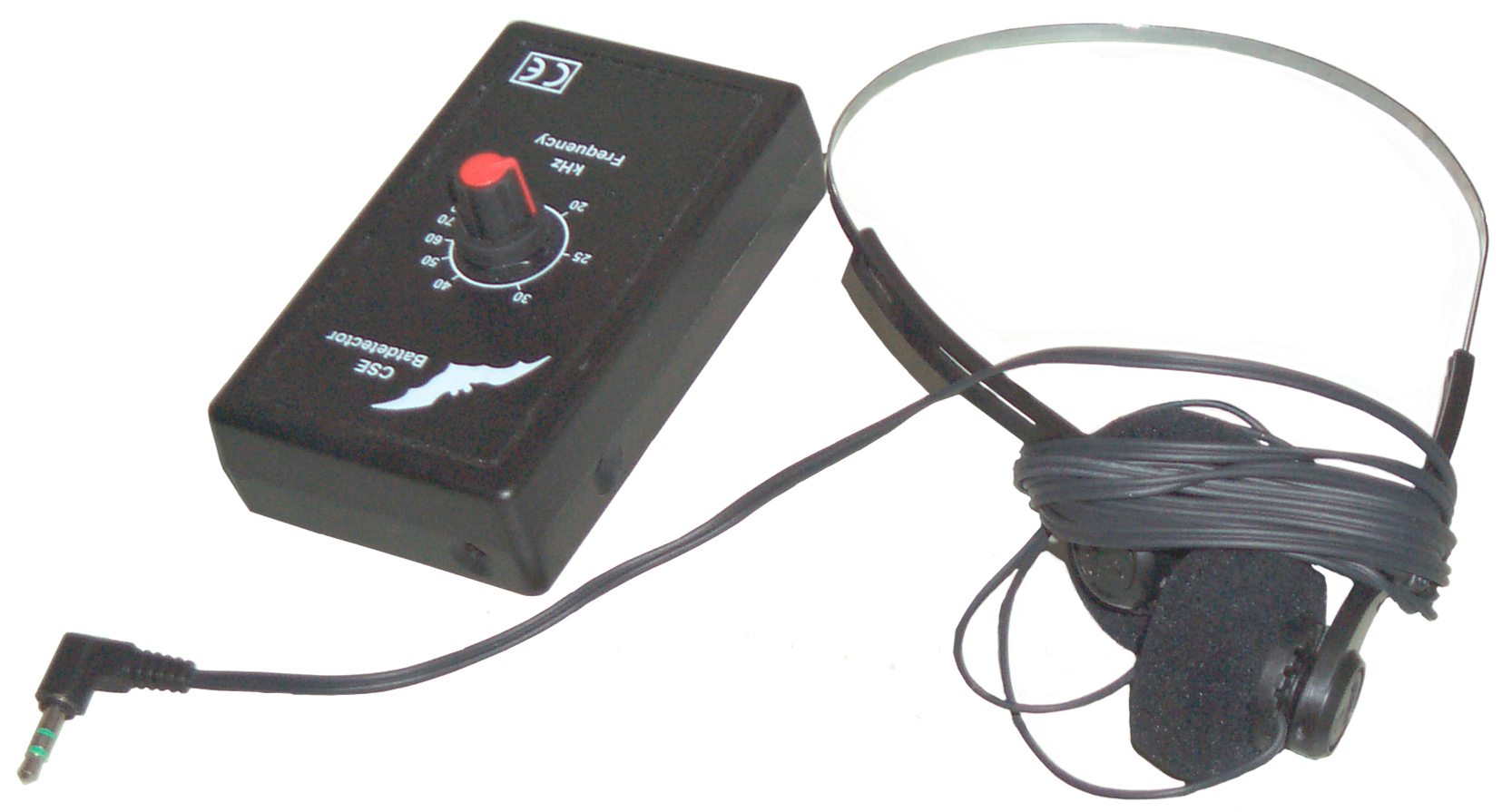
 Around January I got a
"CSE Batdetector". It's a small hand held unit that runs
from a standard 9 volt battery. When you plug in stereo
headphones that turns on the power so you need to unplug the
headphones when it's not in use to save the battery. On the
front is a knob for tuning into the frequency of the bat.
Around January I got a
"CSE Batdetector". It's a small hand held unit that runs
from a standard 9 volt battery. When you plug in stereo
headphones that turns on the power so you need to unplug the
headphones when it's not in use to save the battery. On the
front is a knob for tuning into the frequency of the bat.
Look near the photo's lower right corner of the box and you can
see the two holes for the stereo microphones.
This unit uses two condenser microphones and processes the signals
as stereo so you get a feel if the bat is flying right to left or
left to right. In twilight conditions that's a help when
trying to see them (more like seeing a fuzzy blob moving
fast). If you rub your index finger on your thumb it
generates a lot of ultrasonic noise. When near a computer
there's ultrasonic noise that's strongest around 25 kHz. The
IMP2 Slave Clock Pulser has a 32,768 Hz crystal that can be heard
when the bat detector is right next to it and the knob is peaked
around where 32 kHz would be.
When I first got the bat detector I went out at twilight and later
that evening but could not hear anything. Some Googling gave
me the idea that bats are only active when it's warm and January
is not too warm. But about mid May the bat detector was
hearing bats when tuned to about 26 kHz.
8 Mar 2009 - When trying to find a leak in an air compressor the output was not as
vived as I remembered. Rubbing thumb and finger produced
almost no signal. Replaced battery then when right hand
thumb and finger are rubbed toghther and the unit is in left hand
seperated by about six feet the rubbing is clearly heard.
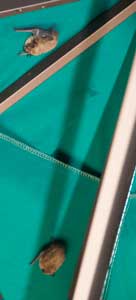
A patio umbrella in the back yard had been closed for a long time
and when opened there were bats sleeping inside, see photo at top
of page.
They make products for professionals, but this one I can
afford. On order 13 Dec 2023. Should work with my LG G6
cell phone which has OTG and plenty of memory. Their
YouTube channel: Wildlife
Acoustics - EMT2
Play List -
10911854
Ultrasonic microphone enclosure, Ian
Agranat, Andrew
P. Moroney, Wildlife
Acoustics, 2021-02-02, - this may cover both the EMT2 and
the standalone mike SMM-U2.
RADAR (SONAR) Ideas
After reading Chapter 2 of
The Blind Watchmaker by
Richard Dawkins which goes into some depth on how he thinks bats
use echolocation I'm writing this section. I spent a couple
of decades in the
Radar Warning Receiver
business.
There are a number of different way that RADAR can work.
Pulse Time of Flight (Wiki: RADAR)
This is the classical method. A pulse is sent out and the
time of flight is measured. The result is you know the
distance to the target. It can be done using sound, radio
waves, or when light is used it's called
Laser
Range Finder. Note the result is a number, i.e. the
time to the target. To get a Plan Position Indicator (PPI)
display the antenna can be rotated about a vertical axis.
This gives you a map but you don't know the elevation of the
target or it's speed.
This is what's used in the police radars that look for speeding
motorists. They transmit a Continuous Wave (CW) signal and
the received signal has been offset by the doppler shift of
aynthing moving relative to the transmitter. If you looked
at a spectrum analyzer plot (the
HP 4395A
would be ideal for this) of the audio output of a police radar
system that was in a police car traveling down the highway you
would see a signal from the road, trees and all the stationary
objects at a doppler frequency related to the speed of the police
car. Note that this would not be a single narrow spike on
the spectrum display but rather it will be spread because of the
angular offset of things not directly in front of the transmitter
antenna. If there was an oncoming car going at the same
speed as the police car there would be a signal at twice the
stationary object signal. If there was a car approaching
from behind the police car (most car mounted speed radars are
really two units one pointed to the front and one pointed to the
back) at half it's speed there would be a signal at half the
stationary object frequency.
In the case of a ground mounted search radar there are echos from
nearby stationary targets that are of no interest and that can
hide more interesting targets. By using some doppler
processing a Moving Target Radar can be made where the returns
from stationary targets are not shown, only moving targets show
up. This can be refined by only showing targets that are
moving between two specified speeds. In the case of bats it
may be that the speed of a moving target would be "seen" as a
color.
So CW doppler is good for learning about the speed of things that
are approaching or moving away.
FM Doppler (Wiki: FMCW)
By Frequency Modulating (FM) the CW signal, say with a linear ramp
now you can determine the range to a target. This type of
system uses much less power than a pulsed system and has better
suppression of background clutter. One application is in
artillery fuses that can be set for a distance above the
target. A bat that used FMCW SONAR would know how far away a
target was and if it also used CW it would also know the relative
velocity of the target.
These was some thought of equipping all cars with FMCW radars as
the heart of a collision avoidance system. But this did not
happen once it was realized that if all cars had these systems
they would interfere with each other and that would cause them to
fail.
The signal to noise ratio of a bats echolocation receiving system
would be improved if it used what's called a matched filter to
pass the desired signals and reject the undesired signals.
It's probable that bats are very good at this. For example
they could tell the difference between echos from their
transmissions from signals from other bats. They might even
be able to use the echos from other bats to better "see"
targets? In The Blind Watchmaker Dawkins mentions there's a
bat that changes it's transmitter frequency so the received
frequency is always the same. That's an excellent way to
make use of a band pass filter (Wiki:
BPF) in
the receiving system to improve the singal to noise ratio.
Signal Domains
There are a number of ways of looking at the signal coming from a
bat.
Time
If the output of a micorphone was fed to an oscilloscope it's a
time domain display.
Frequency
If the output of a microphone was fed to a spectrum analyzer
it's a frequency domain display.
Modulation
There are instruments called Modulation Domain Analyzers (
Agilent
53310A) that display Amplitude vs. Frequency. It
would be interesting to see the MD plot for different species of
bats.
3 Dimensional Image
Note that all the above RADAR (SONAR) systems need some sort to
scanning to get a graphical display. Humans have only two
ears, yet we can tell where in three dimensional space a noise is
coming from (that's why a
Home
Theater system is such a large improvement in movie
watching). At first blush it would seem that with only two
ears we should not be able to have 3D hearing. But it turns
out that the external ear is part of a matched filter that colors
the sound and that color adds the missing information needed to
give us 3D hearing. In a similar way a bat can color the
sound two ways: first it may be colored when it's sent
(maybe related to the shape of it's head) and second by it's
ears. This would allow the bat to "see" a 3D image of it's
surroundings.
This image might have features related to fixed objects and
different features related to moving objects. For example
the "color" of a moving object might be related to it's relative
speed and size. I remember a TV program that said frogs can
"see" small objects that have convex shapes and are moving (i.e.
small flying insects) but can not see a stationary insect and will
die of starvation when there are a lot of dead flies nearby.
They also see predators, not like we do, but instead by their size
and shape (or by their shadow). So not only would bats "see"
their pray they would see other bats in a similar way. Since
they have eyes the echolocation signals are probably combined with
the visual signals to form a composite "multi spectral" image
(Wiki:
MSI).
Note
the
a
multi
spectral
image
is classicaly only made up of light at different frequencies so
this combination of a sonar image and an optical image might be
called a multi sensor image.
Echolocation Links
-
Echolocation
in the Bat -this is a more in depth coverage than in Dawkins
book (might be where he got the info)
Listening to Bats
Bats make a ultrasonic "chip" and listen for an echo (very similar
in concept to RADAR) to hunt and to sense what's happening around
them. There are many species of bats and so the possible
frequency of these "chirps" can vary over a wide range, say from
just above human hearing at 20 kHz all the way up to maybe 140
kHz. Notice that the range or bandwidth of human hearing is
less than 20 kHz for a young person and more like 10 kHz for most
people and the possible range of bat frequencies is 12 times
wider, so with a single down conversion you can only hear 1/12 of
the possible band of frequencies.
So how to listen to bats? There are a number of ways.
By mixing a local oscillator with
the amplified output from a microphone the bat's ultrasound is
changed to a frequency that you can hear. The mixing
process preserves the amplitude modulation on the chip so close
bats are louder than far away bats. Once you know the
frequency for your local bats you probably don't need to change
it. The bandwidth of a single bat species is typically less
than 10 kHz.
Frequency Division
The idea is to amplify the bat ultrasound then use it to clock a
digital counter chip. The output can be taken from some
divisor that brings the ultrasonic frequency down to into human
hearing range. The two disadvantages are that you loose the
amplitude information so can't tell if a bat is close or far away
and the width of the "chirp" gets compressed so the fidelity is
not as good. But the good news is that there's no tuning
required.
There are some ideas floating around that would keep track of the
amplitude informatin and use it to modulate the frequency divider
output, but I don't know if this has been done or is available.
 |
|
Board, software & cable
(box was seperarate part then)
|
PCB
|
If some wide band of frequencies are recorded like 15 to 150 kHz
for example then it can be played back and all viewed on a
spectrum analyzer. You can see subtile details on the
spectrum analyzer that your ears can not distinguish. The
Software Defined Radio called the
SDR-IQ has
this capbility. I.e. it can record 500 Hz to 190 kHz
directly and can show a real time frequency spectrum for that band
or any smaller band. While it's displaying the wide band you can
put a cursor on a bat frequency and it will demodulate that down
to baseband. I haven't yetused the SDR-IQ for bats so don't
have details about modulation type, bandwidth, etc.
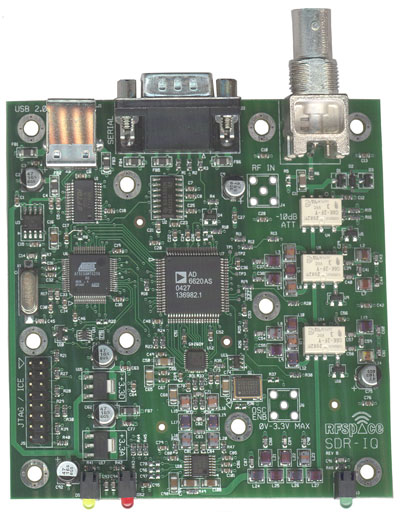
It's powered by the USB2 cable and
has a BNC input jack. The DB-9 connector is so that the
SDR-IQ can control radios that may be acting as RF front ends for
frequencies above 30 MHz. For frequencies of 30 MHz and
lower the SDR-IQ can receive them directly. The hardware on
the board mixes the input and a Direct Digital Synthesizer
supplied Local Oscillator the I & Q channels of the mixer
output get sampled and the digital data stream gets decimated down
to a bandwidth that the USB2 port on a computer can handle.
The Spectraview software runs inside the PC to further tune and
demodulate the digital data. The sound card might act as the
audio output with the SDR-IQ, but for the stock setup is not
involved with the reception.
Electronic Design -March 9 2010
Software
Defined
Radios
Are
Here Now
MoeTronix:
Using a
Hi-Fi horn tweeter as an ultrasonic microphone for bats.
PC Software
Spectravue
is a spectrum analysis package
Winrad is a radio interface (
Yahoo Group,
Winrad,
Radio Portal)
HDSDR - use with the
RFspace DLL
Weak Signal
WSJT
-
RFSpace -
Other
SDR Applications -
SDRanywhere
(w/Android
cell phone)
Accessories
Griffin PowerMate -
USB Knob
Andrea PureAudio -
full duplex USB sound card
SDR-Radio - Allows making
SDR-IQ internet accessable
G4HUP Reference Locking
the SDR-IQ and SDR-14 receivers -
Docs -
from a GPS disciplined 10 MHz source
500 kHz Low Pass Filter -
PAR
BCST-LPF - blocks AM broadcast stations to prevent front end
overload.
McKay Dymec DP 40 could
also be used.
Recording
A normal audio recorder can be used on the headphone output from
the heterodyne or frequency divider type bat detectors.
An ultrasonic microphone could be amplified and recorded on a
recorder that could handle the bandwidth (not a normal Hi-Fi audio
recorder). Such as an instrumentation recorder or a video
recorder with an attachment would work. Modern
Instrumentation recorders are based on digital techonlogy related
to digital TV recording and have total bandwidths similar to a TV
channel. For example the
Kinetic
Systems DAQ848 has 48 channels each just uder 100 kHz wide
or about 4.8 MHz total bandwidth.
A more advanced approach uses direct to hard drive recording, such
as done by
Wide Band
Systems. The bandwith is extended by using RAID.
The SDR-IQ (see above) can record a very wide band (up to 190 kHz)
directly to a PC USB2 port.
Microphones
The normal audible range electret type condenser microphone has
some response above the 20 - 20,000 Hz audio range. There
are also ultrasonic speakers and sensors made to work with remote
control applications but these are usually optimized to operate
over a narrow band and are not suitable for the 15 to 150 kHz bat
band. There are commercial products that work very much like
a bat detector called "ultrasonic leak detectors" but unless you
can find some specification about frequency coverage it's hard to
know what they cover. There are also hydropones with the
needed frequency coverage, but they are designed to work under
water and their performance in air is rather poor.
The other type of microphone is the condenser mike specified to
work in the ultrasonic range. It would be nice if there was
an electret type made for ultrasonic since then you would not need
a DC bias supply, but as far as I know they don't exist or are
very expensive. That leaves the standard condenser
microphone. Probably more properly called a transducer since
it can make ultrasonic sound as well as it can detect it.
The one that's probably been made in the highest quantity is the
one used on a number of Polaroid cameras for the auto focus
function. Details on the
Polaroid
Sonar One Step Camera are on a seperate web page.
Knowles Acoustics makes a
wide band ultrasonic sensor that does not reuqire bias. But
it's a
surface mount technology device
and needs a local op amp as well as some RFI supression.
Wavelength
The speed of sound in air is about
1124 feet/second, at 50 kHz a wavelength is 0.27 inches.
If a sound wave impinges on a microphone diaphragm on it's central
axis then the diaphragm can be many wavelengths in size and will
work better because of the large diameter. This is the case
with the Polaroid Sonar type transducers. They are used in
an application where the outgoing and incoming wave fronts are on
their central axis. That's why in this particular
application the diaphragm size can be many wavelengths in
diameter, but for general purpose microphones it's much smaller.
If an omni directional microphone is used to pickup sounds from a
random location and it's diaphragm is comparable to a wavelength
the average sound pressure can vary because a peak may cancel out
a valley. In this case the diaphragm needs to be small
compared to a wavelength to get flat response.
I expect that when the Polaroid Sonar transducer is used as a bat
microphone it's response will have peaks and valleys that are
quite deep (more than 10 dB) and spaced close to each other.
But as the bat moves it will be moving through a number of these
and the peaks will have a much higher output level than you
would get using one of the much smaller professional type
microphones.
Links
Wildlife Acoustics
- professional
bird & bat recorders.
created 2 June 2007