GRA-39 Radio Set Control
© Brooke Clarke 2004 - 2022| Remote Handset |
 |
Field Wire |
 |
Radio |
Background
The GRA-39 can be used in four
ways:
In order to control a radio from up to 2 miles (3.3 clicks) an extension cord will no longer work and additional equipment is needed. To get around the DC resistance of the field wire an AC tone at 3,900 Hz is used. When the remote handset is keyed this tone is sent that's outside the normal 300 to 3,000 Hz audio range and the local control unit hears this tone and activates a relay closing pins "A" and "C" on the radio's AUDIO cable thus keying the radio. The local control unit also filters the control tone from the audio so it will not be heard by the local control operator or the radio.
The remote unit also amplifies the audio level so any wire losses will not result in too weak a signal for the radio input.
There is also Radio Frequency Interference (RFI) filtering in the remote control units to prevent problems caused by the nearby radio transmitters.
The GRA-39 can be used with any radio that uses the standard 5 pin AUDIO connector, this includes the PRC-68 Family, PRC-25, PRC-77, VRC-12 Series Radios, PRC-104, etc. Fair Radio lists: VRC-12, VRC-43, VRC-49, VRC-53, VRC-64; GRC-125, GRC-160; PRC-25, PRC-74B, PRC-77.
The GRA-39 can be used with the SB-22 local battery switchboard. When this is done there needs to be a connection to one of the line cards both by means of the remote unit line terminals and by means of a special audio cable that connects pins "A" and "C" from the remote units audio jack to the same line card. The switchboard operator needs to act and the remote control operator for the radio circuit, but once a call has been established to one of the other line cards the person on that line controls the radio PTT using their telephone PTT switch.
The GRA-39 does NOT provide Radio Wire Integration (RWI). Because this requires that an in band audio tone, typically 1,600 Hz, be sent over the radio to act as a ringing signal. The 3,900 Hz tone used in the GRA-39 is an out of band PTT keying signal. The tone generator will be within 25 Hz of 3,900 Hz.
The GRA-39 probably can not handle wide band audio like the encrypted audio on a VHF or UHF radio and so the HYX-57 was developed.
The GRA-39 is made up of two different units, the C-2328 remote unit and the C-2329 local unit that connects to the radio. The HYX-57 serves a similar purpose, but the exact same unit is used at both ends of the remote control circuit. One of the advantages of the HYX-57 is that a pair of them can be used back to back (with a special cable between them) to act as a line extender. Thus for each pair of extra units the length of the field wire can be extended. Also they can be used front to front connected by a few feet of field wire and connected to two radios to make a retransmission system. The GRA-39 can not be used either as a wire line extender or as the heart of a retransmission system.
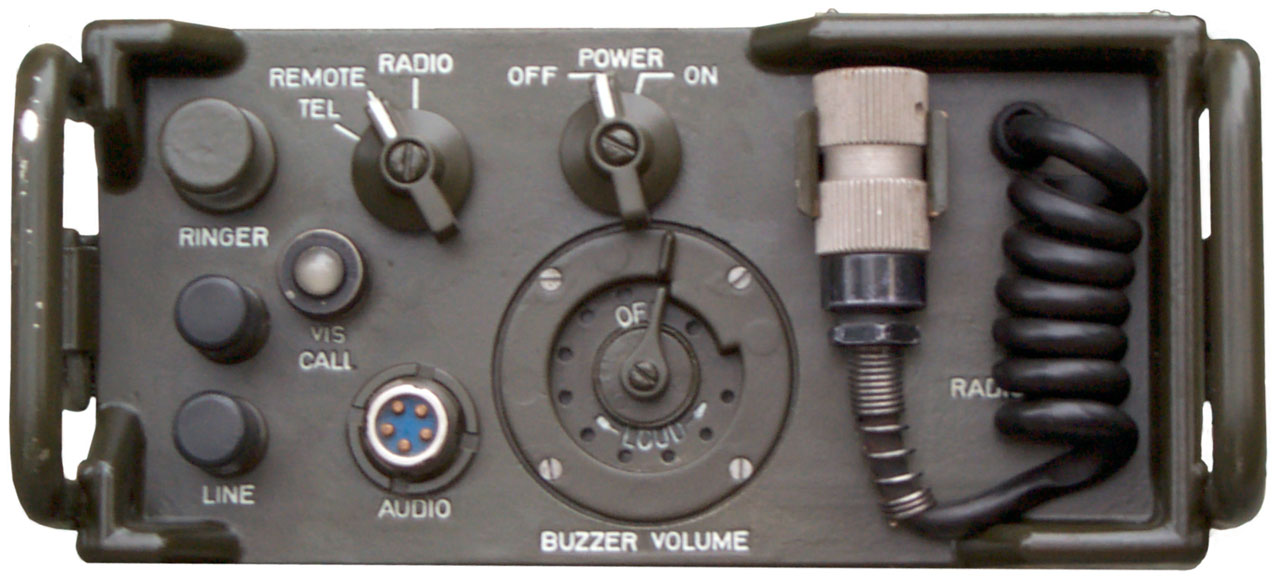
Both GRA-39 units have ring generator plungers so the other unit can be called. They have a "clicker" and the version B and above units have a call light. This allows the GRA-39 to function just like a local battery field phone like the TA-312.
To aid in troubleshooting the front panel of the both units can be separated from the battery box and extended with DC power applied by means of a short coiled cord.
The GRA-39 only has a pair of terminals for the field wire. There is no ground terminal like on the HYX-57. This is strange since RFI suppression would need a ground.
- Radio transmission and reception from the remote control
unit.
- Radio transmission and reception from a local battery
switchboard and the telephones connected to the
switchboard.
- Telephone communication between local and remote control unit operators.
- Radio transmission and reception from the local control unit.
In order to control a radio from up to 2 miles (3.3 clicks) an extension cord will no longer work and additional equipment is needed. To get around the DC resistance of the field wire an AC tone at 3,900 Hz is used. When the remote handset is keyed this tone is sent that's outside the normal 300 to 3,000 Hz audio range and the local control unit hears this tone and activates a relay closing pins "A" and "C" on the radio's AUDIO cable thus keying the radio. The local control unit also filters the control tone from the audio so it will not be heard by the local control operator or the radio.
The remote unit also amplifies the audio level so any wire losses will not result in too weak a signal for the radio input.
There is also Radio Frequency Interference (RFI) filtering in the remote control units to prevent problems caused by the nearby radio transmitters.
The GRA-39 can be used with any radio that uses the standard 5 pin AUDIO connector, this includes the PRC-68 Family, PRC-25, PRC-77, VRC-12 Series Radios, PRC-104, etc. Fair Radio lists: VRC-12, VRC-43, VRC-49, VRC-53, VRC-64; GRC-125, GRC-160; PRC-25, PRC-74B, PRC-77.
The GRA-39 can be used with the SB-22 local battery switchboard. When this is done there needs to be a connection to one of the line cards both by means of the remote unit line terminals and by means of a special audio cable that connects pins "A" and "C" from the remote units audio jack to the same line card. The switchboard operator needs to act and the remote control operator for the radio circuit, but once a call has been established to one of the other line cards the person on that line controls the radio PTT using their telephone PTT switch.
The GRA-39 does NOT provide Radio Wire Integration (RWI). Because this requires that an in band audio tone, typically 1,600 Hz, be sent over the radio to act as a ringing signal. The 3,900 Hz tone used in the GRA-39 is an out of band PTT keying signal. The tone generator will be within 25 Hz of 3,900 Hz.
The GRA-39 probably can not handle wide band audio like the encrypted audio on a VHF or UHF radio and so the HYX-57 was developed.
The GRA-39 is made up of two different units, the C-2328 remote unit and the C-2329 local unit that connects to the radio. The HYX-57 serves a similar purpose, but the exact same unit is used at both ends of the remote control circuit. One of the advantages of the HYX-57 is that a pair of them can be used back to back (with a special cable between them) to act as a line extender. Thus for each pair of extra units the length of the field wire can be extended. Also they can be used front to front connected by a few feet of field wire and connected to two radios to make a retransmission system. The GRA-39 can not be used either as a wire line extender or as the heart of a retransmission system.
Both GRA-39 units have ring generator plungers so the other unit can be called. They have a "clicker" and the version B and above units have a call light. This allows the GRA-39 to function just like a local battery field phone like the TA-312.
To aid in troubleshooting the front panel of the both units can be separated from the battery box and extended with DC power applied by means of a short coiled cord.
The GRA-39 only has a pair of terminals for the field wire. There is no ground terminal like on the HYX-57. This is strange since RFI suppression would need a ground.
Bag
Bag, Cotton Duck CW-598( )/GRA-39, SC-DL-4~6290
PRC-35
The mil spec for the GRA-39 mentions the PRC-35 which was a radio in the VRC-12 family to replace the PRC-6.
TRENDS IN ARTILLERY FOR INSTRUCTION UNITED STATES ARMY ARTILLERY AND GUIDED MISSILE SCHOOL FORT SILL, OKLAHOMA APRIL 1957
........
POI FOR USAR SCHOOLS
The Program of Instruction for field artillery courses to be presented in USAR schools during the 1957-1958 school year will be distributed on or about 1 May 1957.
* * * * * * *
DEPARTMENT OF COMMUNICATIONS AND ELECTRONICS
COLONEL G. W. SEAWARD, ARTILLERY, DIRECTOR
NEW FAMILY OF FREQUENCY MODULATED RADIO SETS
As early as 1948, design was started on reduced bandwidth frequency modulated radios for military use. These radios were to be the replacement sets for our present standard frequency modulated series. However, as development progressed, transistors began to loom as a feature of at least equal importance to reduced bandwidth frequency modulation. When this became evident, the original development project was suspended and a series of conferences were called to incorporate all technological advances in the new sets. As a result of these conferences, military characteristics and specifications for the new family of frequency modulated sets are nearing completion. The basic set of the new series will be known as the AN/VRC-12. This set will replace the entire "3 through 8" series of sets now used by the combat arms. Also, radio set AN/PRC-35 is being developed to replace the current AN/PRC-6; and the AN/PRC-25 to replace the present PRC-8, 9, and 10 series. The PRC-35 and PRC-25 are designed to incorporate all of the technical improvements of the VRC-12 and to be compatible in all operational respects.
Manuals
TM 11-5820-477-12 Operator's and
Organizational Maint. Manual
TM 11-5820-477-30 Direct Support Maint Manual
TM 11-5820-477-23P Organizational and Direct Support Maint Repair Parts & Special Tools List
TM 11-5820-477-30 Direct Support Maint Manual
TM 11-5820-477-23P Organizational and Direct Support Maint Repair Parts & Special Tools List
Back to Brooke's Products for Sale, Telephones, U-229 Connector, Crypto, Crypto Machines, Brooke's Military Information, Home page
Page created 15 Nov. 2004.