HP AC-4A Decade Counter
© Brooke Clarke, N6GCE 2003 - 2024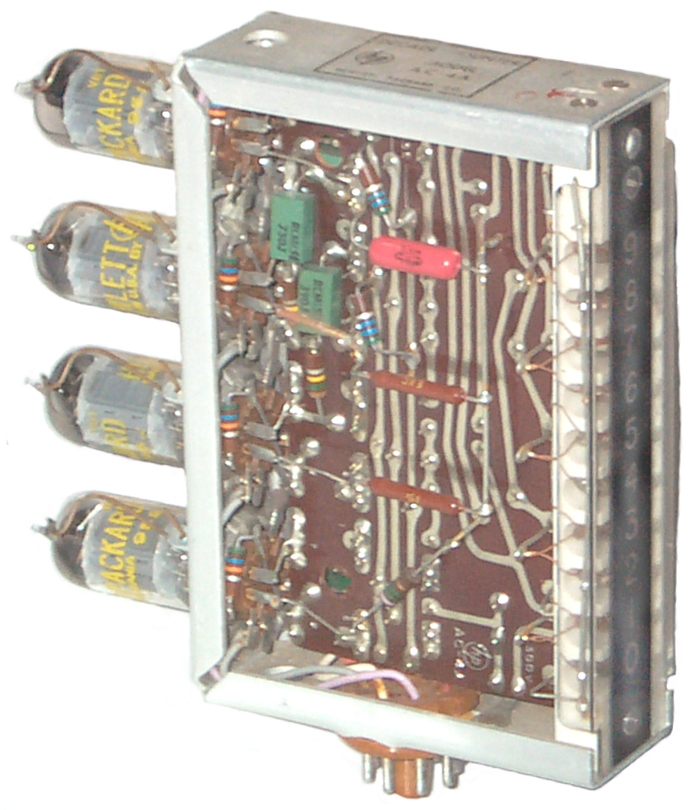 |
 |
|
 |
 |
|
 |
|
|
|
|
|
|
|
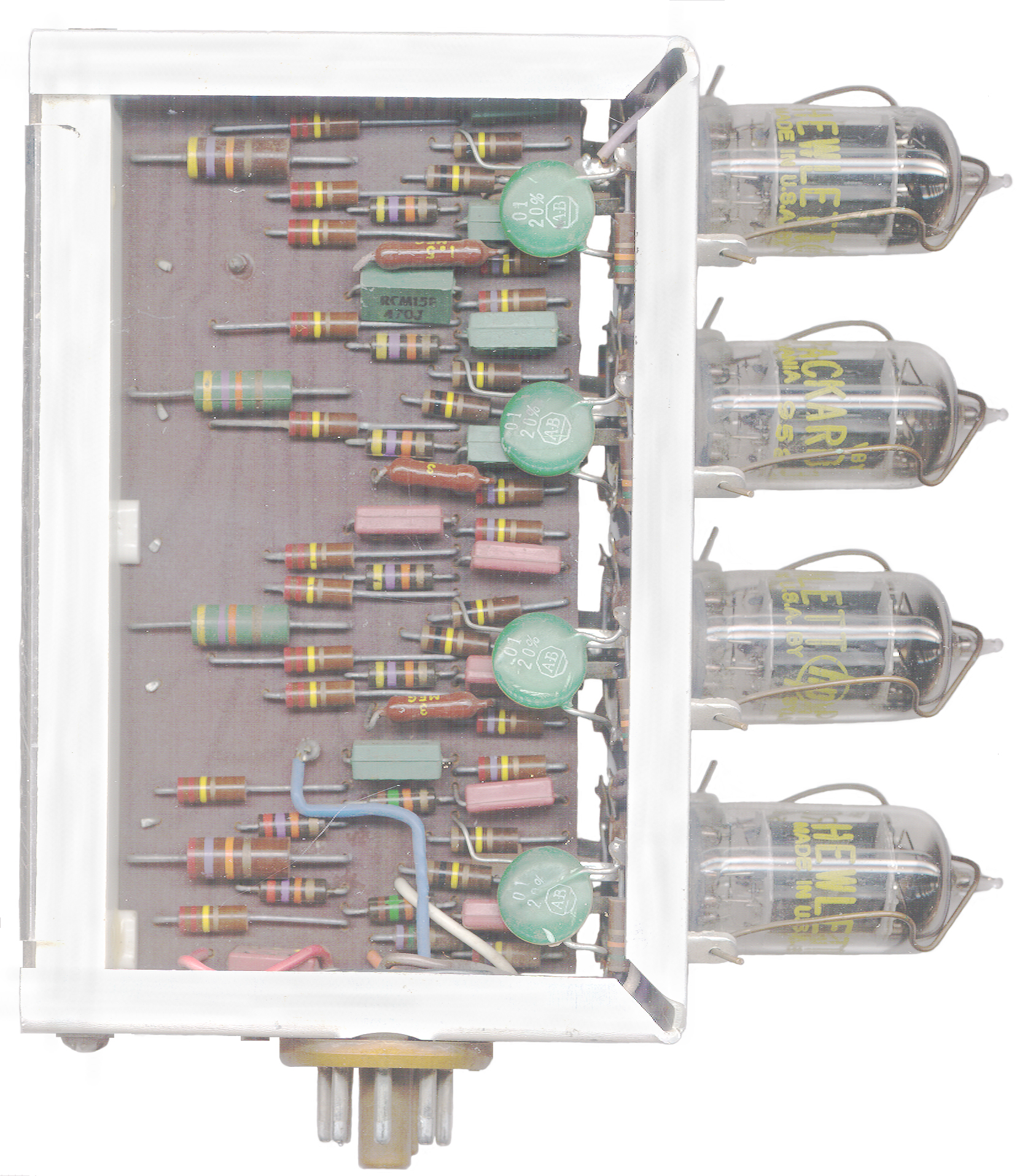
One of the first digital counters was the HP 521A. It's a rack size instrument using tube technology and single sided printed circuit boards. Made in the mid to late 1950s. Each decade consisted of an AC-4() Decade counter module. These modules use 4 each dual triode tubes and 10 each NE-2 Neon bulbs to indicate the digits 0 through 9. There's an output that's the input count divided by 10 to drive the next stage.
The AC-4A is specified to count up to 120 kc and the AC-4B up to 220 kc.
The bottom of the module has a standard 8 pin octal tube base and so the main 521A counter chassis just uses a standard tube sockets for the modules. This particular module has a date stamp of 11 17 59. The manual suggests that other manufacturers also made a plug and play compatible counter module.
This may be based on Fig 17.8 in the MIT Rad Lab Vol 19 Waveforms, Chapt 17 Counting that uses four 6SL7 dual triodes.Alternate Versions
Military FR-38D
(like the HP-524, but made by Northeastern Engineering):
Counter modules are Northeastern Engineering model 140-100C.
Octal plug, pin 8 is N/C.
Modules look nearly identical to AC-4A physically, except no staircase output.
The FR-38 is a real beast: it weighs over 100 lbs, and has about 100 tubes, uses something like 600W of power.
It uses the same plug-ins as the HP.
The FR-38 (no letter) has slower-speed modules: The low digit is good to 100KC, the other modules are only good to 30KC.
The FR-38A actually uses HP AC-4A modules.
Computer Measurements Corp., model 100C.
Plug is 11 pin (like octal, but 11 pins).
The company logo is a "CMC" superimposed on a vertical stack of digits 0 to 9.
Computer Measurements Corp., model 100D.
Octal plug, pin 8 is N/C.
Beckman Instrument model 705AP/1-3.
11-pin plug.
Beckman Instrument model 700A.
Octal plug, pin 8 is N/C.
Beckman Instrument model 705AP/1-3.
Octal plug, pin 8 is N/C.
The Beckman modules are nicer physical construction than the other brands (including HP).
I think I got them from a military FR-67 counter that I disassembled years ago. The FR-67 is very similar to an HP-522.
A bit more info:
Last night I opened up my HP521C, and found that it has "AC-4G" modules in it.
The G modules have a 12 (twelve) pin connector, although only 8 are connected to anything.
The PCB in the G is identical to the AC-4A's PCB (including the marking in the etch that says "AC-4A"). I noticed two extra resistors wired in on the back side of the PCB. There may be changes in component values also, but I didn't check.
Also, in the 521C counter, the crystal is not in an oven. It's just plugged into the chassis, with a tube shield holding it in place mechanically.
The 522B has the xtal inside of an octal-based oven, about 1.25" diameter and 4" tall.
The 524 series has the xtal inside of a much bigger oven, about 3" diameter. There is a hole in the side for a thermometer that sticks in through the front panel. The thermometer looks like a miniature kitchen meat thermometer.
Maybe tonight I'll crack open the HP521DR. I think it's like a 521C, but with nixie displays and rack-mount.
Versions data from Pete McCollum
For some reason that I've now forgotten I ended up with a number of these decade counter modules and miscellaneous parts that went into them such as the string of NE-2 bulbs in the late 1950s or early 1960s. Maybe a friend of our family worked for HP, Palo Alto which is about a 10 minute drive from Mountain View.Special Version
This particular module is not a standard AC-4A although it's marked as an AC-4A. On the octal plug pin 7 is now a special staircase output, maybe coded 4221 and the filament connection that used to be on pin 7 has been moved to ground pin 6. The other pins have the same functions. If you know what this is about please let me know.
The Manual schematic for the AC-4A is dated Nov. 11, 1957 and the AC-4B schematic is dated 18 Apr. 1958. This special version has a newer date stamp: 11 17 59 than either of these, yet is labeled as an AC-4A and the PCB is marked AC-4A.
HP 1957 Catalog page 5 -maybe for use in the 523B Electronic Counter (pg 71)
Also see the NCR web page Patents section for more information about the early days of electronic counting
Phantastron
The HP 521 used a Phantastron circuit to divide the power line frequency down to the gate time. This circuit combines a couple of concepts.
First is the Miller Integrator. A tube circuit typically used to generate a linear ramp voltage for scope horizontal axis time sweeps. If you use an RC charging circuit the left or starting part of the sweep is fairly linear but as the cap charges the sweep becomes more non linear. What's needed for a good linear sweep is a current source to charge the cap instead of a resistor. The Miller Integrator uses a pentode tube where the current in one of the grids looks like a current source. I found a patent class 328/128 that's for the Miller integrator using Google, but there is no top class number 328 on the USPTO web pages, it's been consolidated into 327/131 ramp generators.
The phantastron adds an input diode that couples negative going pulses so that the Miller Integrator is started with a pulse and the ramp time is set to be a little short of the desired output period so that the "nth" input pulse resets the circuit. This circuit can only divide a known frequency by some relatively small number like 10 or 12. The HP 521 has a pot in each phantastron circuit to tweak the ramp time so the the divisor number is correct. If the pot is turned full one way or the other the count may be off by 1 or 2 counts.
The 31 Jan 1950 patent 2495726 by Houghton is an improved phantastron circuit. I've not found a patent on the 1941 phantastron.
HP could have used circuits like the AC4A to get the gate period from the line frequency, but the AC4A is much more complicated than the phantastron.
See: MIT Rad Lab Vol 19 Waveforms, Chapt 17 Counting, Fig 17-22 for the circuit and waveforms.
See: NCR Patents for electronic counting that's faster than the mechanical counting used to break the Enigma machine.
All four tubes are the same dual triode 5963. The CV3900 is a direct replacement. The 12AU7, 12AU7A, 12AU7WA, 5814, 5814A, 6067, 6189, 6680, 6CC40, 7489, 7730, B329, B749, CK5814, CV10323, CV10666, CV4003, CV4016, CV491, CV8155, CV8221, CV9092, E2163, E82CC, ECC802, ECC802S, ECC82, M8136 may also work.
Fig 1 |
Fig 2 |
Fig 3 |
Many patents related to electronic counters are found in Class 377/109.
The Flory 1946 patents:
2404047 Electronic Computing Device, Leslie E Flory, George A Morton, RCA, July 16, 1946 708/627 ; 327/356 and
2410156 Electronic Timing Device, Leslie E Flory, RCA, Oct 29, 1946, 368/58; 327/118; 340/332; 968/564; 968/946; 968/DIG.1
cover the concept of an electronic counting device that uses pairs of triode tubes in what was then called a "trigger circuit", later called a flip-flop. The patent has a discussion of the advantages of the binary number system and a reference to a book about binary (it was not a common concept then). Also the concept of using feedback so that when the count reached 64 it would set the third stage from the input i.e. set the counter to a count of 4 so there would be 60 counts until the sequence started over. Uses a neon bulb on each Flip-Flop to show in binary the count. Robert Flory has a web page with more of his grandfather's patents but they are not linked.
Note that in modern micro controllers if you want to have a counter with a period of 60 it's easy to start with a count of 4 and reset when the bit for 128 turns on. Very similar to the above method.
2407320 Electronic counter, O.R. Miller, Bell Labs, Nov 5, 1942, Sep 10, 1946, 377/113, 714/E11.185, 315/323, 377/119, 313/DIG.700 - octal counter using 3 pairs of tubes and neon lamps as indicators (0 to 7) & decade counter (0 to 9) using 5 (not 4) pairs of tubes (6SJ7).
The 1950 patent 2521788 by Grosdoff uses 4 flip-flops and a "dual diode tube" as the feedback device to automatically reset the decade counter. In addition the 10 Neon indicating lamps are present as in the AC-4A.
The 1951 patent 2538122 by J. T. Potter eliminates the dual diode tube so only 4 tubes are required for a decade counter, but it uses 4 Neon lamps as the binary indicators.
2540442 Electronic counter, RCA, Aug 11, 1948, Feb 6, 1951 -
2566918 Binary-decade counter, Carl Bergfors, Dec 1, 1948, Sep 4, 1951 - 11 single function tubes
2584811 Electronic Counting Circuit, Byron Phelps, Dec 27, 1944, Feb 5, 1952 - 9 single function tubes
The 1956 patent 2762915 by A. S. Bagley assigned to H.P. is for an improvement to the AC-4() type counter that increases it's speed to over 1 MC.
I think that staircase generators already existed but don't know if there is a patent on generating a staircase using a 4 stage decade counter. None of the counter patents includes the staircase output.
2719228 Binary computation circuit, Isaac L Auerbach, Stanley B Disson, Burroughs Corp, 1955-09-27, - tube based flip-flop
2862660Decimal converter, Robert B Purcell, Priority:Jun 14, 1954, Pub:Dec 2, 1958, 341/104, 377/113, 315/169.2
These circuits might be called liner with feedback. A faster way to count is the Johnson Ring Counter (Wiki). For decade counters it also has the advantage that decoding is simple in that it only requires a two input gate for each digit. I built one of these using the first family of integrated circuits from Fairchild, the 700 series RTL. The 3.6 Volt logic is used for counting and decoding then high voltage transistors are used to drive a NIXIE tube (see computers/Nixie)
Has a manual test schematic circuit that uses a push button to cycle the counter and a related troubleshooting table indicating the probable cause for a number of counting sequences.
I have made a pdf version of the manual on CD-ROM and added a number of color photos of my special AC-4A, including ones of the left, top, bottom and right side with all the parts identified. Also includes a marked up schematic showing this special version AC-4A with the second staircase output. Includes schematics for the AC-4A and AC-4B and mechanical mounting drawing.
See the Product page for ordering information.
Description
HP AC-4A Manual & Patents:
2404047Electronic computing device, RCA, Jan 21, 1943, Jul 16, 1946 - tube flip-flop
2521788Electronic counter, RCA, Mar 1, 1945, Sep 12, 1950 - 4 ea dual triode tubes (Ac4A?)
2538122 Counter, John T Potter, Nov 13, 1943, Jan 16, 1951 - 4ea dual triodes & 4 neon lamps
2762915 Electronic decade scaler, Alan Bagley, HP, May 21, 1951, Sep 11, 1956 - lower feedback delay means higher speed counting
Computers
Cryptography
Neon Light
NCR Counting Tubes
Radar Warning Receivers Ref 3 Vannevar Bush patents
Time & Frequency Electronics
HP Memory Project -Early
Electronic Frequency Meter & Counter - Model Numbers:
500A, 500B analog readout frequency meters, 521, 524A,B (URM-26?)
neon lamp (AC4A) readout digital counters, 523C, 524C Nixie
readout,
HP
Journal February 1955 pages 3 & 4
AC-4A Plug-In Decade Counter Specifications
Counting rate: 120 kc
Double-pulse resolution: 5 uS
Input Voltage: Aprox 80 v negative pulse 1 uS rise time.
Output Voltage: 80 volt negative pulse to dirve succeed AC-4A Counter.
Reset: (a) Reset to zero by opening base pin connection. (b) Reset to nine by applying negative pulse.
Staircase Output Voltage: 135 volts at count of zero, 55 volts at count of nine in 10 steps. Internal resistance, 700k. Operation of counter unaffected by load on staircase output.
Power Supply: Filament 6.3 v +/-10% at 1.2 A; Plate 300 v +/-10% at 15 mA (nominal).
Dimensions: 5-5/8" deep x 1-1/4" wide x 6-1/8" high (overall).
Mounting: Standard; requires octal socket.
Weight: 1 lb
Price: $45.00 f.o.b. PA, Calif.
Hewlett Packard Decade Counters AC-4 -
Page created 16 October 2003.