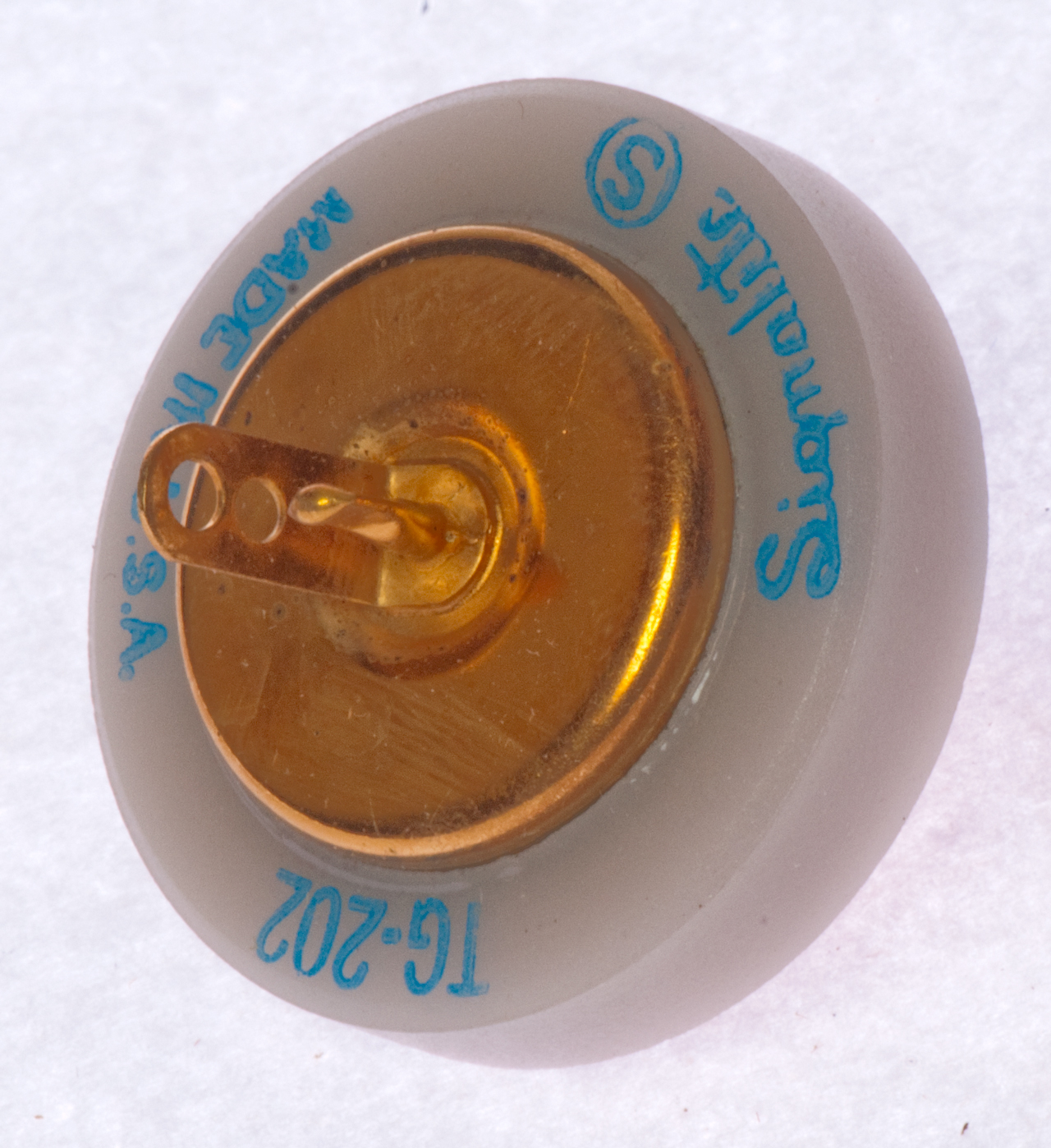
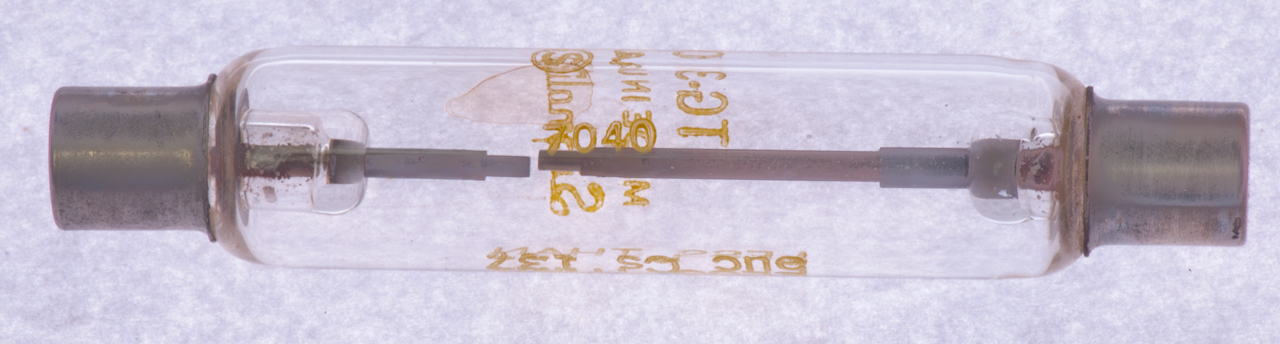
Geiger-Mueller (Wiki: Tube,
Counter)
These are the most common "Geiger
Counter" sensors. They are biased with enough voltage so
that when an atomic particle gets into the gas it causes an
avalanche. The size of the output pulse is the same no
matter what the energy of the input particle. Although
it's possible to turn down the voltage so that the output pulse
has a relation to the input particle energy, the operation is
then no longer called Geiger Mueller.
There is a plateau in the count rate vs. applied voltage plot
for a G-M tube and it should be operated on the plateau, not
above or below. The recomended voltage for most tubes is
in the 500 to 900 volt area.
After the particle leaves the tube there is a recovery
time. If another particle enters the tube before the
recovery time has passed the tube will conduct
continuously. This is bad because most Geiger counters
will show zero when in fact they should be showing full scale.
The common G-M tube is a metallic cylinder with a wire insulated
in the center. One end typically has a mica window to
allow alpha particles to enter. But the end area is much
smaller than the active area of a pancake type G-M tube.
Pancake G-M tubes are much more sensitive to alpha as well as
beta and gamma rays than the cylindrical type tubes.
The end of a "hot dog" type G-M tube or the face of a "pancake"
tube typically has a thin mica window. Ideally for the
detection of alpha particles there would be no window, but then
the gas in the tube would except. The density of the
window puts a limit on the energy level of the alpha particles
that can get into the tube (typically around 3 Mev).
Google "
Geiger
Mueller"
The sensivity of a G-M type tube can be greatly increased by
adding more electrodes.
2397071 Radiation Detector, Gerhard Herzog (Texaco - oil
wells) - multiple cathode disks and multiple anode wires
2397072 Radiation Detector - multiple cathode disks and multiple
anode wires
2397073 Radiation Detector - 5 to 10 times more sensitive than
G-M tube, uses more electrodes, but has some volumes where the
field is zero, hence there's a better way
2397074 Radiation Detector - very rugged
2397075 Radiation Detector - minimizes anode to cathode leakage
(noise)
2873399 Radiation Detector - has no zero field volumes so is
somewhat more sensitive than 5 to 10 times a G-M tube
Calls:
2599352 Radiation Detector - greater cathode area by adding
fins - more sensitive
2649554 Radiation Indicator, Anton - (beta & gamma
dosemeter)
2699513 Radiation Detector -multiple anode wires in addition
to increased cathode area
Scintillator (Wiki)
Some crystal or plastic that
generates a photon of light when hit by a particle is coupled
with a photo multiplier tube and both enclosed in a light tight
package. The output pulse is proportional to the energy of
the input particle.
Ionization Chamber (Wiki)
An insulating chamber with some
gas the ionizes under the influence of strong radiation.
Many of the surplus civil defense survey meters (often
erroneously called geiger counters) use this type of detector.
Spinthariscopes (Wiki)
This is a hand held magnifier
focused on a screen made of Silver activated Zinc Sulfide and
with an alpha emitter source like Po-210 Polonium (Anti-Static
Brush) or AM-241 (Smoke Detector). With a night adapted
eye you can see the scintillation. These show up on eBay,
new from United Nuclear, old from antique instrument dealers.
Lone Ranger Atom
Bomb Ring
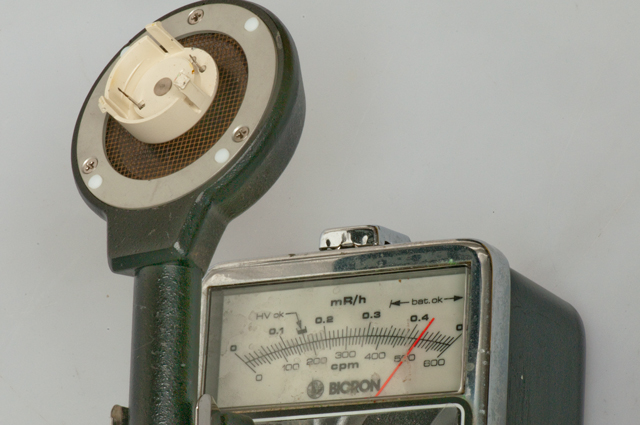
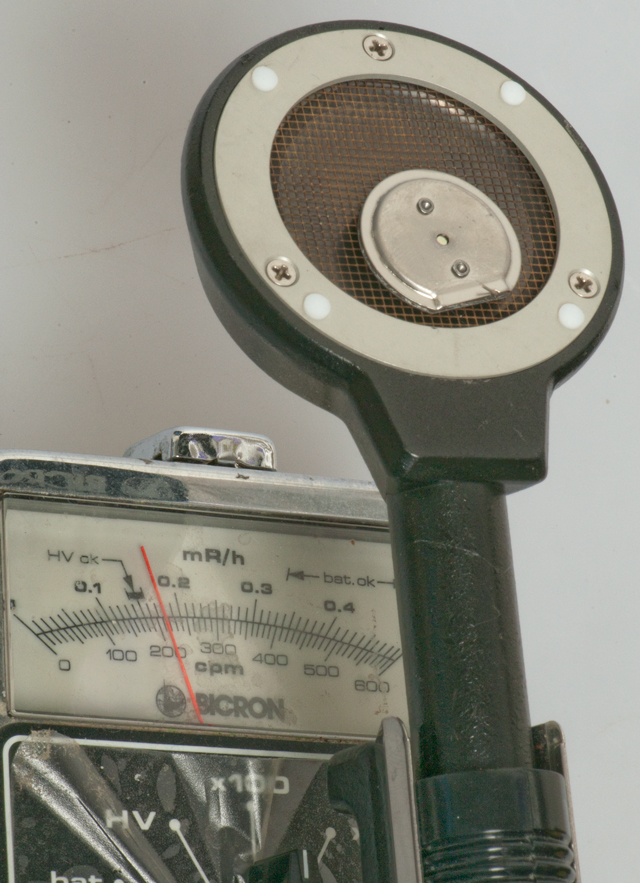
The first thing I did was check it with the Bicron Surveyor
50 with LND pancake probe and detected no radiation
above background.
ORAU Museum of Radiation and Radioactivity:
Lone
Ranger Atom Bomb Ring Spinthariscope (1947-Early 1950s) - In
a reply this said this ring has decayed to the point where the
sparkles are no longer visible. Hence my looking for a
working Spinthariscope. All the older models have long since
lost their radiation since the alpha sources have a short half
life.
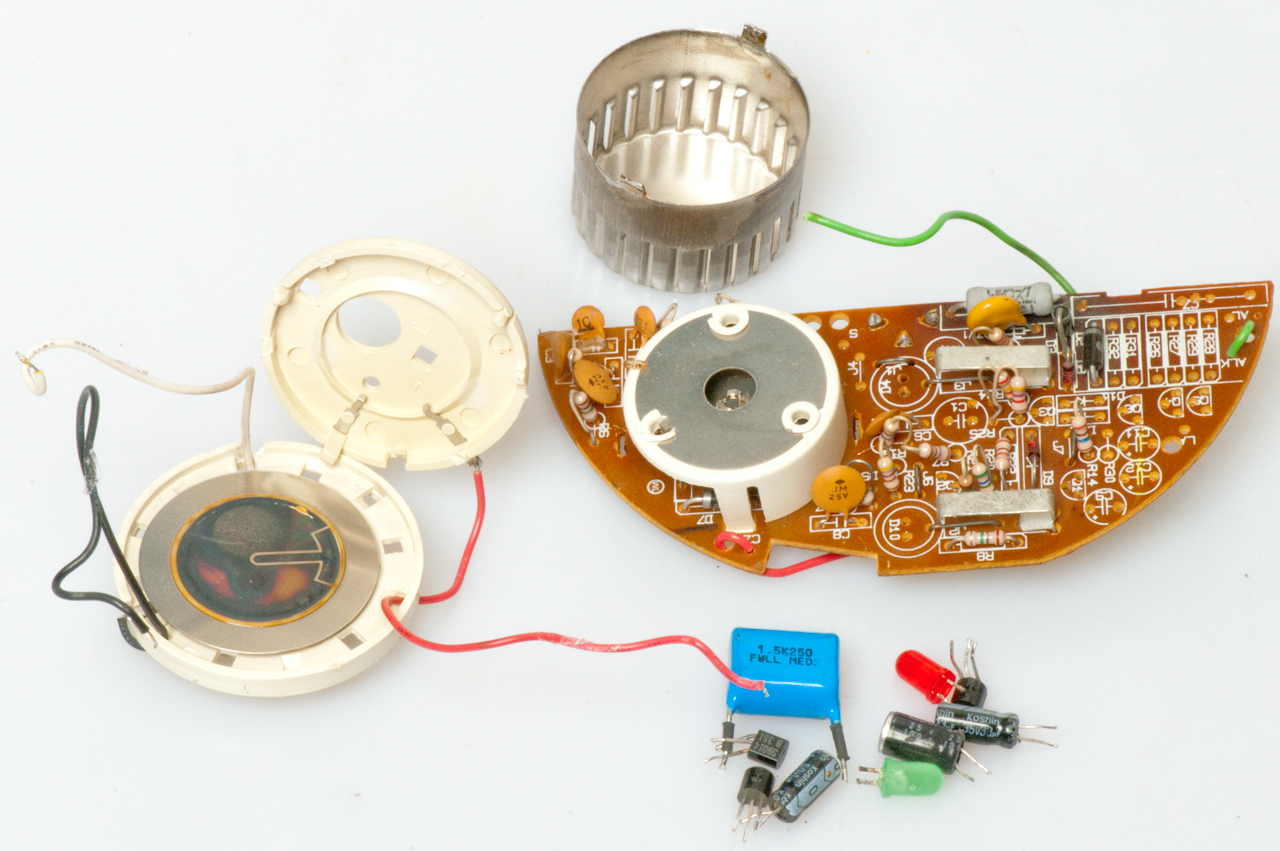
New as of January 2023 so should have some Thorium (Wiki) life
left in it.
It's built into a 1-1/2" PVC end cap. The "Super" version
has the Thorium mounted on the end of a threaded rod so that its
distance to the ZnS screen and be adjusted. There's also a
built-in magnifier with an optical diameter of 1 inch.
The focal length of the lens is about 37mm to the edge of the
flange facing the screen.
The ZnS screen is about 33mm down from the edge of the 1-1/2"
fitting.
So nominal focus would be with a 4 mm gap between the magnifier
and the housing.
The fine threads on the magnifier and on the mating part are
plastic so a great deal of care is needed to engage the threads
properly if you remove the magnifier lens.
Fig 1

|
Fig 2
 |
Other Detectors
There are many other ways of
detecting atomic radiation. One of the first was the use
of photograph film.
Dose Meters (Wiki)
While Geiger counters measure the
rate (i.e. counts per minute) a dose meter adds up the counts
giving a total exposure. These are usually in the form of
badges that may have photographic film or an electronic
integrator or pen shaped electrometer.
One way to detect X-Rays is to use
a Scintillator coupled to a photomultiplier tube in a light
tight manner. This was the method used on first generation
CAT scanners. The problem is that you can only have a
small number of these around the circumference of a circle and
so the spacial resolution is low. GE developed X-Ray
sensors using Xenon gas that can have many more sensors in the
same space where there were only a few photomultiplier
types. As of 2008 this is a hot bed of activity since CAT
is the preferred method of imaging many things in the human body
(i.e. is preferred over MRI which is good for other things).
4031396
X-ray Detector, GE - multiple anode wires in a curved chamber
for CAT scanner
4707607
High Resolution X-Ray Detector, GE - an even higher resolution
detector using a flow of Xenon gas through the curved chamber
for CAT scanner
7355181
Radiological imaging apparatus and radiological imaging method
and radiological imaging support method, Hitachi - combines CAT
and PET images
8126109
X-Ray CT Apparatus and an Image Controlling Method Thereof,
Toshiba - An X-ray CT apparatus and image controlling method
thereof that achieves a higher time resolution tomography image
on a region of interest (ROI) of an object while reducing a
total amount of X-ray irradiation exposure.
Geiger Counter .............................  250 / 374+
    Design .................................  D10 / 47
    In nuclear reactions ...................  376 / 254

Geiger Muller Tube .........................  313 / 93
    Survey meter ...........................  250 / 374+
    With circuit ...........................  250 / 374+
2722650 Vibratory power supply, John
Degelman, A.C.
Gilbert Co., (motor, Erector Set) 363/33,
313/152,
250/389,
335/91 - HV pwr supply for GM Tube using
mechanical rectification
Calls:
1578998
Shot Firing System, Jakosky
John J, Mar 30, 1926 - a form of Blasting Machine
1580804
X-Ray System, L. Baumeister, Apr 13, 1926, -
1935569 Electric current converter for radio or
other apparatus, Utah
Radio Products Co, Nov 14, 1933, 363/33, 327/548 - B+ radio supply
mechanical rectification
2113762 Vibrator transformer and rectifier, James
Stephen F, Apr 12, 1938, 363/33, 310/32, 335/91 - car radio B+ supply
1181423
Apparatus for Measuring Rontgen Rays,
May 2, 1916, K
Bangert,
250/385.1 ; 313/523;
313/93
1589833
Measuring Device for Electromagnetic Waves, H Behnken, June 22,
1926,
313/538 ; 250/374;
313/93; 378/207;
378/82; 378/98 - X-Ray detector
1855669
Method and Apparatus for the Measurement of Radiation Intensity,
April 26, 1932,
250/377 ; 313/93; 324/109; 324/702; 324/97
1961708
System for Influencing an Electric Current by Irradiation, F M
Penning, June 5, 1934,
250/214.1 ; 313/538; 313/93;
315/150; 315/157; 315/337
1961717
Ray Intensity Meter System, C H Thomas, June 5, 1934,
378/97
; 250/214R; 250/382; 313/601; 313/93; 315/150; 315/157; 315/234;
315/241R; 361/175
1995018
Gas Filled Tube, H J Spanner, March 19, 1935
313/592 ;
313/253; 313/594; 313/93; 315/105; 315/268
2257827
Electron Discharge Tube, G J Weissenberg, October 7, 1941,
445/35
; 313/149; 313/355; 313/485; 313/93; 427/111; 427/74
2390965 Central Electrode Support, S A Scherbatskoy,
December
11, 1945, 250/374 ; 174/152E; 250/256; 313/246;
313/247; 313/255; 313/292; 313/318.01; 313/357; 313/545; 313/93
2521315
Geiger Tube, J A Victoreen, September 5, 1950,
313/93
; 313/278; 313/286; 313/290; 313/552 - improved quenching
2542440
Geiger Tube, J A Victoreen, February 20, 1951, 313/93 ; 220/2.3R;
313/247; 313/281 - Mica end window
Calls:
249064
Receiver for Telephones, R M Lockwood, November 1, 1881, 181/167
454941
Phonograph Recorder or Reproducer, T A Edison, June 30, 1891,
181/162 ; 181/170
2159628
Telephone Transmitter, E G Danielson, May 23, 1939, 381/174 ;
181/167; 264/320; 425/DIG.56
2475603
Geiger Counter Structure, H Friedman, July 12, 1949, 313/93 ;
313/312; 313/622
2609512
Frequency meter,
Conviser
Harry,
Bendix
Aviation, 1952-09-02, - rate meter for G-M tube
detector
4162425
Ultraviolet detection tube quenching circuitry,
Theodore
E. Larsen,
James
M. Celt,
Detector
Electronics Corp, 1979-07-24, - for G-M tubes and UV
4721857
Sampling and recording dose rate meter 250/374 ; 250/376; 250/377
4859853
Solid Gamma Ray Dosimeter which measures radiation in terms of
absorption in a material different from the detector material
5665970
Directional Radiation Detector and Imager
4853163
Method of controlling discharge of stored electric charge in
plastic objects and forming Lichtenberg figures in plastic objects
264/406 ; 264/101; 264/162; 264/340; 264/341; 264/40.1; 264/78;
428/13
10451750
Scintillation detector with a high count rate, Jaksch Et al,
Forschungszentrum Juelich GmbH, 2019-10-22, -
Liquid Scintillation
Analyzer
In the book Physics for Future Presidents, Richard Muller talks
about measuring alcohol beverages for mandatory radiation so that
it can be confirmed they were made from plant material and not
from oil. Here are some patents for doing that:
4220855 Scintillation counter
with rotatable light seal, Packard
Instrument Company, Inc., Sep 2, 1980,
250/328 - hardware
4555629 Method and apparatus for
determination of sample homogeneity in scintillation counting,
Packard Instrument Company, Inc.,
Nov 26, 1985,
250/362,
250/369,
250/328
about data
processing
4628205 Regionless multiple label scintillation
counting, Packard
Instrument Company, Inc., Dec 9, 1986,
250/361.00R,
250/328,
250/364
-
DPM for two different radionuclides based on
calibration quench curves
4633088 Reverse sum quench
measurement using a liquid scintillation counter, Packard
Instrument Company, Inc., Dec 30, 1986,
250/369,
250/364,
250/361.00R,
250/363.09,
250/363.01,
250/362
math in support of the quench curves
4651006 For counting sample optical events
resulting from the radioactive decay, Packard
Instrument Company, Inc., Mar 17, 1987,
250/362,
250/363.07,
250/363.01,
250/369,
250/366
A method and apparatus for separating
background events from valid sample events - dual phototubes &
coincidence detector
5483070 Scintillation counter, Packard
Instrument Company, Jan 9, 1996,
250/366,
250/362,
250/364,
250/369
A scintillation measurement
system for measuring optical events produced by scintillators
in response to the radioactive decay of a constituent or
constituents of a sample to be measured comprises a sample
support for positioning a sample in a sample well; a bismuth
germanate (BGO) scintillation crystal, such as Bi4
Ge3 O12, located adjacent the sample
well; a plurality of photodetectors located outside the
bismuth germanate crystal for detecting optical events
occurring in the sample well or in the bismuth germanate
crystal and converting those optical events into electrical
pulses; and a pulse analyzing system for receiving the
electrical pulses from the photodetectors and determining
whether such pulses represent α, β or γ events. This system
can be used with samples containing α, β and γ emitters, or
any combination thereof.
Radium Glow
863287
Device for effecting illumination,
George
F Kunz, 1907-08-13, -
"...providing the dials of watches, clocks,
electric meters, gas meters, steam gages and any and all other
measuring instruments or apparatus with a radio-responsive
substance such as willemite, zinc sulfid, calcium sulfid,
kunzite, or any other substance possessing like properties, and
in providing the hand or indicator, or hands or indicators with
a small quantity of a radio-active body such as a radium
compound, actinium, polonium,..."
789811
789812
Luminous Composition
page created 19 Jan 2006.